Leviathan, demon of the Christian tradition
By Ralf Ittermann · last reviewed on
Leviathan is a demon of the Christian tradition.
Primordial sea serpent and chaos figure of the Hebrew and Christian tradition.
Leviathan appears in the Bible as a chaos dragon and adversary of creation.
Leviathan (Heb. Liwjatan) is one of the oldest chaos figures of the ancient Near East, appearing prominently in the Hebrew Bible (Job 40, 41; Ps 74; Isa 27) as both a menacing primordial being and a divine plaything.
In apocalyptic literature he becomes the eschatological enemy of the end times; in Christian demonology he rises into the hierarchy of supreme demons, often as a demon of envy or as ruler of the deep.
Structurally, Leviathan belongs to the family of chaos serpents of the ancient Near East: Tiamat, Yam (Ugarit), Apophis, Vrtra, and the Germanic Midgard Serpent.
The fundamental motif of establishing order by subduing the primordial monster is widespread across Indo-European and Semitic traditions. Thomas Hobbes used Leviathan as a symbol of state power (1651); modern imagery has made him the very embodiment of the overwhelming and ungovernable.
Ugaritic Lotan as Predecessor
Leviathan is, from a history-of-religions perspective, one of the best-documented examples of an ancient Near Eastern chaos-serpent tradition. The oldest evidence is the Ugaritic word Lotan (in the KTU texts 1.5 and 1.83, dated to around 1400 BCE), where the seven-headed sea monster Lotan is defeated by the storm god Baal.
This model is closely related to the Mesopotamian Tiamat myth (Enuma Elish); both belong to the ancient Near Eastern combat myth tradition (Chaoskampf), which served as a template for the Jewish Liwjatan tradition.
Scholarship (John Day, God’s Conflict with the Dragon and the Sea, 1985; Mark S. Smith, The Origins of Biblical Monotheism, 2001) has examined these diffusionist connections in detail.
Quick Overview: Leviathan
Type: Primordial sea being, chaos figure, supreme demon of hell
Origin: Ugaritic Lotan, Hebrew Liwjatan
Texts: Job 40, 41; Ps 74; Isa 27; Rev 13; Enoch; Grimoires
Period: Late Bronze Age to the present
Function: Embodiment of chaos, eschatological end-times motif
Distinction from Satan: Unlike Satan, the personified adversary of the Jewish-Christian tradition, Leviathan is not an active agent but a cosmic monster symbolism, the sea beast of the Job texts, later employed as an image of ungovernable chaos in theology and political philosophy (Hobbes 1651).
Classification
First attestations in Ugaritic texts (2nd millennium BCE) as Lotan. Described in detail in the Hebrew Bible in Job 40, 41. Apocalyptic elaboration in the Second Temple period (Enoch). Christian reception in Revelation and the Patristic era. Grimoires and Hobbes in the early modern period.
Originating in the ancient Syrian-Canaanite region (Ugarit) and into biblical Israel; from there across the entire Christian world, with a strong presence in iconography (the hellmouth) and literature (Hobbes, Moby Dick).
Ugaritic texts (KTU 1.5); Job 40, 41; Ps 74; Ps 104; Isa 27:1; 1 Enoch 60; Rev 12, 13; Grimoires (Dictionnaire Infernal); Hobbes; modern reception.
Name
Hebrew: Liwjatan, “the one who coils,” “the coiling one.”
Ugaritic: Lotan, with direct etymological and thematic continuity.
Greek (LXX): drakon.
Latin (Vulgate): Leviathan.
The thematic relationship to Tiamat, Apophis, and Vrtra is undisputed; linguistically, Leviathan and Ugaritic Lotan stand in a direct line. In the Kabbalistic tradition he is occasionally conceived as female (as the consort of a “wicked Leviathan”) or as a pair (two Leviathans).
Characteristics
Appearance
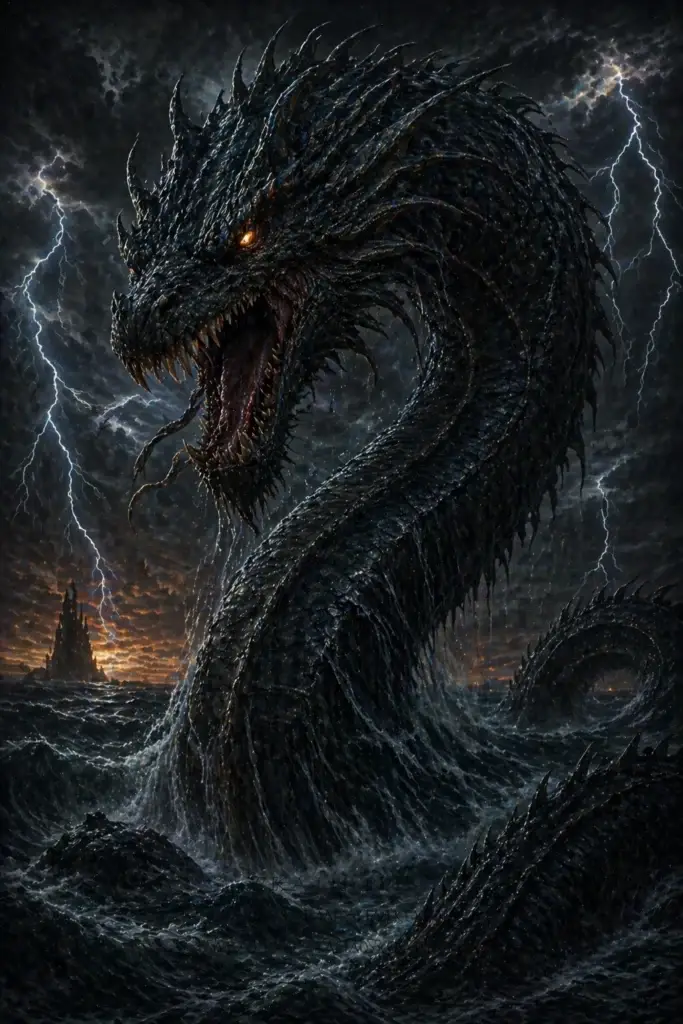
A giant sea serpent or dragon-shaped sea monster. Job 40, 41 describes it with a fire-breathing mouth, armor of scales, and unconquerable strength. Medieval iconography: a dragon, Leviathan as a hellmouth devouring the damned.
Behavior
In Job, the plaything of God and proof of divine supremacy. In Isa 27:1, the enemy whom God subdues at the end of days with the sword. In Revelation, the apocalyptic dragon rising from the sea.
Domain
The sea, the deep, the chaotic. In eschatological interpretation, the end times; in medieval hell iconography, hell itself.
Mythological Origin
Ugaritic roots in the Lotan motif, embedded in the combat myth of the god Baal against the sea power Yam. In the Bible, a moment of creation (the taming) as well as of the end times (destruction).
Job 40, 41 as the Most Detailed Source
The most extensive description of Leviathan in the Bible is found in Job 41 (in some enumerations 40:25, 41:26): a detailed 34-verse portrait of the being with scales, fire breath, an enormous mouth, and invincibility.
The theological context is God’s answer to Job from the storm (Job 38, 41), in which God demonstrates his cosmic sovereignty even over the powers of chaos.
Leviathan stands here alongside Behemoth as a double proof that creation contains powers beyond human control, yet subject to divine authority. Psalm 74:14 alludes to the cosmological prehistory (“You crushed the heads of Leviathan”); Psalm 104:26 adds a later, almost playful note (“Leviathan, which you formed to frolic there”).
The Jewish rabbinic tradition (Talmud Bavli Bava Batra 75a) tells of an end-times banquet for the righteous at which Leviathan’s flesh is consumed.
Profile: Leviathan
The most important aspects of Leviathan at a glance.
Ugaritic Lotan, Hebrew Liwjatan. In the Hebrew Bible both a being subdued at creation and an eschatological adversary.
Cosmic threat; in medieval reception the damned (hellmouth). Thematically: people at the boundary of what can be controlled.
Giant sea serpent, fire-breathing mouth, armor of scales. In medieval depictions a hellmouth devouring souls.
Embodiment of chaos, threatening cosmic order, ultimately subdued. In the grimoire tradition: demon of envy.
No everyday apotropaic practice. Theologically: trust in God as the one who subdues. In Kabbalistic and grimoire literature, specific binding formulas.
Tiamat (Mesopotamia), Apophis (Egypt), Vrtra (Vedic), Midgard Serpent, the dragon of Revelation.
Ritual Function
Liturgical
In the Jewish end-times banquet narrative, Leviathan serves as food for the righteous (Talmud, Baba Batra 74b, 75a). In the Christian liturgy there is no direct reference, but the dragon iconography of the Easter liturgy carries an echo.
Conjurations
The Dictionnaire Infernal lists Leviathan as one of the supreme demons with seal and rank. In the Kabbalistic tradition he is part of the Sitra Achra.
Symbolic
As a chaos figure, the counterimage of divine order; as a hellmouth, the iconographic focal point of medieval depictions of the last things. In Hobbes, the symbol of sovereign state power.
Parallels and Afterlife
Ancient Near East: Ugaritic Lotan, Babylonian Tiamat, the same family of motifs. The basic pattern: creation through subduing the power of the primordial sea.
Indo-European Traditions: Vrtra in the Rigveda, the Midgard Serpent, the dragon of Greek heroic myth. All designate the primordial force that must be subdued by the divine hero.
Modern Reception
Hobbes’ Leviathan as a political metaphor for state power. Melville cites Leviathan in Moby-Dick. In contemporary usage: film, literature, and political vocabulary (surveillance state as “Leviathan”).
Political and Early Modern Reception
Thomas Hobbes in 1651, with his major political work Leviathan, or The Matter, Forme and Power of a Common-wealth Ecclesiasticall and Civill, turned the figure into an allegory of the absolute state: the “mortal god” Leviathan is the sovereign, created by contract from the state of nature (bellum omnium contra omnes), commanding over the life and death of citizens.
Hobbes’ choice of this particular image is notable from a history-of-religions perspective: it identifies the state with the chaos power whose biblical taming provides the state with its function.
In modern reception (Carl Schmitt, Der Leviathan in der Staatslehre des Thomas Hobbes, 1938) and in discussions of state sovereignty, Leviathan remains a central point of reference.
This political reception runs parallel to the theological-demonological one, in which Leviathan features in the early modern hell hierarchy (Peter Binsfeld, De confessionibus maleficarum, 1589) as one of the seven princes of hell, responsible for the deadly sin of envy.
Leviathan in the Book of Job: The Divine Speech from the Storm
The most detailed description of Leviathan in the Hebrew Bible is found in the Book of Job, in chapter 41. It forms part of the divine speeches in which God answers Job’s laments from the storm.
God describes the monster in a long series of rhetorical questions, all pointing toward the conclusion that no human being is a match for Leviathan. No one can put a hook through its nose, bridle its mouth, or pierce its hide with spears.
The description is concrete and vivid. Leviathan has impenetrable scales that lie close together like shields; from its mouth go torches, from its nostrils rises smoke, its breath kindles coals.
When it rises, even the mighty are afraid. It treats iron as straw and bronze as rotten wood. It makes the deep boil like a pot. It is king over all who are proud.
In the history of interpretation the question of what is meant here has been debated. An older line read Leviathan rationalistically as a crocodile; another as a pure symbol of chaos. Modern scholarship emphasizes the rhetorical context: in the Book of Job, Leviathan represents the boundary of human power and human understanding.
God shows Job a creature that humans can neither control nor comprehend, yet which poses no threat to God. The divine speech paradoxically transforms the chaos monster into part of an incomprehensibly vast order of creation, whose meaning remains beyond human grasp.
The West Semitic Background: Lotan and the Combat Myth
Leviathan is not an isolated biblical invention. The discovery of the Ugaritic texts at Ras Shamra on the Syrian coast from 1929 onward has revealed an older background.
In the mythological texts of Ugarit, belonging to the second millennium BCE, there appears a serpent named Lotan, phonetically closely related to the Hebrew Liwjatan. Lotan is described there as a coiling, many-headed serpent slain by the storm god Baal or by the goddess Anat.
Leviathan thus belongs to the widespread ancient Near Eastern motif of the combat myth. In Mesopotamia the god Marduk fights against the primordial flood Tiamat in the Enuma Elish; in Ugarit Baal defeats the sea Yam and the dragon Lotan.
The basic pattern is similar throughout: an ordering power subdues a watery-chaotic power, often in serpent form, thereby establishing or confirming the world order.
The Hebrew Bible knows this motif and takes it up, but with its own distinctive treatment. Several psalms and prophetic texts speak of God shattering the heads of Leviathan or the sea dragon.
Scholars such as John Day have shown in God’s Conflict with the Dragon and the Sea (1985) how these older images continue within the biblical texts while being attributed to the one God of Israel.
Leviathan is thus transformed from an independent divine adversary into a creature that God subdues, or, as in the Book of Job, one that appears as his powerful but harmless plaything.
The End-Times Banquet: Leviathan in Jewish Tradition
In post-biblical Jewish literature, Leviathan is elaborated in distinctive ways. A broad tradition, attested in apocalypses, the Talmud, and midrashic literature, connects him with the end of time.
He frequently appears as a pair with the land monster Behemoth; sometimes the bird Ziz is added as a third. Leviathan rules the sea, Behemoth the land.
A widespread conception holds that God originally created both primordial monsters as a pair but prevented their reproduction so that they would not overwhelm the world.
At the end of days, so a narrative attested in several sources, Leviathan and Behemoth will be slain and their flesh served as a banquet for the righteous. From Leviathan’s hide, according to one talmudic embellishment, God fashions a tent or canopy for the pious.
These images are instructive from a history-of-religions perspective. The chaos monster, which in the oldest layers represented a real threat to creation, is here fully integrated into the history of salvation. It has been under control from the beginning and ultimately even serves to reward the righteous.
The concept of the Leviathan banquet has had a long reception in Jewish liturgy and popular piety; it appears in table songs for the Feast of Tabernacles. Scholarship regards this as an example of how an ancient mythic motif could remain vital across centuries through repeated reinterpretation without ever fully losing its menacing origins.
Christian Interpretation: From Hellmouth to Political Symbol
In the Christian exegetical tradition, Leviathan was predominantly interpreted negatively. Church Fathers such as Gregory the Great applied him in their Job commentaries to the devil or the Antichrist.
The fire-spewing mouth of the Book of Job developed in medieval art into the image of the hellmouth, a vast gaping monster-maw into which the damned are driven. This image shaped manuscript illumination, church portals, and later the morality play.
Another interpretive line employed Leviathan allegorically for the idea of redemption. In some medieval texts the Leviathan caught on a fishhook appears as an image of how the devil is outwitted through the Incarnation of Christ; the cross becomes the hook on which the monster is caught.
This concept linked the old image of the uncatchable Leviathan with Christian soteriology.
The most consequential modern reappropriation comes from Thomas Hobbes. In his work Leviathan of 1651, he chose the biblical monster as the emblem of the state, an artificial human composed of many humans who, through superior power, ends the state of nature as a war of all against all.
Hobbes drew explicitly on the word from Job about the king over all the proud.
The famous copperplate frontispiece, showing a giant ruler composed of many small figures, ranks among the most recognizable political images of all time. Since Hobbes, Leviathan has become in political discourse an expression for overwhelming state power, a strand of meaning connected to the original chaos dragon only through the motif of unconquerable might.
Further reading:
- Christianity
- Satan, Lucifer, Beelzebub, Legion
- Apophis (closest parallel)
- Mesopotamia (Tiamat tradition)
Research Literature
Further standard works in the literature index.
Frequently Asked Questions about Leviathan
What is Leviathan?
Leviathan is a vast sea monster of the Jewish-Christian tradition. In the Hebrew Bible (Isaiah, Psalms, Job) it appears as a chaotic primordial power of the sea that God restrains at the beginning of creation. In later Jewish apocalypticism and Christian demonology, Leviathan became a personification of evil; in Thomas Hobbes the name became the emblem of the all-powerful state.
Is Leviathan a demon or an animal?
In the original biblical tradition, Leviathan is a vast, cosmic animal, closely related to the Ugaritic Lotan and the Mesopotamian Tiamat. In later Jewish apocalypticism (the Book of Enoch) and the Christian demonology of the early modern period, it became a demon: in Peter Binsfeld’s classification, one of the seven archdemons, responsible for the deadly sin of envy.