Tyr, Germanic God of Law and War
By Ralf Ittermann · last reviewed on
Tyr is a Germanic god of war and the guardian of the oath, to whom law and the binding word are subject. Tyr is among the oldest deities of the Germanic pantheon.
He appears in the Eddic sources as the god of war, of law and of the thing assembly, and is regarded as the guarantor of the binding oath.
His one-handed appearance goes back to the binding of the wolf Fenrir, one of the central episodes of Norse mythology.
In the history of religion, Tyr is read as a reflex of an Indo-European sky and law deity, comparable to the Roman Mars and to the Greek Zeus in his older function as a god of the oath.
Profile: Tyr
Tyr: the most important aspects at a glance. The following fields summarise origin, function, appearance, veneration, symbols and parallels.
Germanic god of war, law and the oath, who is counted among the Aesir. His name (Old Norse Tyr, Old High German Ziu, West Germanic Tiwaz) continues an Indo-European sky god. Snorri calls him a son of Odin, the “Hymiskvida” a son of the giant Hymir.
Tyr is guardian of the vow and guarantor of the binding oath and, as keeper of the legal order, watches over the Thing assembly. According to Snorri he decides who wins in battle. At Ragnarok he fights the hellhound Garmr; the two kill each other.
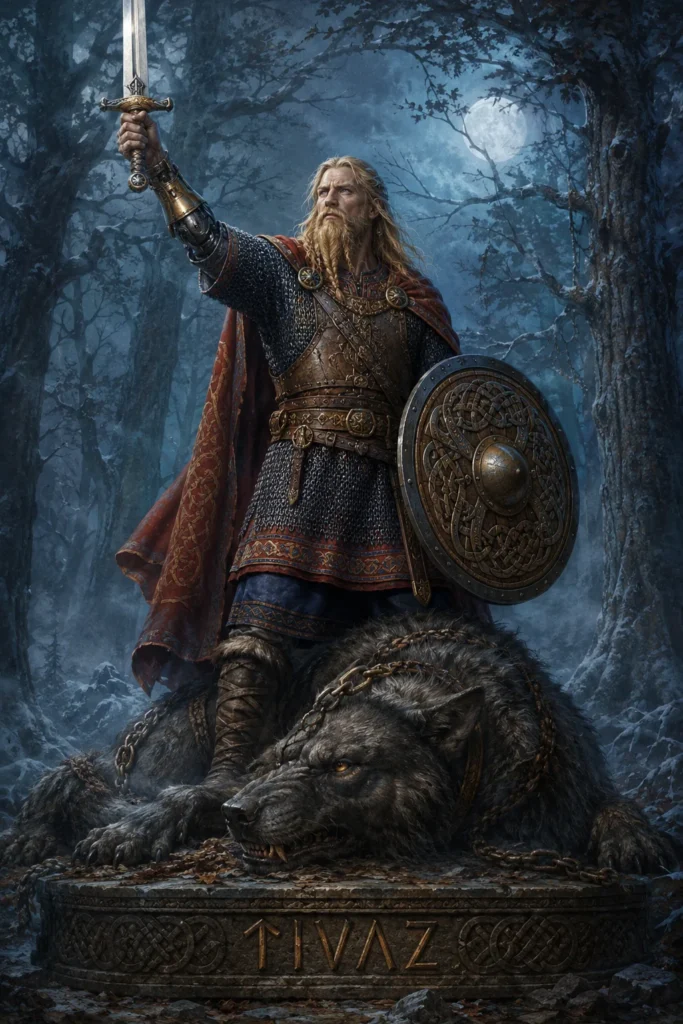
His distinguishing mark is the missing right hand, which Fenrir bit off. In images Tyr usually appears with a sword and a stump reaching into the wolf’s jaws; the scene is attested on Scandinavian picture stones and bronze pendants of the 6th to 10th centuries.
The Thing site was assigned to him. Tacitus reports animal sacrifices for a Germanic Mars, and in the bog finds of Illerup Adal and Nydam, destroyed weapons are regarded as war-booty offerings to a war deity, presumably Tiwaz. At Uppsala he is absent among the images of the gods.
The rune Tiwaz has the form of an upward-pointing arrow; according to the “Sigrdrifumal” one should carve the rune on the sword and say Tyr’s name twice to gain victory. Tuesday is assigned to him (English Tuesday, Swedish tisdag).
The name can be linked with Greek Zeus, Latin Iuppiter and Sanskrit Dyaus Pitar. Tyr is regarded as comparable with the Roman Mars, with whom he was equated in the interpretatio Romana, and with Zeus in his older function as god of oaths.
Myth and Origin
Scholarship sees in Tyr (Old Norse Tyr, Old High German Ziu, West Germanic Tiwaz) a linguistically well-secured continuation of an Indo-European sky god of Proto-Germanic name *Tiwaz. The root can be connected to Greek Zeus, Latin Iuppiter (originally *dyeu-pater) and Sanskrit Dyaus Pitar.
In the Germanic tradition the function shifts: from the lord of the heavens of the Indo-European tradition arises a god of war and law of the thing society.
Snorri Sturluson, in the «Prose Edda» (Gylfaginning 25), calls Tyr the «boldest and most courageous» of the Aesir, who decides who is victorious in battle. He is named son of Odin, but in the «Hymiskvida» of the «Poetic Edda» son of the giant Hymir.
Jan de Vries and Rudolf Simek interpret this contradictory genealogy as a trace of an older, independent position of Tyr that was later overlaid in the literary sources by the predominance of Odin.
The central mythologem is the binding of Fenrir. When the Aesir wish to bind the unrestrainedly growing wolf Fenrir with the fetter Gleipnir, the beast demands a pledge of good will. Tyr alone places his right hand in the wolf’s jaws.
When Fenrir recognizes the deception, he bites off the hand. Snorri records that Tyr has been one-handed ever since and cannot be regarded as a founder of peace among humans. The scene is attested iconographically on several Scandinavian picture stones and small bronze pendants of the 6th to 10th centuries.
In the «Voluspa» and in Snorri’s «Gylfaginning» 51 Tyr’s end is described. At Ragnarök he confronts the hellhound Garmr. The two kill one another.
The death of both beings marks the end of the old order and stands in symmetrical relation to Odin’s downfall in the fight against Fenrir and Thor’s death from the poison of the Midgard serpent.
Scholarship has traced the name Tyr in numerous inscriptions and place names. The Tiwaz rune is found on the spearhead of Kovel (Volhynia, 3rd century), on the clasp of Aquincum (Pannonia, 4th century) and on numerous bracteates from the Migration Period finds of Denmark and southern Sweden.
The distribution of these attestations reaches from the Danube to central Sweden and shows a tradition extending across all Germanic tribal groups.
The special position of Tyr in relation to the other gods is also underscored by the degree of his mythic scarcity. While Odin, Thor and Loki appear in dozens of episodes, Tyr’s narrative possibilities are limited to a few key scenes: the binding of Fenrir, the journey to Hymir, the Ragnarök fight against Garmr.
Klaus von See, in his Edda commentaries (vol. 4, 2004), advanced the thesis that this mythic scarcity is not coincidental but a reflex of an older god whose literary presence was in decline in the 9th to 13th centuries, while his cultic and legal function continued to work on beneath the surface.
Symbols and Attributes
The most striking attribute is the missing right hand. In the pictorial tradition Tyr usually appears with a sword and a stump reaching into the wolf’s jaws. The runic sign named after him, Tiwaz (Germanic t-rune, Old Norse tyr), has the form of an upward-pointing arrow.
The «Sigrdrifumal» of the «Poetic Edda» recommends carving the rune onto the sword and naming Tyr’s name twice in order to gain victory. The rune thus appears at once as a written character and as a magical sigil.
The weekday assigned to him is Tuesday, in English Tuesday, in Swedish tisdag, in Norwegian and Danish tirsdag. In Southern German the form Ziestag, Zischtig survived in Alemannic dialects into the 20th century.
This formation of the weekday follows the interpretatio romana, in which Tyr was equated with Mars. Tacitus reports in the «Germania» chapter 9 that the Germani also venerated Mars among the gods, by which Tiwaz is meant.
Animal sacrifices for Tyr are associated in archaeological findings above all with horse and dog.
Bog finds from Denmark, such as Illerup Adal and Nydam, contain destroyed weapons on a massive scale that, according to the interpretation of Klavs Randsborg and Joachim Werner, are read as offerings of war booty to a war deity, presumably Tiwaz.
Cult and Veneration
Adam of Bremen, in the «Gesta Hammaburgensis ecclesiae pontificum» (around 1075), describes the temple of Uppsala with three divine images: Thor, Wodan and Fricco. Tyr is absent from this late enumeration, which is read as an indication of his declining cultic importance in the final phase of the Viking Age.
In older strata, for example in the continental tribal regions of the Southern Germans and Saxons, his position was by contrast prominent. Place names such as Tislund (Denmark), Tysnes (Norway) or Zierberg, Ziessenhausen (Southern Germany) attest a dense sacral network.
Tacitus names in «Germania» 9, without a proper name, a Germanic Mars to whom animal sacrifices were offered. In «Annals» 13.57 he reports the victory of the Hermunduri over the Chatti, in which the entire army of the opponents, together with horses and weapons, was consecrated to Mars and Mercurius.
Scholars of religion such as Jens Peter Schjodt interpret this practice as a ritual devotio, a form of anticipatory sacrifice to the war deity for the securing of victory.
The thing place was the space assigned to him. Since the thing was at once a court of law and a political assembly, the role of guardian of the legal order fell to Tyr.
The Old Icelandic «Landnamabok» and the Swedish legal work «Upplandslagen» preserve traces of an older connection between oath formulas, the thing ground and the figure of Tyr.
Margaret Clunies Ross, in «Prolonged Echoes» (1994), showed that the legal function in the late literary stratum largely passed to Forseti and other younger figures, while the archaic evidence of Tyr was preserved in oath formulas and runic testimonies.
Important Myths
The binding of Fenrir stands at the center.
Snorri narrates in detail in Gylfaginning 34 how the dwarves of Svartalfheim forge the fetter Gleipnir from six impossible ingredients: the sound of a cat’s paw, the beard of a woman, the roots of a mountain, the sinews of a bear, the breath of a fish and the spittle of a bird.
The enumeration has a magical-poetic function and explains why the world no longer possesses these things. Fenrir mistrusts the seemingly thin cord. Tyr’s action is therefore not impulsive bravery but a deliberate sacrifice for the securing of the cosmic order.
Georges Dumezil, in «Mitra-Varuna» (1948), interpreted this scene as an example of the loss of sovereignty of the juridical god: Tyr loses the hand that swears, and with it symbolically a part of his legal function.
A second myth is the fetching of the cauldron in the «Hymiskvida». Thor and Tyr travel to the giant Hymir to fetch the brewing cauldron of the Aesir.
Tyr is here introduced as Hymir’s son, which underscores the contradictory genealogy. The scene ends with Thor’s fishing expedition, in which he hooks the Midgard serpent. Tyr functions as guide and genealogical link between the Aesir and the giants.
The third myth is the Ragnarök fight against Garmr. Snorri and the «Voluspa» 44 name the dog at the entrance to Hel. In the final battle Tyr and Garmr confront one another. The two kill each other.
This mutual destruction is read in scholarship as a mirror-image variation of the Odin-Fenrir fight. Where Odin is devoured, Tyr falls in symmetrical destruction. The composition speaks for a late poetic reshaping that fits Tyr into the Ragnarök scheme.
Scholarship on the binding of Fenrir has brought the motif of divine self-sacrifice into the foreground. Tyr’s gesture is not only bravery but a juridical act: he gives his pledge for a contract that is then broken.
The breaking of the contract by the other Aesir is thereby marked cosmically and at the same time legitimized. Klaus von See worked out this reading in juridical, contract-theoretical terms: Tyr loses the hand because he was the only god’s hand that Fenrir trusted, and this trustworthiness was the actual guarantor of the binding.
A less well-known mythological trace is found in the «Heidreks saga» (13th century), where Tyr’s sword appears as a magical weapon that secures victory. This late narrative stratum shows that Tyr’s martial function remained present in the saga literature as well, long after cultic veneration in the narrower sense had ceased.
The saga connects the sword with a long genealogy of pagan kings and reflects a remembering appropriation of the pagan heritage by the Christian age.
Relationships within the Pantheon
Tyr belongs to the Aesir, without his genealogical position being unambiguous. Snorri names him son of Odin, the «Hymiskvida» son of Hymir and of an unnamed giantess whose golden adornment and noble bearing point to a more distinguished origin than the giant rank alone would lead one to expect.
Rudolf Simek, in the «Lexikon der germanischen mythology» (3rd ed. 2006), proposed assuming two competing traditions here.
A consort of Tyr is not expressly named in the Eddic sources. In the «Lokasenna» 40 Loki speaks of an unnamed wife of Tyr with whom he, Loki, is said to have begotten a son.
The passage is invective and is not to be read as a reliable genealogy.
In relation to Thor, Tyr appears in the «Hymiskvida» as a travelling companion and bearer of knowledge.
In relation to Odin the function is complementary: while Odin is the god of ecstasy, of magic and of the spirit, Tyr represents the legal and oath side of sovereignty. This binary division of the sovereignty function between two figures belongs to Dumezil’s classic three-functions thesis.
Reception and Influence
In the early Middle Ages the cultic veneration of Tyr declines with Christianization, but his name remains preserved in weekday designations, place names and in the runic row.
The Anglo-Saxon «Rune Poem» (10th century) devotes its own stanza to the Tiwaz rune and describes it as a «sign that keeps faith with nobles». The rune is encountered on swords, spearheads and amulets of the 5th to 10th centuries. Klaus Duwel, in «Runenkunde» (4th ed. 2008), catalogued about two dozen attestations.
In the folklore studies of the 19th century Tyr was brought back to awareness through Jacob Grimm’s «Deutsche Mythologie» (1835). Grimm collected regional remnants, such as the Augsburg place name Ziesberg and Swabian oath formulas.
In the course of Romanticism and the Wagner reception (Ring of the Nibelung), Tyr remained a minor figure, quite unlike Wodan or Donar. This marginalization in artistic mythology contrasts with his central position in the archaic stratum.
In the 20th century Tyr was repeatedly reactivated in folkloric and religious contexts, in part in problematic connections. Academic scholarship, represented by Jan de Vries, Folke Strom, Klaus von See and most recently Jens Peter Schjodt, has distanced itself from ideological appropriations and rehabilitated Tyr as a key figure of the Indo-European doctrine of sovereignty.
The naming of the weekday Tuesday in the Germanic languages is one of the strongest traces of the ancient interpretatio romana, in which Germanic gods were identified with Roman ones.
Tyr-Mars thus became the holder of the Dies Martis, which lives on today as Dienstag, Tuesday, tisdag, tirsdag, Tirsdag and so on. The South Alemannic Ziestag and the Southern German Zischtig are particularly archaic remnants that still occurred in the spoken language in the 19th and 20th centuries.
In the «Schweizerisches Idiotikon» (volume 8, 1920), numerous attestations from the peasant speech of the Swiss Alps were collected.
In the English-language tradition Tyr is especially present in the Tolkien reception. J. R. R. Tolkien, himself an Indo-Europeanist, incorporated allusions to Tyr-Tiwaz into his fictional mythology, above all in the figure of Beren and in the battle descriptions of the Silmarillion.
This literary influence reached a broad audience in the 20th and 21st centuries and made the figure of Tyr known beyond academic scholarship.
Archaeological research of the last three decades has provided additional indications of Tyr’s cult. The investigations in the bog of Vimose yielded inscription finds with the Tiwaz rune. These finds attest a deliberate cultic reference to Tyr-Tiwaz during the late Iron Age and the Migration Period.
Classification in Religious Studies
Scholarship places Tyr within the model of the three Indo-European functions devised by Georges Dumezil. Tyr and Odin share the first function of sovereignty. Odin embodies the magical-religious side (Varuna type), Tyr the juridical-contractual side (Mitra type).
This division explains why Tyr remains a god of the oath and at the same time, in the fight against Fenrir, represents the legal side of the sovereign.
Jens Peter Schjodt, in «Initiation between Two Worlds» (2008), argued against Dumezil’s rigid schematization and showed that Tyr’s profile in the late phase is shifted more strongly toward war and victory.
Margaret Clunies Ross, by contrast, points to the ritual significance of the one-handed oath gesture in Scandinavian legal sources and sees here a continuity into the 11th century.
Linguistically, Tyr’s etymology is well secured by Herbert Jankuhn, Wolfgang Krause and most recently Edgar Polome. The form *Tiwaz is the only Germanic divine designation that can be traced back, by sound laws, compellingly into the Indo-European parent language.
This antiquity underscores the archaic character of the figure and supports the thesis of a continuous meaning as a god of the oath and of law.
Sources and Further Reading
Primary sources: «Prose Edda» (Snorri Sturluson, around 1220, critical edition Anthony Faulkes 1982), «Poetic Edda» (Codex Regius, around 1270, edition Klaus von See et al. 1997 ff.), «Germania» (Tacitus, 98 AD, edition Allan Lund 1988), «Gesta Hammaburgensis» (Adam of Bremen, around 1075). Runic inscriptions collected by Wolfgang Krause/Herbert Jankuhn «Die Runeninschriften im alteren Futhark» (1966).
Secondary literature: Jan de Vries «Altgermanische Religionsgeschichte» (2 vols., 2nd ed. 1956/57), Rudolf Simek «Lexikon der germanischen Mythologie» (3rd ed. 2006), Georges Dumezil «Mitra-Varuna» (1948) and «Les dieux des Germains» (1959), Margaret Clunies Ross «Prolonged Echoes» (2 vols. 1994/98), Jens Peter Schjodt «Initiation between Two Worlds» (2008), Klaus Duwel «Runenkunde» (4th ed. 2008), Regis Boyer «La religion des anciens Scandinaves» (1981).