Tuchulcha: Fearsome Etruscan Underworld Demon with Snake Hair
By Ralf Ittermann · last reviewed on
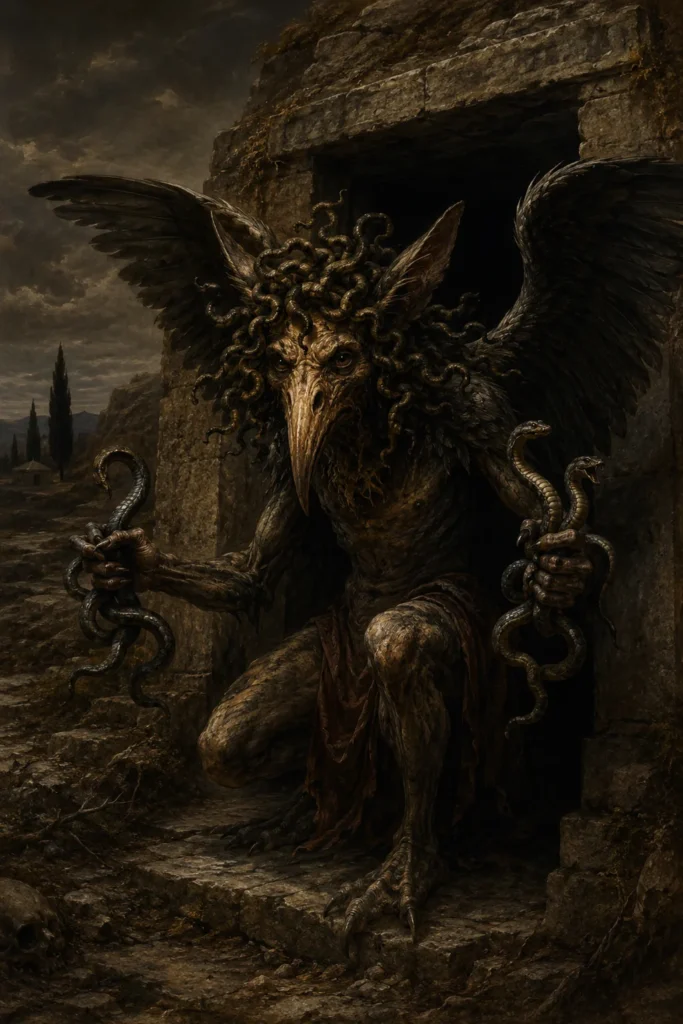
Tuchulcha is, in Etruscan religion, a fearsome demon of the underworld, depicted with snake hair, donkey ears, a vulture’s beak, and a threatening posture. Unlike the conducting demons Charun and Vanth, Tuchulcha is actively punishing and recalls the Greek Erinyes, the Furies. This portrayal describes his religious-studies position within the Etruscan eschatological system.
Classification within the Etruscan pantheon
Tuchulcha belongs to the demons of the Etruscan underworld. He is not a ‘god’ in the sense of the Olympians, but a powerful underworld being with a markedly punishing and fearsome function.
In the Tomba dell’Orco II in Tarquinia he is shown in a famous scene together with Theseus and Peirithous, heroes who are trapped in the underworld.
Larissa Bonfante, Stephan Steingräber, and Cornelia Weber-Lehmann have dealt with Tuchulcha in their works on Etruscan religion. He is a particularly striking figure of Etruscan sepulchral iconography.
The fearsome underworld demon Tuchulcha is part of a religion that interests religious studies above all because it stands between the Greek-Mediterranean and the Italic-Roman traditions. Massimo Pallottino, Jacques Heurgon, Sybille Haynes, Mauro Cristofani, and Giovanni Colonna have sharpened, through their investigations, the picture of an independent Etruscan tradition.
Tuchulcha’s narrowly bounded, punishing role in the underworld fits into an Etruscan theology that ordered its pantheon hierarchically and assigned functions clearly. The older characterization of Etruscan belief in the gods as ‘mysterious’ or ‘alien’ does not do justice to the matter: it is an independent expression of Mediterranean religion.
Tuchulcha is regarded as a largely independent Etruscan creation and nevertheless shows how the Etruscans mediated, within Italic religious history, between Greek influence and the emerging Roman religion. This mediating position is of particular interest to religious studies.
Tuchulcha has no recognizable Greek model and thereby demonstrates what the religious-ethnological research of recent decades has generally worked out: Etruscan religion is a self-contained, religious-phenomenologically independent system. The earlier reading, that it was merely an offshoot of Greek religion, has given way to a more differentiated view.
Name and etymology
The name Tuchulcha is securely attested only in the Tomba dell’Orco II through an inscription. A secure etymological meaning has not been reconstructed. Helmut Rix’s Editio Minor documents the attestation.
The name form is linguistically isolated and has no obvious parallels in other Etruscan theonyms. This isolation suggests that Tuchulcha is an independent Etruscan creation, without a direct Greek model.
Tuchulcha’s name is transmitted as linguistically isolated, which fits into the overall picture: the Etruscan language itself is considered isolated within language families or part of a hypothetical ‘Tyrsenian’ family with Lemnian and Raetic. The decipherment of the texts has occupied scholarship since the 19th century and remains open to this day.
The only secure attestation for Tuchulcha, the inscription of the Tomba dell’Orco II, is recorded in Helmut Rix’s Editio Minor, the fundamental epigraphic collection of the Etruscan language corpus. Today it is supplemented by the Thesaurus Linguae Etruscae and the online database ETP (Etruscan Texts Project).
Tuchulcha is regarded as a genuinely Etruscan figure without a foreign model, yet the origin of the Etruscans themselves remains disputed: Herodotus derived them from Lydia, Dionysius of Halicarnassus from Italy. From the standpoint of religious history this question is significant, because it concerns possible connections to Anatolian cults.
Because Tuchulcha’s name stands linguistically isolated, the close combination of language and inscription research is especially important here. The digital edition of Etruscan texts in the ETP (Etruscan Texts Project) considerably facilitates comparative studies, and Marie-Laurence Haack and Vincent Jolivet have contributed pioneering works on this.
Description and iconography
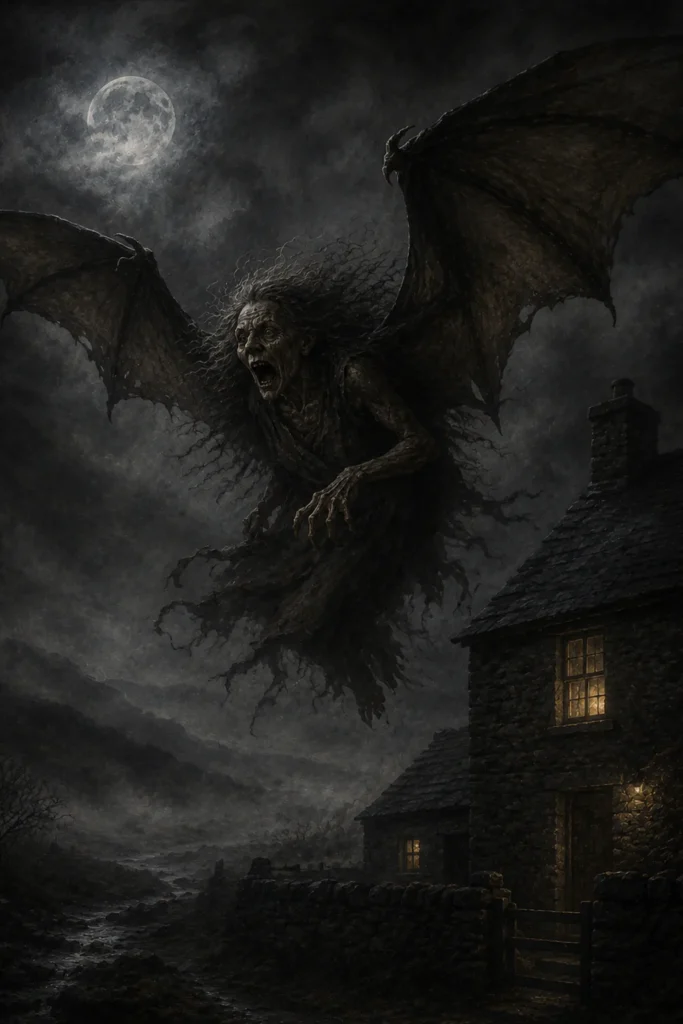
Tuchulcha is depicted in a monstrous form in the Tomba dell’Orco II: with a vulture’s beak or a hooked nose, donkey ears, yellowish-gray skin, and snakes instead of hair.
He holds a snake in his hand and threatens the captive heroes. This iconography is, from a religious-phenomenological standpoint, markedly fearsome and belongs to the most striking images of Etruscan sepulchral art.
Stephan Steingräber, in Etruscan Painting, has opened up the iconographic significance of this depiction. The mixture of animal and human elements marks Tuchulcha as a ‘mixed-essence’ demon: a widespread religious-phenomenological type.
Tuchulcha is known almost exclusively through a single image, which underscores the importance of Etruscan visual art: mirrors, vases, tomb painting, and bronzes are the main sources of our knowledge. Larissa Bonfante has appreciated this visual language as an independent, not merely derivative, tradition.
Tuchulcha is known precisely through Etruscan tomb painting, which in Tarquinia, Cerveteri, and Vulci forms a first-rate source for Etruscan religion and eschatology. Its banquet, dance, and music scenes, as well as mythological episodes, present the afterlife as a continuation of life.
Tuchulcha is, in the Tomba dell’Orco II, part of a multi-figure composition with Theseus and Peirithous, thus illustrating the Etruscan iconography‘s preference for narrative references and symbolic condensations. This visual language is the subject of Etruscan religious iconography.
The Tomba dell’Orco II shows Tuchulcha embedded in a layered scene and thereby stands for the narrative condensation of Etruscan visual art, in which a mirror or a vase can present several mythological references at once. This density requires a careful contextual analysis.
Tuchulcha in Etruscan eschatology
Tuchulcha is part of the Etruscan conception of the underworld as a complexly structured space with different demon functions. While Charun and Vanth conduct the dead, Tuchulcha seems to have a punishing function: he threatens those trapped in the underworld and causes their torment.
This functional differentiation is noteworthy for religious studies. It shows that the Etruscan underworld is not an undifferentiated realm of shadows, but a domain with clear distributions of roles.
There is no narrative tradition about Tuchulcha, which is no special case: Etruscan mythology generally does not survive in elaborated narrative texts as the Greek or Roman does. It is reconstructed from visual sources, inscriptions, and the Greek-Roman secondary tradition, which requires methodological caution.
Tuchulcha appears in a scene with the Greek heroes Theseus and Peirithous and thereby illuminates the complex relationship of the two mythologies. The Etruscans adapted many Greek subjects around Achilles, Odysseus, or Oedipus, but gave them their own interpretations. This adaptation is the subject of intensive research.
Tuchulcha is part of a dense web of underworld figures and thereby fits into a basic principle of Etruscan theology, the council of the gods (consensus deorum). Tinia too does not act alone, but consults with other gods. This concept is regarded, from a religious-phenomenological standpoint, as a distinctive feature.
Tuchulcha’s figure is graspable only through an inscription-secured image, for the mythological tradition of the Etruscans does not survive in closed narratives, but is reconstructed from pictorial scenes, inscriptions, and secondary sources. The combination of Etruscan inscription, Greek visual model, and contextual reading is well established.
Mythological narratives
The most important Tuchulcha narrative is his encounter with Theseus and Peirithous in the Tomba dell’Orco II. Greek mythology knows the story of how Theseus and Peirithous descend into the underworld to abduct Persephone, and are trapped there.
The Etruscan adaptation adds Tuchulcha as a punishing demon: an element that is not attested in the same way in the Greek tradition.
This adaptation shows Etruscan creativity in handling Greek myths. It adds its own characters that reinforce the image of the underworld.
Among the core of Etruscan religion was the Disciplina Etrusca, the divination system of entrail inspection (haruspicina), lightning interpretation (fulguratio), and bird observation (auspicia). Transmitted from the Etruscans to the Romans, it remained in use until the 4th century AD; Cicero and Seneca described it in detail.
The Disciplina Etrusca was passed on in specialized priestly schools; its central writings were the Libri Rituales, the Libri Haruspicini, and the Libri Fulgurales. They are not preserved, but quotations in Cicero, Festus, and Macrobius allow a partial reconstruction.
The Etruscan cult was strongly bound to the city. Tarquinia, where Tuchulcha is transmitted in the Tomba dell’Orco II, had its own principal cults and religious peculiarities, as did Caere, Vulci, Veii, Clusium, Volsinii, Cortona, Perugia, Arezzo, Volterra, Populonia, and Roselle.
As a coherent religious-divinatory system, the Disciplina Etrusca ranks among the highly developed divination practices of the ancient world. The Romans adopted it systematically, and it remained in use into late antiquity, a continuity remarkable in religious history.
Cult and rituals
Tuchulcha was not ‘venerated’ in the sense that the Olympian gods were. His image served primarily to make present the fearsomeness of the underworld, the Pythagorean and Etruscan teaching about the afterlife.
The religious-pedagogical function of such terrifying depictions is of interest to religious studies. It possibly served to promote ethical behavior in this world: whoever does evil fears Tuchulcha’s punishment in the afterlife.
The Etruscan temples show architectural peculiarities: the Tuscanus style forms its own column order, which Vitruvius describes in De Architectura. Their ground plans emphasize the cella and a broad frontal hall, and in this clearly set themselves apart from Greek models.
The Etruscan temples were in many cases monumental structures. The Iuppiter temple on the Capitolium in Rome was built by Etruscan architects and artists, in particular by Vulca of Veii, and is regarded as an architectural testimony of Etruscan religiosity in early Rome.
The Etruscan league of twelve cities convened annually at the Fanum Voltumnae near Volsinii for religious and political assembly. Voltumna was the federal god of the Etruscan confederation, and to him belonged a superordinate religious significance.
The Etruscan temples often rested on tuff stone foundations, bore wooden superstructures and terracotta decorations. As an architectural and religious principal testimony of this tradition, the famous Apollo statue of Veii, a work of Vulca, is regarded.
Protective traditions
Tuchulcha was not invoked, but was rather that against which one protected oneself. Apotropaic practices aimed to avoid his appearance, both in this world and in the afterlife. Whoever lived well did not need to fear him.
This ‘negative’ function is, from a religious-phenomenological standpoint, typical of demon figures. They act not through direct invocation, but through the fear they trigger.
Etruscan protective practice knew many apotropaic means: phallus amulets, gorgoneion images, eye symbols, bullae, and certain formulas.
In Etruscan culture, apotropaic symbols such as the eye of Tinia, phallus amulets, and gorgoneia were found widely. They adorned temples, tombs, household shrines, and personal objects, and this practice was continued in Roman and Mediterranean popular belief.
In the Etruscan context, protective practice was closely bound to the Disciplina Etrusca. Before every significant undertaking, whether the founding of a city, a military campaign, or the building of a house, divination was consulted.
Parallels in other cultures
Tuchulcha can be compared, in religious-comparative terms, with the Greek Erinyes (Furies), the Germanic giants, the Christian demons of hell, and the Buddhist Naraka guardians. The idea of fearsome underworld punishing demons is, from a religious-phenomenological standpoint, universal.
The specifically Etruscan expression of Tuchulcha is the marked iconographic condensation of various animal elements (vulture, donkey, snake) in a single figure. This ‘hybridity’ is interesting from a religious-phenomenological standpoint and shows the creative independence of Etruscan visual art.
Through the interpretatio Romana, Etruscan gods were carried under Roman names: Tinia became Iupiter, Uni Iuno, Menrva Minerva. This assignment was mostly selective and not complete; the research of the last fifty years works out what remained of Etruscan particularity.
Etruscan religion touches in many ways on Anatolian, Phoenician, and Near Eastern traditions. The Phoenician mediation is documented through the Pyrgi tablets, and this trans-Mediterranean networking belongs to the important research fields of recent decades.
In religious-comparative terms, the Etruscan cult can be assigned to the Mediterranean religious family, with references to Greece, Phoenicia, Egypt, Anatolia, and Latium. This networking represents an important field of research.
Present-day research
Tuchulcha research is closely connected with the investigation of the Tomba dell’Orco II in Tarquinia. Stephan Steingräber, Marina Cipollone, and Cornelia Weber-Lehmann have made important contributions.
Research examines the religious-pedagogical function of such terrifying depictions as well as their possible references to Pythagorean teaching, which had a strong influence in southern Italy and Etruria.
Etruscan religion is today the subject of international research. Important centers are the universities of Florence, Rome Sapienza, Pisa, Tübingen, and Princeton, and each year several international congresses are devoted to individual aspects.
International research projects on Etruscan religion today make use of digital methods: 3D scans of temples and tombs, databases on inscriptions and visual sources, and GIS analyses of the Etruscan settlement structure. These procedures open up new insights.
Present-day Etruscan research is conveyed to the public through exhibitions in the Vatican Museum, in the Museo Nazionale Etrusco di Villa Giulia, and in the Boston Museum of Fine Arts, as well as through numerous publications.
Sources and state of research
The most important source on Tuchulcha is the Tomba dell’Orco II in Tarquinia. Beyond it, further demon figures in Etruscan tombs may possibly be interpreted as relatives of Tuchulcha, though without a secure inscription.
A deeper classification within Etruscan religious history as a whole shows how Tuchulcha is to be understood within the network of relations with Charun, Vanth, Aita, and other underworld beings. This networking is essential for religious studies.
The source situation for Etruscan religion is heterogeneous: epigraphic testimonies such as Helmut Rix’s Editio Minor, archaeological finds, visual sources, and secondary literature. This variety requires interdisciplinary methods, which is why more recent research systematically combines philology, archaeology, religious studies, and anthropology.
Source criticism for Etruscan religion presupposes that one masters the Etruscan primary sources as well as the Greek-Roman secondary tradition. This dual perspective is demanding, but indispensable for an adequate religious-historical reconstruction.
To classify Etruscan religious history in depth, knowledge of the epigraphic, archaeological, and literary sources is just as necessary as that of modern religious studies. Such a multilayered engagement belongs to the standard of research.
The Tomba dell'Orco and the only secure pictorial attestation
Tuchulcha is one of the most enigmatic figures of the Etruscan afterworld, and that is due above all to the extraordinarily narrow source basis.
The only pictorial attestation secured by inscription is found in the Tomba dell’Orco II in Tarquinia, a burial chamber from the 4th century before Christ. There Tuchulcha appears in a scene showing the Greek hero Theseus, in Etruscan form These, in the underworld.
The figure is of an unusually mixed form: it has a face with a bird’s beak or beak-like features, pointed ears or donkey-ear-like projections, wild hair that can consist of snakes, and holds snakes in its hands.
The sex of the figure is disputed in research, since the depiction can combine female and male traits; much speaks for understanding Tuchulcha as a sexually ambiguous or hermaphroditic being.
In the scene Tuchulcha apparently threatens Theseus, who together with Peirithous is trapped in the underworld, a subject known from Greek mythology and taken up by the Etruscans. From the standpoint of religious studies the situation is acute: everything that can be said with certainty about Tuchulcha’s appearance hangs on this one wall painting. There is no literary tradition, no second unambiguously inscribed depiction, and no inscription that would give information beyond the name. Research, among others by Stephan Steingräber in his works on Etruscan wall painting, therefore treats Tuchulcha as a prime case of a figure known almost exclusively from a single find context.
Attempts at interpretation between punishing demon and guardian
Because the tradition is so thin, every characterization of Tuchulcha rests on interpretation of the one preserved image and on comparison with related Etruscan underworld beings.
The most obvious interpretation sees in Tuchulcha a threatening punishing demon or guardian of the underworld, who intimidates or torments the captive heroes Theseus and Peirithous. The snakes in the hands, the beak-like features, and the altogether terrifying appearance fit this reading.
Other researchers have understood Tuchulcha rather as a threshold or guardian figure who controls access to certain areas of the underworld, similar to Charun and Vanth, but with a markedly more threatening appearance.
The mixture of animal traits, especially the bird and snake elements, has led to comparisons with the Greek Erinyes and with conceptions of the Furies, yet such equations are to be treated with caution, because they force Etruscan material into Greek categories.
It also remains disputed whether Tuchulcha was an individual being with a proper name or the designation of a class of demons. Since the name is attested only a single time, this cannot be decided. From the standpoint of religious studies, Tuchulcha is thus a lesson about the limits of reconstruction: an impressive, often illustrated figure of modern Etruscan literature in truth rests on a single wall painting, not fully secured in detail. Serious accounts, for instance by Nancy de Grummond, therefore expressly emphasize how little is actually known about this being, and resist the temptation to fill the gaps with analogies from Greek or Roman underworld mythology.
Literature (selection)
- Stephan Steingräber: Etruscan Painting (1986)
- Larissa Bonfante: Etruscan Mythology (2006)
- Jean-Rene Jannot: Religion in Ancient Etruria (2005)
- Cornelia Weber-Lehmann: Contributions to Etruscan sepulchral art
- Nancy Thomson de Grummond: Etruscan Myth, Sacred History, and Legend (2006)
Further standard works in the literature index.
In Etruscan myth, Tuchulcha appears as a fearsome underworld figure with snake hair and a vulture’s beak, transmitted above all through the wall paintings of the Tomba dell Orco in Tarquinia from the fourth pre-Christian century.
Related key terms: Tuchulcha Etruscans underworld demon snake hair donkey ears Tomba dell’Orco II Theseus.
iWell Guard and protective traditions
iWell Guard ties in with the cultural-historical tradition of portable protective objects, in the tradition of Etruscan and many other cultures worldwide. 41 layers, solid gold, platinum, silver, made in Germany. 30-day right of return.
Personal experiences may vary. Not a medical device. No healing promise.