Gwrach y Rhibyn, the wailing woman with bat wings
By Ralf Ittermann · last reviewed on
Gwrach y Rhibyn is a spirit of Welsh tradition.
Her nocturnal call at the window announces death drawing near.
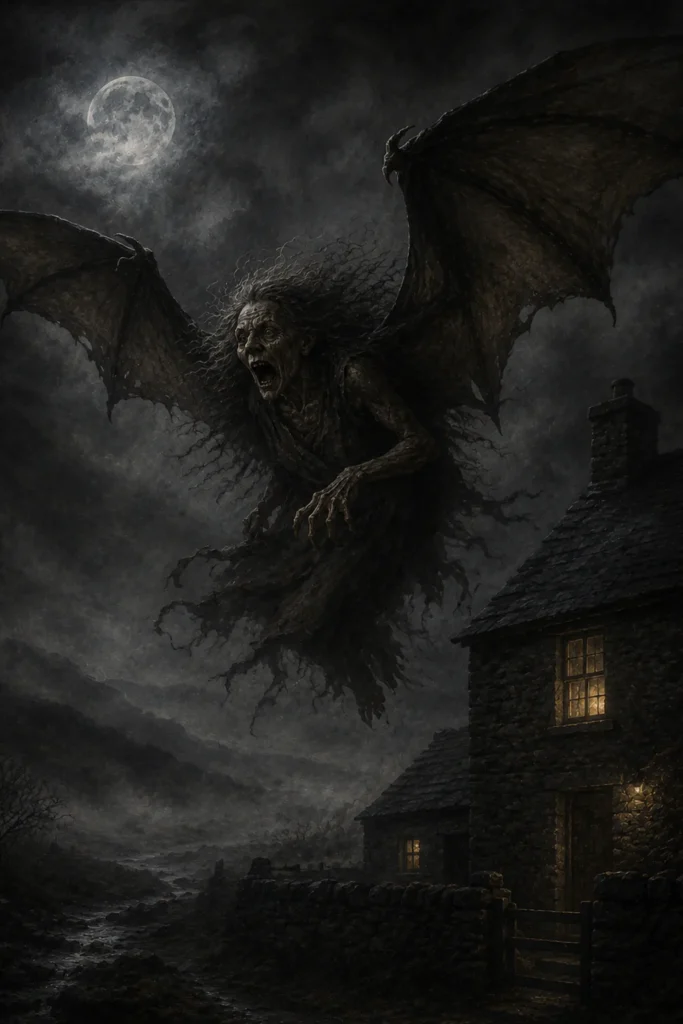
Gwrach y Rhibyn, the hideous wailing woman, is the visible harbinger of death in Welsh tradition. As a harpy-like witch with leathery bat wings, she approaches the window of a dying person at night, wails and calls out their name. Unlike active messengers of death, she does not kill; she merely announces what is already imminent.
The belief is widespread especially around the river Tywi and along the Glamorgan coast, but proverbially known throughout the country: in Wales, anyone considered particularly ugly was said to be as hideous as the Gwrach y Rhibyn. The most detailed description is provided by Wirt Sikes in the 19th century.
Type: Visible and audible death omen, winged wailing woman
Origin: Oral Welsh tradition around the river Tywi and the Glamorgan coast
Texts: Wirt Sikes, British Goblins, along with other Welsh collections of legends
Period: 18th and 19th centuries
Appearance: hideous witch figure with leathery bat wings
Textual history
Period of the Texts
Extensively documented in the 18th and 19th centuries, with Wirt Sikes as the most important source for the classic description.
Area of Diffusion
Wales, particularly around the river Tywi and along the Glamorgan coast; the figure is, however, proverbially known throughout the whole country.
Sources
Well: the classic description by Wirt Sikes, supplemented by John Rhys and Marie Trevelyan.
Name and variants
Welsh: gwrach means witch or old woman, rhibyn is usually interpreted as hem or streak. Her epithets are the Hag of the Dribble and the Hag of the Mist.
Appearance and symbolism
Appearance
Gwrach y Rhibyn appears as a monstrously hideous woman with a harpy-like appearance: tangled hair, withered, shrivelled arms, leathery bat wings, long black teeth and deathly pale features. She covers great distances swiftly on her wings. In her, ugliness, age and decay converge into a single herald of death.
Effect
At night she approaches the window of the dying or travels invisibly at their side, calling out their name. Her wailing cries are fy ngŵr, fy ngŵr, my husband, my husband, or fy mhlentyn, fy mhlentyn bach, my child, my little child. Like the banshee and the Bean Nighe, she is also said to wail for Welsh people who die far from home. Her effect is purely one of announcement; she does not intervene in events.
Profile: Gwrach y Rhibyn
The key aspects of the Welsh wailing woman at a glance.
One of the classic Welsh death omens, popularised by Wirt Sikes in the 19th century and closely linked to the Cyhyraeth.
A dying family member, whose name she calls, at times also for Welsh people who die far from home.
Tangled hair, leathery bat wings, long black teeth and deathly pale, withered features.
A pure omen: she announces death drawing near without bringing it about herself.
Interpret the sign and prepare for death; no reliable rituals of defence have been handed down.
The Welsh Aderyn y Corff and the Welsh Cwn Annwn as further messengers of death, along with the Scottish Bean Nighe.
From the Hag of the Dribble to the Welsh banshee
The name is Welsh: gwrach means witch or old woman, rhibyn is usually interpreted as hem or streak. Her epithets include the Hag of the Dribble and the Hag of the Mist, and it was proverbially said in Wales of a particularly ugly woman that she was as hideous as the Gwrach y Rhibyn.
The classic description is provided by Wirt Sikes in British Goblins, who popularised the figure as the Welsh banshee, shaping how she is spoken of to this day. Among the Welsh death omens, she stands particularly close to the Cyhyraeth, with whom she is at times equated.
The winged herald of death in the reception of folklore
The Gwrach y Rhibyn is present in folklore blogs and formats as the Welsh banshee and is a fixture in overviews of Welsh death omens. Her image as the winged wailing hag shapes the popular idea of the Welsh herald of death.
From a religious-studies perspective, the Gwrach y Rhibyn is an embodied death omen that is both audible and visible, and a keening woman. She represents the personification of death as an ugly old woman, a widespread Celtic-European pattern in which female wailing figures announce approaching death.
No ban against the herald of death's call
No reliable rituals of defence against the Gwrach y Rhibyn herself have been recorded. She is an omen, not an avertable danger: her call announces a death already approaching, and the only handed-down response is to interpret the sign and prepare for death. Against the misfortune her appearance foretells, folk belief generally turned to consecrated holy water, to the light of a protective candle for the death watch, and to the sound of consecrated bells, regarded as a protective sign against misfortune.
Welsh and Irish heralds of death compared
The Gwrach y Rhibyn corresponds to the Irish banshee, the wailing fairy of death, and to the Scottish Bean Nighe as well as the Caoineag. Within Wales, she is closely linked to the Cyhyraeth, with whom she is sometimes equated: both are regarded as the Welsh banshee, though the Cyhyraeth is purely audible while the Gwrach y Rhibyn is also visible. Alongside her, the bird omen Aderyn y Corff and the corpse candle Canwyll Corff count among the classic Welsh death omens, while the Cwn Annwn plays a different role as a soul-guide of the Otherworld.
Frequently asked questions about the Gwrach y Rhibyn
Is the Gwrach y Rhibyn the same as the Cyhyraeth?
They are closely related and are sometimes equated. The Cyhyraeth is purely audible, while the Gwrach y Rhibyn is also visible.
What does she call out?
Usually ‘my husband, my husband’ or ‘my child, my little child’, as well as the name of the dying person.
Why is she called the Welsh banshee?
Because, like the Irish banshee, she wails and screams before the death of a family member.
Further links
Further reading:
- Celtic – the Celtic world of gods and spirits in Britain
- Cyhyraeth – the purely audible Welsh sister in spirit
- Aderyn y Corff, Canwyll Corff – further Welsh death omens
- Cwn Annwn, Bean Nighe – heralds of death from the Celtic isles
- Holy water, protective candle, bells – traditional protective means
- Protection Compass – an overview of protective means
Literature (selection)
Further standard works in the bibliography.
As a Welsh keening woman and Welsh banshee, the Gwrach y Rhibyn remains what she has been for centuries: a voice at the window that does not bring death, only calls it by name.