Coblynau, the little mine fellows of Wales
By Ralf Ittermann · last reviewed on
The Coblynau are spirits of the Celtic tradition of Wales.
Their knocking shows miners the way to rich ore veins. Miners once credited little mine fellows, the Coblynau, with knocking to reveal rich ore veins.
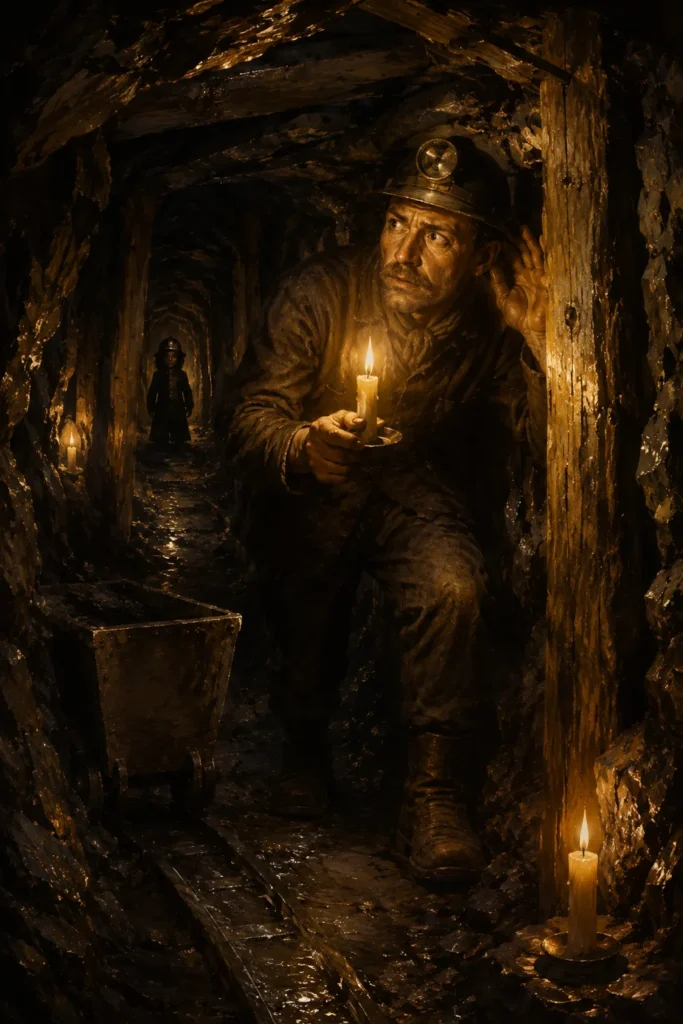
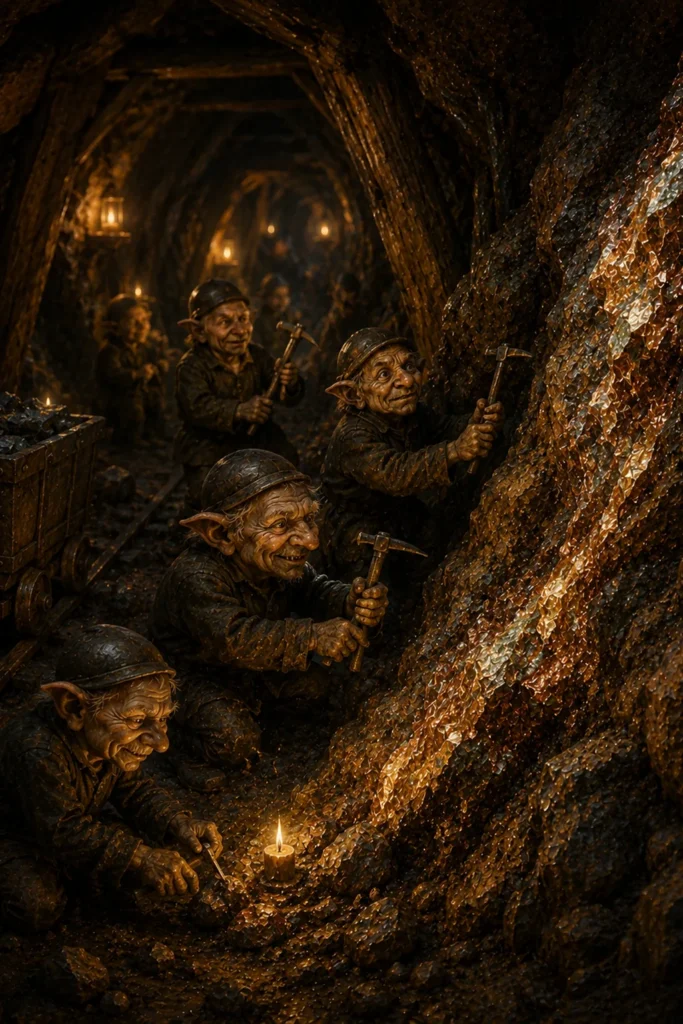
The Coblynau, singular Coblyn, are the Welsh mine and knocking spirits of the mountains. They dwell in the mines and quarries of Wales, wear miners’ clothing and busily but ineffectively imitate the miners’ work with their tools.
Their knocking at ore-bearing spots points to rich veins, much like their Cornish relatives, the Knockers. The Coblynau are, on the whole, well disposed towards humans; the classic source for them is Wirt Sikes with his 1880 work British Goblins.
Type: Welsh mine and mountain knocking spirits
Origin: Welsh folklore, classically in Sikes 1880
Texts: Sikes, British Goblins; Rhys, Celtic Folklore
Period: 19th-century Welsh folklore, with older roots in folk belief
Appearance: about half a metre tall, ugly, in miners’ clothing
Region of origin and sources
Period of the Texts
The Coblynau belong to Welsh folklore; their classic documentation comes from Wirt Sikes in 1880, supplemented by John Rhys.
Area of Diffusion
The Coblynau are recorded in the mines and quarries of Wales, as well as in Welsh mining settlements in America, where emigrants carried the belief with them.
Sources
The source situation is good: Wirt Sikes and John Rhys document the tradition, and Katharine Briggs classifies it lexically.
Name and variants
Welsh: coblyn, with the double meaning of knocker and goblin. The word is linguistically related to the English goblin and presumably derives, via the French gobelin, from a Germanic root such as Kobold; this etymology is considered plausible but not definitively established.
Appearance and behaviour
Appearance
The Coblynau are about half a yard tall, roughly half a metre, and decidedly ugly. They wear miners’ clothing and carry tools with which they busily but ineffectively imitate the miners.
Effect
Their knocking at ore-bearing spots, like that of the Cornish Knockers, points to rich veins. Towards miners, the Coblynau are on the whole well disposed; their signs are regarded as help, not as a threat.
Profile: Coblynau
The most important aspects of the Welsh mine spirits at a glance.
Mine and mountain knocking spirits of Welsh folklore, related to the Cornish Knockers; Sikes remains the classic authority.
Miners in the mines and quarries of Wales, later also in Welsh mining settlements in America.
About half a metre tall, ugly, in miners’ clothing with tools, with which they busily but ineffectively imitate the miners’ work.
Knocking at ore-bearing spots as a sign of rich veins; the Coblynau are considered on the whole well disposed.
Respect and calm, similar to the treatment of the Knockers. No dedicated protective rites are recorded for the Coblynau.
The Cornish Knockers as their closest relatives, along with Kobold and Goblin; the Welsh Bwca, by contrast, is a household and farmyard goblin.
From Coblyn to Goblin: name and sources
The Welsh word coblyn carries the double meaning of knocker and goblin, naming exactly what these beings do: they knock. Linguistically it is related to the English goblin and presumably derives, via the French gobelin, from a Germanic root such as Kobold, an etymology considered plausible but not definitively established.
The Coblynau are recorded in the mines and quarries of Wales, as well as in Welsh mining settlements in America, where emigrants carried the belief with them. The classic source is Wirt Sikes, whose 1880 British Goblins organised the Welsh fairy world; John Rhys supplemented these findings around the turn of the century.
From Sikes to the role-playing game
In fantasy and role-playing games, including Dungeons and Dragons, the Coblynau have been adopted as beings. For the folklore itself, Sikes’ classification of the Welsh fairies remains the reference framework.
From the perspective of religious studies, the Coblynau are helpful and harmless. Two clarifications are important: Coblynau and Knockers are related but not identical, the former Welsh, the latter Cornish. And the Coblynau are not to be confused with the Welsh Bwca, which is a household and farmyard goblin and does not belong in the pit.
Dealing with the mine spirits
An independent tradition of warding off the Coblynau is barely documented; the approach follows that used with the Knockers, with respect and calm underground. No elaborate protective rites are recorded specifically for the Coblynau, and this should be stated honestly: where a spirit is regarded as well disposed, folk belief apparently needed no banishing formulas, only good behaviour.
Knocker, Kobold and Bwca
The Coblynau are closest to the Cornish Knockers, with whom they share the knocking at ore veins; they are also related to Kobold and Goblin. Clearly distinct from them is the Welsh Bwca, a household and farmyard goblin belonging not in the pit but on the farm. In the German-speaking world, the Bergmönch is encountered as an entirely different kind of mine spirit.
Frequently asked questions about the Coblynau
What are the Coblynau?
The Welsh mine and mountain knocking spirits, whose knocking points to rich ore veins. They wear miners’ clothing and imitate the work of miners.
Are they the same as the Knockers?
They are related but not identical; the Coblynau are Welsh, the Knockers Cornish.
Are they dangerous?
No. They are on the whole well disposed, helpful and harmless.
Further links
Further reading:
- Celtic – all beings of the Celtic tradition
- Knocker – the Cornish knocking spirit, their closest relative
- Bergmönch – the mine spirit of German mining
- Amulet, Salt, Protective candle – traditional protective means
- Protection Compass – protective means at a glance
Literature (selection)
Further standard works in the bibliography.
As a Welsh mine spirit, the Coblyn is among the friendliest figures underground: a knocking spirit of the mines whose hammering does not frighten but points the way to the ore veins.