Canwyll Corff, the wandering flame on the path of the dead
By Ralf Ittermann · last reviewed on
Canwyll Corff is a spirit of Welsh tradition.
Its flame moves from the house of the dying, along the paths, to the grave.
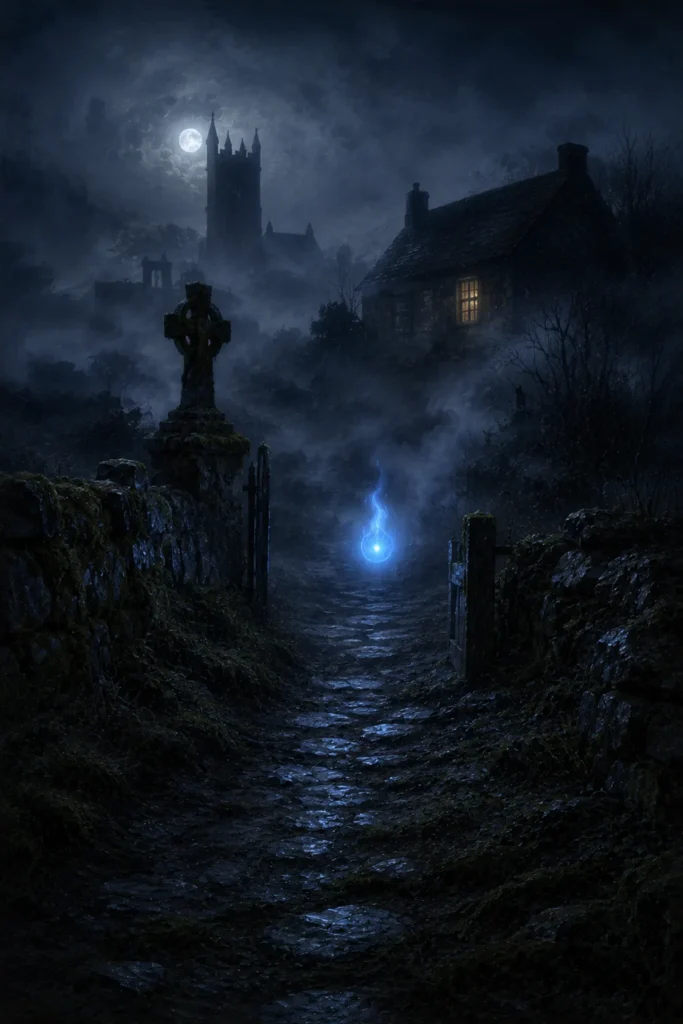
Canwyll Corff, the corpse candle, is a Welsh death light. As a small yellow or blue flame, it moves at night from the house of a dying person along the old paths to the churchyard, thereby anticipating the later funeral route. It announces death and the path to the grave, but causes nothing itself.
The name is made up in Welsh of canwyll, candle, and corff or corph, corpse, so literally corpse candle; the plural is canwyllau corff. It is important to clarify that the candle consists neither of a corpse nor of corpse wax; what is meant is solely the ghostly death light itself.
Type: Light death omen, announces death and the path to the grave
Origin: Welsh folk belief around death and omens, throughout Wales
Texts: Well documented, one of the best-documented Welsh omens
Period: widely attested in the 18th and 19th centuries, with case reports in Sikes and Trevelyan
Appearance: ghostly light, small yellow or blue flame
Area of origin and sources
Period of the Texts
Widely attested in the 18th and 19th centuries, with several case reports in Sikes and Trevelyan from this period.
Area of Diffusion
Throughout Wales, with particular density in West and Southwest Wales, in the old Dyfed.
Sources
Good: the corpse candle is among the best-documented Welsh omens, with several eyewitness accounts in Sikes and its own chapter in Trevelyan.
Name and variants
Welsh: canwyll means candle, corff or corph means corpse: Canwyll Corff means corpse candle, the plural is canwyllau corff. Internationally the phenomenon is also known as the corpse candle. The name refers to the death light itself, not an object made of wax.
Nature and effect
Appearance
Observers describe Canwyll Corff as a small yellow or blue ball of light that follows old roads, moves across moors and through woods, crosses streams and disappears at its destination. The size of the flame is regarded as a sign of the age of the dying person: a small candle for a young person, a large one for an old person. Two candles together, one of them shorter, indicate the death of a mother and child.
Effect
The corpse candle anticipates the route from the house of the dying to the grave, announcing death and the route, but does not itself act upon the person. Whoever encounters it interprets it as an announcement of who will soon die and which path the coffin will later take. Often the light belongs to the wider circle of the phantom funeral, the spectral funeral processions on the old paths of the dead.
Profile: Canwyll Corff
The key aspects of the corpse candle at a glance.
One of the best-documented Welsh death omens, firmly established in the collections of Sikes and Trevelyan.
Observers among the circle of the future deceased who encounter the wandering light on the old paths.
Small yellow or blue flame, whose size indicates the age of the dying person.
Announces death and the path to the grave by anticipating the later funeral route from the house to the churchyard.
Do not step in the candle’s path and give way to it; no specific banishing ritual has been recorded.
Aderyn y Corff and Cyhyraeth as further Welsh death omens, along with the globally widespread Will-o’-the-wisp.
A death light, not burning wax
An important clarification: the corpse candle consists neither of a corpse nor of corpse-wax; the name refers to the death-light itself. Wirt Sikes records several eyewitness accounts in British Goblins, including that of a woman whose gravely ill sister lay in the house.
Marie Trevelyan devotes a chapter of her own to the corpse candle and the phantom funeral. The tradition is especially dense in west and south-west Wales, in the old Dyfed, where the old paths between farmstead and churchyard remain part of the story to this day.
From eyewitness account to established folk motif
The corpse candle is a firm fixture of popular Welsh ghost-lore. It is discussed in collections, by the National Library of Wales, and in present-day folklore formats, and is among the best-known Welsh death signs.
From a religious-studies perspective, Canwyll Corff is a prototypical light-based death omen. It combines naturally observed luminous phenomena, such as marsh gas or phosphorescence, with an eschatological reading of the path from house to grave, showing how folk belief translates a natural phenomenon into a sign of death.
Avoiding the candle: protective signs at the death-house
The source material on warding off the corpse candle is likewise thin: there is no reliable ritual tradition for banishing it. What is recorded is rather the practice of avoiding it and not stepping into its path, as with the phantom funerals, since doing so was thought to mark oneself as soon to die. At its core, Canwyll Corff is an omen, not a threat that can be repelled.
At the death-house itself, the light of the protective candle accompanied the death-watch, for which the corpse candle served as a preparatory sign; holy water served as a Christian sign in dealing with the death omen, and the sound of consecrated bells was regarded along the coasts and in the villages as a protective sign.
One death-light among many will-o'-the-wisps
Canwyll Corff is the Welsh, death-signifying form of the globally widespread will-o’-the-wisp, the Will-o’-the-wisp, and stands alongside the other Welsh omens Aderyn y Corff and Cyhyraeth; the wailing woman Gwrach y Rhibyn and the spectral hunt Cwn Annwn also belong to this Welsh circle of death-messengers.
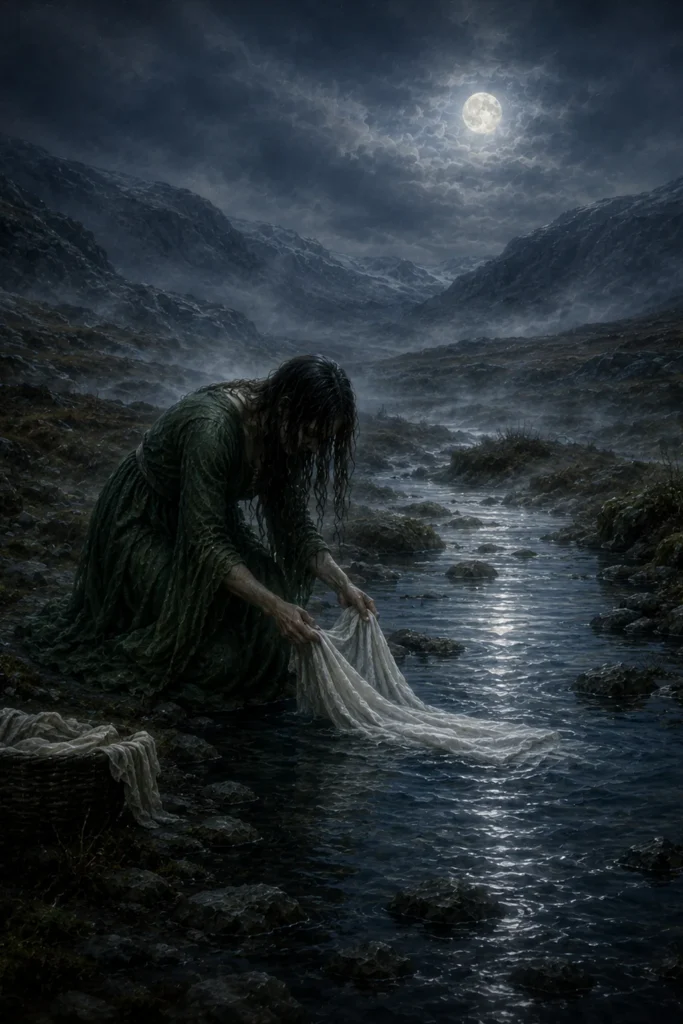
Related to these are also the Irish and Scottish death and light omens, including the wailing Bean Nighe at the ford, as well as the Breton Ankou with his creaking death-cart: both herald death in their own way, though neither appears as a wandering light like Canwyll Corff.
Frequently asked questions about Canwyll Corff
Does the corpse candle consist of a real candle?
No. The name refers to a ghostly death-light, not an object made of wax; neither a corpse nor corpse-wax is involved.
What does the size of the flame mean?
It indicates the age of the dying person: a small flame for a young person, a large one for an old person. Two candles together suggest several deaths, for instance a mother and child.
Where does the light move to?
From the house of the dying person along the old paths to the churchyard, thereby anticipating the later funeral route.
Further links
Further reading:
- Celtic – beings of Celtic tradition
- Aderyn y Corff – the Welsh corpse bird
- Cyhyraeth, Will-o’-the-wisp – related light and wailing omens
- Protective candle, Holy water, Bells – traditional protective means
- Protection Compass – overview of protective means
Literature (selection)
Further standard works in the bibliography.
Known as the Welsh corpse candle and internationally as the corpse candle, Canwyll Corff remains one of the best-documented death-lights: a wandering flame that indicates the path and time of death, long before the actual funeral procession takes the same route.