Glaistig, the green guardian of the Highlands
By Ralf Ittermann · last reviewed on
The Glaistig is a spirit of Celtic tradition.
The green woman who watches over cattle and becomes dangerous to men.
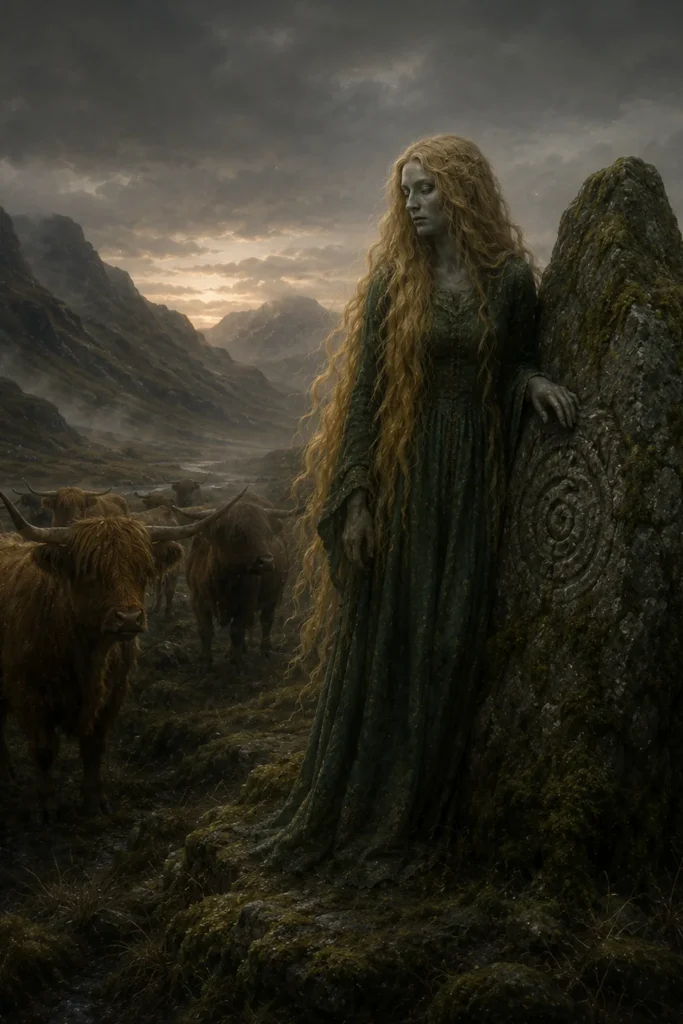
The Glaistig is an ambivalent protective spirit of the Scottish Highlands, usually appearing as a grey woman in a green dress with long yellow hair. She watches over cattle and house, punishes careless milkmaids, and can become dangerous to men.
She is documented chiefly through the oral tradition of the 19th century, collected by John Gregorson Campbell in Argyll and on the islands. A real custom was observed for her: each evening, part of the milk was poured into a hole in a particular stone.
Type: Ambivalent protective spirit for cattle and house
Origin: Gaelic Highlands
Texts: John Gregorson Campbell, 19th-century collections
Period: oral tradition, recorded in the 19th century
Appearance: grey woman in a green dress with long yellow hair
Textual history
Period of the Texts
The Glaistig belongs to the oral tradition of the Gaelic Highlands; she was recorded in the 19th century, chiefly by John Gregorson Campbell.
Area of Diffusion
The Scottish Highlands and islands; Campbell collected the tales in Argyll and on the Hebrides.
Sources
Good source material: Campbell’s Superstitions of the Highlands as the primary source, along with Briggs and the collection of John Francis Campbell.
Name and variants
Gaelic: The name comes from glas, grey or pale green, from which both the grey woman and the green lady derive. An epithet is maighdean uaine, green maiden.
Being and effect
Appearance
In Campbell’s primary source, the Glaistig is a thin, small grey woman with long yellow hair reaching to her heels, dressed in green. The widespread depiction as half woman, half goat comes from later reference works; Campbell himself rejected it as an error. Reliable features are the long yellow hair, the green garment and the grey skin colour.
Effect
The Glaistig is genuinely ambivalent. As a benevolent protective figure, she is bound to a building or a place, watches over the cows, punishes careless milkmaids, sweeps and spins, and takes fools and weak-minded people under her special protection; she dislikes dogs. In other tales she watches over red deer or lures men with song and dance into her hiding place. These strands represent different traditions, not a uniform creature.
Profile: Glaistig
The key aspects of the Highland protective spirit at a glance.
Protective figure of the Gaelic Highlands, poised between the fairy world and humankind, bound to places and buildings and honoured through a real milk custom.
Cattle and house, and in some strands also red deer; she takes fools and weak-minded people under her special protection.
A thin, small grey woman with long yellow hair reaching to her heels, dressed in green; Campbell rejected the goat imagery of later works.
Watches over cows, punishes careless milkmaids, sweeps and spins; in other tales she lures men with song and dance into her hiding place.
Each evening, part of the milk was poured into a specially designated hole in a stone, the Clach na Glaistig.
From glas to the green lady
The name of the Glaistig comes from Gaelic glas, grey or pale green; from this derive both the grey woman and the green lady, and her epithet is maighdean uaine, green maiden. She is documented chiefly through the oral tradition of the 19th century, which John Gregorson Campbell collected in Argyll and on the islands.
Campbell’s records are also the corrective to later reception: his primary source describes a thin, small grey woman in green, not the hybrid creature of woman and goat that later reference works spread and which he explicitly rejected as an error. The narrative strands of the cattle guardian, the mistress of red deer and the dangerous seductress stand side by side here as different traditions.
Reception and interpretation
The Glaistig survives in tourism and heritage chiefly as the green lady of castle ghosts; in popular reference works the contested goat- and satyr-image dominates. In modern fantasy she appears among other things as Glaistig Uaine.
From the standpoint of religious studies, the Glaistig is an ambivalent protective spirit between the fairy world and humankind. Important clarifications: the half-goat form is a contested strand rejected by the primary source. The label ‘hunting goddess’ is a modern interpretation, not a traditional title. And the blood-sucking trait belongs rather to the baobhan sìth.
The Milk Offering at the Glaistig Stone
A real custom was tied to the Glaistig: each evening, part of the milk was poured into a hole specially set aside for this purpose in a stone, the Clach na Glaistig. Whoever offends her loses her protection. The legend of Ach-na-Creige tells how a shepherd boy poured boiling milk into the stone, whereupon the Glaistig burned her tongue, left in anger and withdrew her protection from the farm.
Gruagach, Brownie and the Wailing Woman
Frequently Asked Questions about the Glaistig
What is a Glaistig?
An ambivalent protective spirit of the Scottish Highlands, usually a grey woman in a green dress with long yellow hair, who watches over cattle and household.
Is she really half goat?
This is a disputed strand found in later reference works; Campbell’s primary source explicitly rejects this image.
How was she honoured?
By pouring part of the milk each evening into a hole in a particular stone, the Clach na Glaistig.
Further links
Literature (selection)
Further standard works in the bibliography.
The Glaistig is regarded both as a Scottish cattle-protecting spirit and as a green woman of the Highlands: a figure whose care for herd and household is as well attested as her dangerous side.