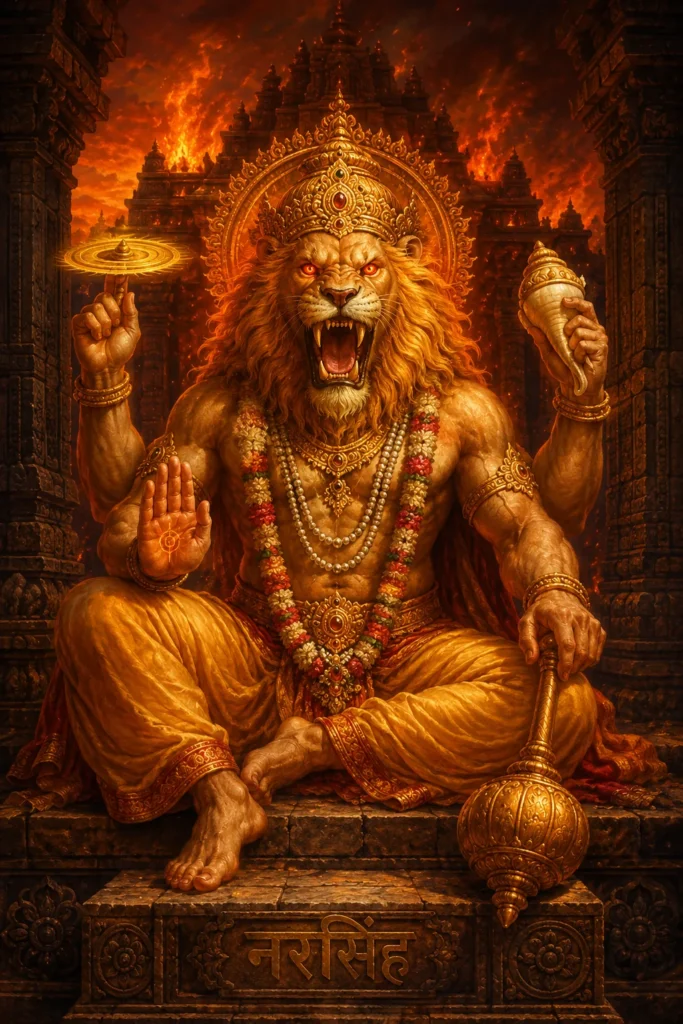
Narasimha is the fourth avatar of Vishnu, half human and half lion. He appears in order to defeat the demon king Hiraṇyakaśipu and to protect his devout son Prahlāda. The figure combines the terrifying with the idea of divine justice.
Narasimha is the man-lion avatar of Vishnu and appears as the fourth of the ten classical avatars.
Within Hinduism, Narasimha belongs to the classical ten principal embodiments of Vishnu and is listed in the usual order as the fourth avatar. His name designates a being that is at once human and lion.
This hybrid form is not accidental but fulfils a precise function in the myth, since it circumvents the conditions of a seemingly unbreakable protective formula.
In terms of religious studies, Narasimha is a striking example of the ambivalent side of the divine. He embodies a terrifying, awe-inspiring manifestation that nonetheless stands in the service of the world order and the protection of the devout.
The main sources are the Purana texts, above all the Bhagavata Purana and the Vishnu Purana, in which the narrative is unfolded in detail. Earlier hints of the material are already found in the Mahabharata and in individual early Purana layers.
The figure exemplifies how the avatar concept works: Vishnu intervenes in the world when injustice and arrogance prevail, taking the form that corresponds to the particular situation. Narasimha is the form for the moment in which a seemingly invulnerable tyrant must be overthrown.
Scholarship also sees in Narasimha an indication of older, possibly local lion cults that were taken up into the worship of Vishnu. The lion as a emblem of kingship and terror was widespread in the Indian cultural sphere.
The theological achievement of the Purana literature lay in integrating such a terrifying animal form into the ethical fabric of avatar doctrine and assigning it a salutary function.
The name Narasimha is composed of two Sanskrit elements. Nara means human or man, Simha means lion. The compound therefore directly describes the dual nature of the figure as man-lion. In religious usage the forms Nrisimha and Narasingha also appear, along with regional pronunciations such as Narasinga.
Various epithets emphasise individual aspects. Ugra-Narasimha denotes the wrathful, terrifying manifestation, while forms of address such as Lakshmi-Narasimha emphasise the calmed state, turned toward the worshippers, after the demon has been vanquished, in which the goddess Lakshmi appears at his side.
Yoga-Narasimha names the meditating form, Sthamba-Narasimha the one bursting forth from the pillar. This distinction is also reflected in temple culture, in which different image types are venerated.
The etymology already points to the theological crux of the narrative. Because the demon king had been assured of protection from human and animal, it is precisely a being that is neither clearly human nor clearly animal that is able to break the protective formula.
The name itself thus carries the logic of the myth: it names not only a figure but the solution to a seemingly hopeless problem.
The pictorial tradition depicts Narasimha with a human torso and a lion’s head, often with an open mouth, bared teeth and a mane. The eyes are frequently wide open and express wrath. In several arms the figure holds the typical attributes of Vishnu, including the discus and the conch.
A particularly widespread pictorial form shows Narasimha at the moment when he has the demon king Hiraṇyakaśipu lying across his thighs and tears open his body with his claws.
This dramatic scene captures the climax of the narrative in a single image. Alongside it there are calmer depictions, for instance Narasimha seated with his consort Lakshmi on his lap or in a meditative posture with a yoga band encircling the knees.
In the temples of South and Central India, Narasimha is widespread. Some sculptures show him in connection with a pillar from which, according to tradition, he bursts forth.
Rock sculptures from the time of the Pallava and the Chalukya, for instance at Mahabalipuram and at the cave temples of the Deccan, are among the early iconographic witnesses and attest to the spread of the cult already in the first millennium CE. The iconography consistently emphasises the tension between the terror of the manifestation and the protective intention behind the intervention.
The central narrative concerns the demon king Hiraṇyakaśipu, who through severe asceticism had obtained a boon from the creator god Brahma that made him almost invulnerable.
He was to be able to die neither by day nor by night, neither inside the house nor outside it, neither by human nor by animal, neither by weapons nor by other means, neither on the ground nor in the air.
Trusting in this assurance, he declared himself the highest object of worship and suppressed every Vishnu cult. His hatred of Vishnu was moreover personally grounded, for a previous avatar, the boar Varaha, had killed his brother Hiranyaksha.
His own son Prahlāda, however, remained an unshakeable worshipper of Vishnu. Already in the womb, according to one version, he had heard the teaching of the sage Narada.
With increasing harshness the father tried to turn the son away from his piety, had him instructed by demonic teachers and finally did not shrink from attempts on his life.
Prahlāda was thrown from cliffs, trampled by elephants, given poison and exposed in a fire on the lap of the demoness Holika.
He survived all the ordeals, which in the bhakti tradition is interpreted as a sign of the protective presence of the deity. According to a widespread interpretation, the spring festival Holi recalls the episode with Holika.
When, in a confrontation, Hiraṇyakaśipu mockingly asked whether Vishnu was also present in a pillar of the palace and struck it with his fist, the pillar burst apart and Narasimha stepped forth roaring.
The narrative now describes how the hybrid form circumvents every condition of the protective formula: it is twilight, thus neither day nor night.
The threshold of the house is neither inside nor outside. Narasimha is neither human nor animal. He kills the demon with his claws, thus without a weapon, and in doing so lays him across his thighs, so that he dies neither on the ground nor in the air.
Each individual condition is thus cancelled by the particular nature of the situation and of the figure.
After the killing of the demon, tradition describes the wrath of Narasimha as so immense that the world is shaken by it and even the gods are afraid.
Only the fearless Prahlāda, who calmly steps before the terrifying figure, in some versions also the intervention of other deities or of the goddess, are able to appease Narasimha.
Narasimha thereupon crowns Prahlāda as king and promises protection to his lineage. The narrative thus ends with the restoration of order and the confirmation of Prahlāda’s piety as a model.

The veneration of Narasimha is especially pronounced in South and Central India. Well-known temple sites lie, among others, in the present-day states of Andhra Pradesh and Telangana, for example Ahobilam with its nine Narasimha shrines, furthermore Simhachalam near Visakhapatnam and Yadagirigutta.
In Karnataka and Maharashtra there are further significant shrines. In many of these places both the wrathful and the calmed manifestation are taken into account, often in separate shrines.
In the festival calendar, Narasimha Jayanti is of importance, a day in early summer that celebrates the appearance of the avatar at dusk. On such occasions the narratives are recited, images are festively adorned, special food offerings are presented and communal forms of veneration are observed.
In bhakti piety, Prahlāda serves as an exemplary worshipper whose steadfastness is to be imitated. The recitation of the protective hymn Narasimha-Kavacha is widespread in several traditions.
Theologically, Narasimha is interpreted within the various Vishnu traditions. In the Ahobila Matha tradition of the Shrivaishnavas he holds a central position. In some schools he is regarded in particular as a remover of obstacles, as a protector against enemies and evil powers.
The regional diversity of the cults shows how an epic narrative was translated, over long periods of time, into concrete ritual practice and fixed places of pilgrimage.
Narasimha is regarded in many regional traditions as a protective figure. Worshippers recite hymns and protective formulae assigned to him, above all the Narasimha-Kavacha, place his image on household altars or wear corresponding pendants.
Such practices are understood by the faithful as an expression of trust in the protective presence of the deity, especially in situations perceived as threatening.
The mythological basis of this notion is the narrative itself, in which Narasimha preserves the devout Prahlāda from his violent father and protects him despite all attempts on his life.
The steadfastness of Prahlāda is presented in the bhakti tradition as a model that worshippers are to emulate in their own practice. The wrathful aspect of Narasimha is here interpreted not as a threat to the devout but as a force directed against injustice and hostile powers.
From the perspective of the history of religion, it should be noted that these forms are handed-down beliefs and ritual practices. A factual account describes them as part of the tradition, without attributing to them a verifiable or objective protective effect.
What is interesting in terms of religious studies is rather how a figure perceived as terrifying could be reinterpreted as a source of security.
The hybrid form of human and animal is a widespread motif in the history of religion. Lion-headed or lion-shaped beings are found in several ancient Near Eastern and Mediterranean traditions, for example the lion-headed goddess Sachmet in ancient Egypt or various hybrid creatures of the Mesopotamian pictorial world.
Such parallels prove no direct historical connection, but point to the recurring significance of the lion as a symbol of strength and terror.
Within the Indian religious sphere, Narasimha stands in the series of the avatars of Vishnu and shares with them the attributes and the function of restoring the cosmic order.
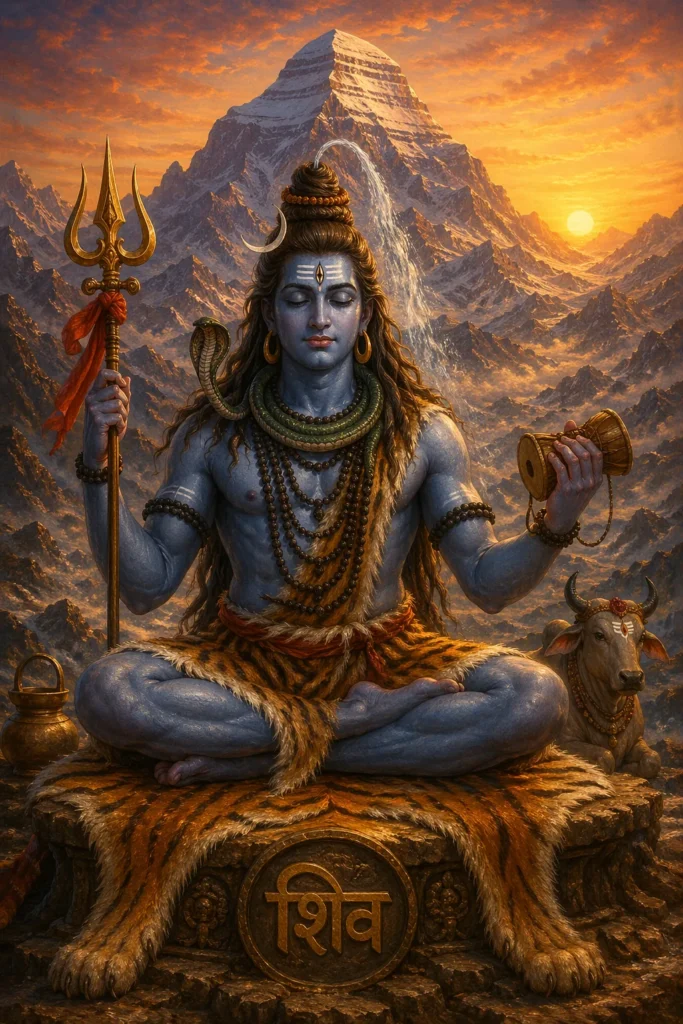
The contrast with Shiva, who is venerated in his own wrathful manifestations such as Bhairava, shows that the notion of a terrifying yet salutary form of god is expressed several times in Hinduism. Scholarship here speaks of the ambivalent structure of the sacred.
The core narrative motif, breaking a seemingly seamless protective formula through an unforeseen condition, likewise has counterparts in other mythologies and in folktale research. It shows a narrative logic that emphasises the hopelessness of the situation and the surprising nature of the solution.
The motif of the devout son of a godless father is also a recurring narrative pattern that expresses the tension between family ties and religious loyalty.
Narasimha is present in contemporary Indian culture through temple festivals, religious narrative literature, pictorial art and media adaptations.
The story of Prahlāda and Hiraṇyakaśipu is often told in connection with the spring festival Holi and is also widespread in children’s and picture books, in comic series and in animated films. The places of pilgrimage, above all Ahobilam, continue to attract numerous pilgrims.
Research in religious studies examines Narasimha, among other things, with regard to the layering of the sources, the regional distribution of the cults and the theological interpretation of the wrathful divine.
Of interest here is how the ambivalent manifestation is classified in different schools and treated in temple practice, for instance through the separation of wrathful and calmed image types. The question of possible pre-Vishnuite lion cults is also discussed.
Overall, Narasimha remains an important subject for the understanding of the avatar concept and for the question of how a tradition deals with the terrifying and violent aspects of its image of god.
The figure combines narrative drama with a clear theological statement about divine justice and about the limits of human self-exaltation. It is thus equally instructive for Indology and for comparative religious studies.
Related key terms: Narasimha Vishnu Hiraṇyakaśipu Prahlāda Avatar man-lion Bhakti Purana.
iWell Guard ties in with the cultural-historical tradition of portable protective objects, in the tradition of Hinduism and many other cultures worldwide. 41 layers, solid gold, platinum, silver, made in Germany. 30-day right of return.
Personal experiences may vary. Not a medical device. No healing promise.