


Aganjú, Lord of the wilderness, rock and lava
By Ralf Ittermann · last reviewed on
Aganjú is a god of the Yoruba tradition.
Lord of the wilderness and fire, and the volcano Orisha in the diaspora.
Aganjú, also written Agayú or, in the diaspora, simply Aganju, is an Orisha of the Yoruba: a lord of the wilderness, of dry land, of the mountains and of fire. In Nigeria he is associated with rock and heat, while in Santería in Cuba and Candomblé in Brazil he is linked above all with the volcano and lava.
In Nigeria he is regarded as a deified warrior-king from Shaki, whose rocky monolith landscape is considered his manifestation. His relationship to Shango is close but has been passed down ambiguously.
Type: Orisha of the wilderness, dry land, mountains and fire
Origin: Yoruba religion of southwestern Nigeria and Benin
Texts: oral Yoruba tradition, research on Santería and Candomblé
Period: living cult in Africa and the diaspora
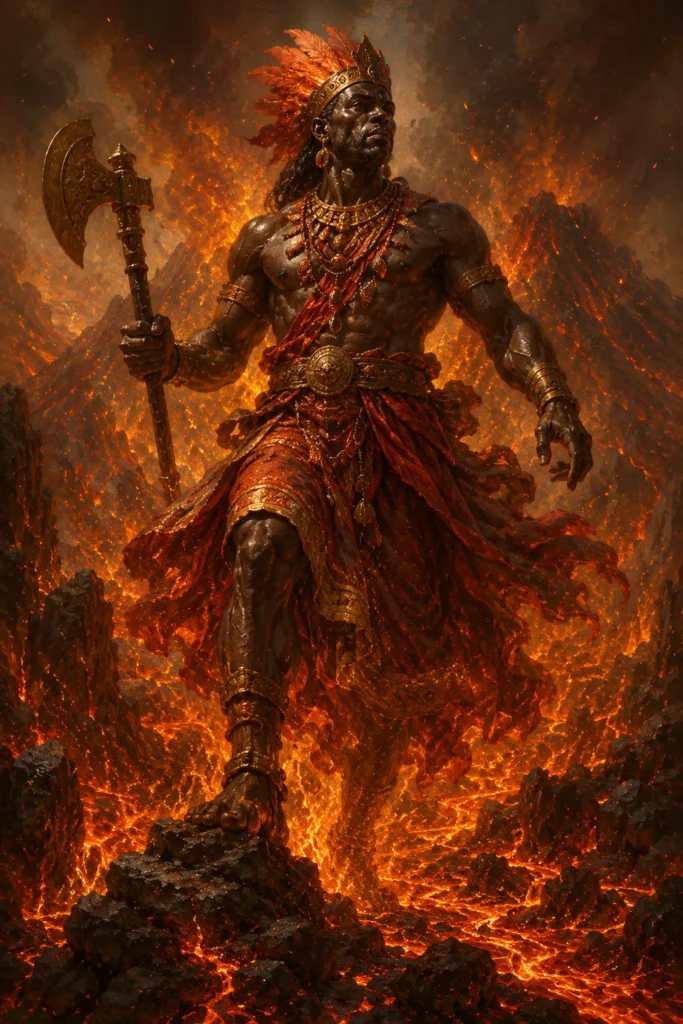
Appearance: powerful warrior, associated with rock, heat and fire
Region of origin and sources
Period of the Texts
The tradition is passed down orally; the cult remains alive in Africa as well as in the diaspora to this day.
Area of Diffusion
Southwestern Nigeria and Benin, along with the diaspora: Santería in Cuba and Candomblé in Brazil.
Sources
Well documented through research on Yoruba religion and the diaspora, from Bascom through Verger to Thompson.
Name and variants
Yoruba: aginjù means wilderness, forest, wasteland or desert. The name forms Aganjú and Agayú exist alongside one another; the form Agayú is especially widespread in the diaspora.
Being and effect
Appearance
In Nigeria, Aganjú fights with sword and heat or fire. In Santería he is assigned the number nine, along with brown and nine colours, as well as symbols of the volcano and sun with a shepherd’s staff, axe or trident; his dance with high steps suggests the overcoming of obstacles and rivers.
Effect
Aganjú is the lord of the wilderness, of dry land and of the mountains, an embodiment of raw strength and the overcoming of obstacles. As ferryman and crosser, he holds the key to his syncretic interpretation; in the diaspora he is linked to the volcano, magma and the interior of the earth.
Profile: Aganjú
The most important aspects of the Orisha at a glance.
Orisha of the Yoruba in south-western Nigeria and Benin, who lives on in Santería in Cuba and in Candomblé in Brazil.
Wilderness, dry land, mountains and fire; in the diaspora also volcano, magma and the interior of the earth.
Powerful warrior with a sword; in Santería associated with the number nine, brown, volcano and sun symbols, and a shepherd’s staff, axe or trident.
Embodiment of raw strength and the overcoming of obstacles; as ferryman and crosser he carries people across rivers and thresholds.
In the diaspora, sacrificial animals such as bull, billy goat, rooster and dove, as well as bloodless offerings such as nine biscuits coated in palm oil.
From warrior king of Shaki to volcano Orisha
Yoruba aginjù means wilderness, forest, wasteland or desert. Aganjú is an Orisha of the Yoruba in south-western Nigeria and in Benin, who lives on in Santería in Cuba and in Candomblé in Brazil. In Nigeria he is regarded as a deified warrior king from Shaki, whose landscape of rock and monoliths is considered his manifestation; the native connection to nature is rock, mountain and dry land, not the volcano.
Only in the diaspora did the lord of the wilderness become the Orisha of the volcano and lava. This shift can be explained: in Yorubaland there are no active volcanoes, but there is rock, heat and wasteland; in the New World the idea of the glowing interior of the earth found a new image for the same raw power.
Afterlife in Africa and the diaspora
In Candomblé, Aganjú appears as Xangô Aganjú, a manifestation of Shango; in Santería he is regarded as the patron saint of Havana. The rock and iron landscape of Shaki preserves his Nigerian connection to nature.
From a religious-studies perspective, Aganjú shows how an Orisha of the wilderness changed into a volcano Orisha in the diaspora. Important clarifications: the connection to the volcano and lava is primarily a diaspora development, since there are no active volcanoes in Yorubaland; in Nigeria, river, ferryman, wilderness and rock dominate. And the relationship to Shango, as father, brother, nephew or manifestation, is passed down ambiguously.
Sacrifices and offerings in the cult of Aganjú
In the diaspora, sacrificial animals such as bull, billy goat, rooster and dove are recorded, as well as bloodless offerings such as nine biscuits coated in palm oil, aubergines and roasted maize. A clear individual taboo or a fixed drum rhythm, however, could not be reliably documented and therefore remains uncertain.
Ferryman, volcano and the closeness to Shango
Aganjú embodies the ferryman and crosser archetype, iconographically close to Saint Christopher, who carries the child through the river. Via the diaspora volcanic facet there is a typological closeness to the Hawaiian Pele. Within the Yoruba religion, he stands closest to Shango, but is to be distinguished from him: Shango judges from the sky with thunder and lightning, while wilderness, rock and the fire of the earth belong to Aganjú. How the two are related, whether as father and son, as brothers or as manifestations, is passed down differently across traditions.
Frequently asked questions about Aganjú
Who is Aganjú?
A Yoruba Orisha of the wilderness, dry land, mountains and fire. In the diaspora of Santería and Candomblé, he became the volcano Orisha.
Is he a volcano god?
The connection to the volcano is primarily a diaspora development, since there are no active volcanoes in Yorubaland. In Nigeria, Aganjú is linked to rock, river and wilderness.
How is he related to Shango?
The relationship is passed down ambiguously: depending on the tradition, he is regarded as father, brother, nephew or as a manifestation of Shango.
Further links
Further reading:
- Shango – the thunder Orisha in a close, ambiguous relationship
- Pele – Hawaiian volcano goddess as a typological parallel
- Iron, protective candle, amulet – traditional protective means
- Protection Compass – protective means at a glance
Literature (selection)
Further standard works in the bibliography.
Aganjú unites two faces: the Yoruba Orisha of the wilderness, dry land and rock in Nigeria, and the volcano Orisha of the diaspora, linked in Santería and Candomblé with lava and the interior of the earth. Both refer to the same raw, overcoming power.


