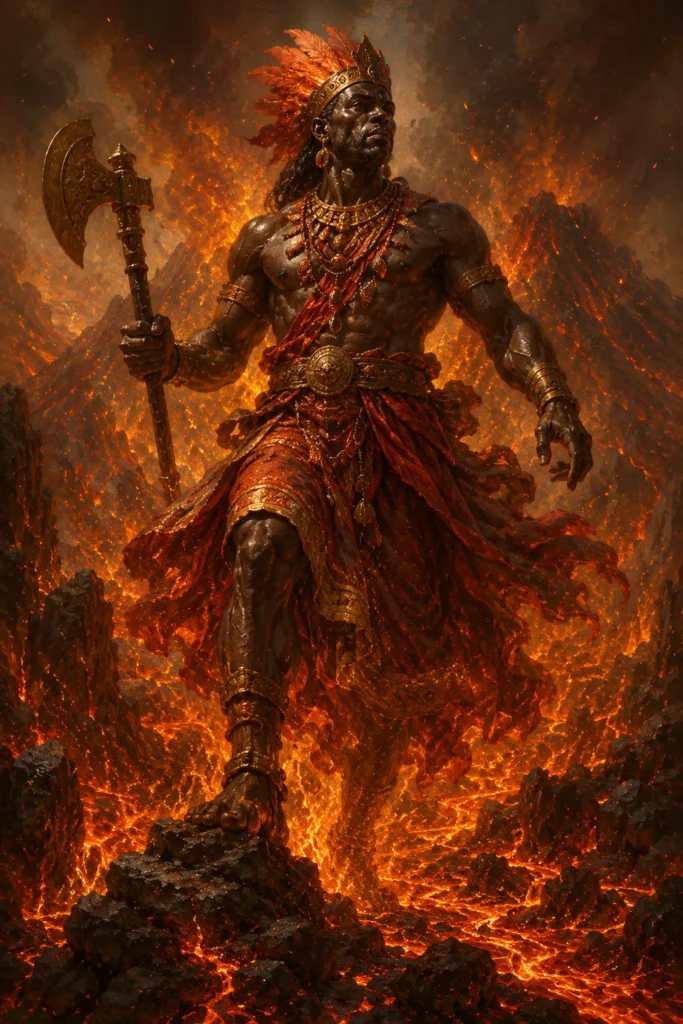
Shango, the lightning judge of Oyo
By Ralf Ittermann · last reviewed on
Shango is a god of the Yoruba tradition.
Thunder Orisha who judges and punishes with lightning. Tradition celebrates him as the lightning judge of Oyo, who passes judgment with thunder. According to this title, Shango is the thunder and fire Orisha of the Yoruba.
Shango, also Sango or Changó, is the Yoruba Orisha of thunder, lightning and fire, and at the same time lord of justice and royal authority. As a deified ancestral king and force of nature, he hurls lightning bolts and punishes with fire; he is one of the best-known and most vibrant Orisha.
His colours are red and white, his emblem is the double axe, and the edun ara, neolithic stone axes, are considered his lightning bolts. The cult stretches from the Oyo Empire to present-day Santería and Candomblé.
Type: Orisha of thunder, lightning, fire and justice
Origin: Yoruba religion of south-western Nigeria, Oyo Empire
Texts: oral Yoruba tradition, extensive diaspora research
Period: living cult in Africa and the diaspora
Appearance: royal warrior with double axe, in red and white

Traditional context
Period of the Texts
The tradition is oral; the cult has lived on from the old Oyo Empire to the present day in Africa and the diaspora.
Area of Diffusion
South-western Nigeria with the Oyo Empire as its centre, along with Santería in Cuba, Candomblé in Brazil, and the Orisha religion in Trinidad.
Sources
Well documented: extensive Yoruba and diaspora research, from Bascom and Idowu to the edited volume by Tishken, Falola and Akinyemi.
Name and variants
Yoruba: The name forms are Ṣàngó, Changó and Xangô; the origin is disputed, traditionally linked to ṣán, to strike or flash. An epithet is Jakuta, the stone-thrower; an honorific title is Oba Koso, the king did not hang himself.
Form and Activity
Appearance
Shango appears as a royal warrior in red and white, his sacred number is six. His emblem is the double axe, the oshe Shango; the edun ara, neolithic stone axes, are considered his lightning bolts. His sacred tree is the Ayan.
Effect
Shango rules over thunder, lightning and fire, and also over justice, retribution, royal authority and masculinity. He is a strict judge who punishes with lightning.
Profile: Shango
The key aspects of the thunder Orisha at a glance.
Deified ancestral king of Oyo, merged with the older thunder deity Jakuta; one of the most vibrant Orisha cults.
Thunder, lightning and fire, as well as justice, retribution, royal authority and masculinity.
Royal warrior in red and white with the double axe oshe Shango; sacred number six, sacred tree Ayan.
Strict judge who punishes with lightning; the edun ara, neolithic stone axes, are regarded as his descended lightning bolts.
Rams as sacrificial animals, bata drums of the Ayan drummer caste, edun ara in covered vessels on the altar; in Oyo a living world festival.
Ancestral king and thunder god: Shango's dual nature
Shango has a dual nature as a deified ancestral king and as a force of nature. He is regarded as the son of Oranyan and as the third or fourth Alaafin, king of Oyo, though the sources vary, as the tradition has only been passed down orally. The honorific title Oba Koso, meaning the king did not hang himself, refers to the legend of his end.
Behind the royal myth stands the older thunder deity Jakuta, the stone thrower, with whom the king figure merged. This merging explains the dual face of the cult: courtly authority and justice on one side, the raw thunderstorm with lightning and thunderstone on the other.
From Saint Barbara to bata music
In Santería, Shango is venerated as Changó and syncretised with Saint Barbara, whose feast day is celebrated on 4 December; in Candomblé he is called Xangô. He is present in Trinidad, in bata music and in the visual arts, and remains the subject of ongoing research.
From the perspective of religious studies, Shango is a classic example of the merging of a deified king and an older nature deity. Important clarifications: the historicity of the king remains scholarly open, the story of the fourth king who hanged himself is legend, merged with the older thunder deity Jakuta. The syncretism with Saint Barbara is colonial disguise, not a female nature. And the edun ara are neolithic stone axes interpreted as lightning bolts.
Rams, bata drums and thunderstones
His sacrificial animal is the ram; central are the bata drums of the Ayan drummer caste. The edun ara are collected in fields and venerated in covered vessels on the altar. In parts of Yorubaland there is a taboo against eating black-eyed peas. In Oyo, a living world festival is held in his honour; red foods and rum belong mainly to the diaspora.
Thunder gods with stone axes: the parallels
Shango is a thunder god with throwing weapon and stone axe, comparable to Thor, Zeus, Baal, Perun and Indra. The thunderstone motif, neolithic axes as lightning bolts, is also documented for Thor and Perun and forms a genuine analogy in the history of religion, without genetic relation. Within Yoruba religion, Aganjú is closest to him, depending on tradition as father, brother, nephew or manifestation: to Aganjú belong wilderness, rock and earth fire, to Shango the thunderstorm and the office of judge.
Frequently asked questions about Shango
Who is Shango?
The Yoruba Orisha of thunder, lightning and fire, also lord of justice and royal authority. He is among the most well-known and vibrant Orisha.
Was Shango a historical king?
The historicity remains open. The story of the fourth king of Oyo, who hanged himself, is legend, merged with the older thunder deity Jakuta.
What are edun ara?
Neolithic stone axes interpreted as his lightning bolts. They are collected in fields and venerated in covered vessels on his altar.
Further links
Further reading:
- Aganjú – the wilderness and volcano Orisha at his side
- Zeus – the Greek lightning thrower as a parallel
- Iron, Protective Candle, Amulet – traditional protective means
- Protection Compass – protective means at a glance
Literature (selection)
Further standard works in the bibliography.
As the Yoruba Orisha of thunder and god of lightning and fire, Shango combines the force of nature with the office of royal judge: the lightning bolt, which descends to earth as a stone axe, is in his cult at once punishment, verdict and sign of the Orisha’s presence.