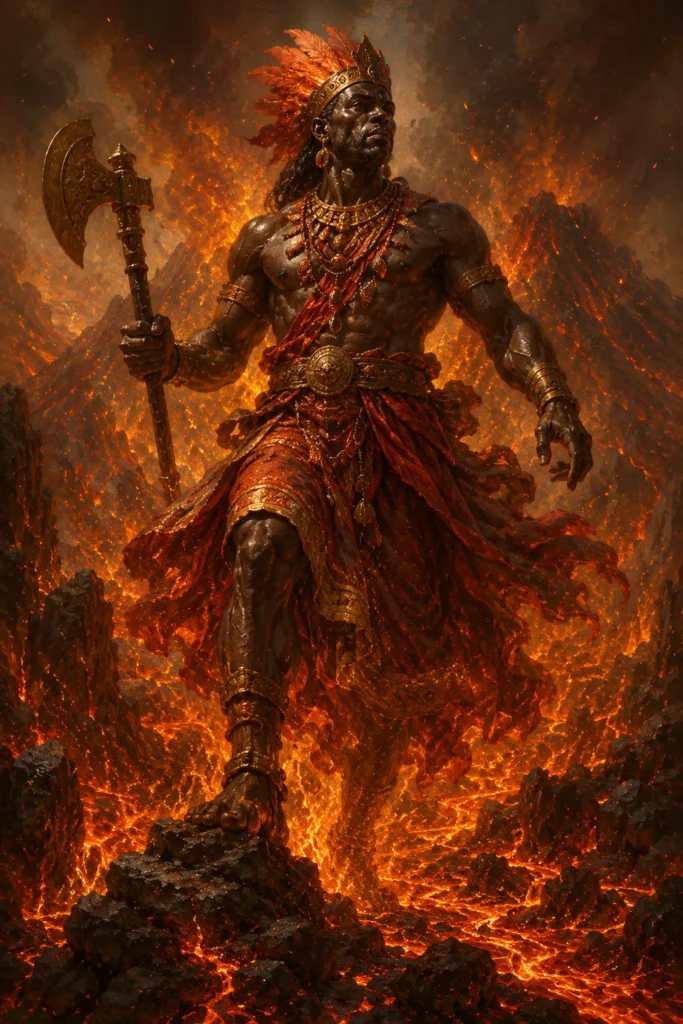
Olokun, lord and lady of the ocean depths
By Ralf Ittermann · last reviewed on
Olokun is a god of Yoruba tradition.
Lord and Lady of the Depths, keeper of wealth and mystery. Among the Yoruba, Olokun is the orisha of the ocean depths, and the text explains what rank this figure holds.
Olokun is the orisha of the ocean floor, lord over wealth, health and the mysteries of the deep. Ambivalent in gender, male, female or androgynous depending on tradition, Olokun is regarded in the diaspora as protector of the descendants of the enslaved.
Type: Orisha of the ocean floor
Origin: Yoruba and Edo tradition, southern Nigeria
Texts: Ifá tradition, Benin bronzes
Period: alive to this day, diaspora in Cuba, Brazil
Appearance: deity of the deep sea, gender variable

Region of origin and sources
Period of the Texts
Attested orally in Ifá and Edo tradition, materially in the Benin bronzes.
Area of Diffusion
Yorubaland and Edo land, southern Nigeria, diaspora in Cuba, Brazil.
Sources
Solid: Ifá verses, Edo tradition, art objects, ethnographic literature.
Name and variants
Yoruba: The name Olokun roughly means lord of the ocean, even though the deity is not thought of as solely male depending on the tradition.
Nature and effect
Appearance
Blue and white are Olokun’s colours; in Santería she rests in a sealed vessel.
Effect
Olokun grants wealth and health and guards secrets, but also carries danger.
Profile: Olokun
The most important aspects of the orisha at a glance.
Yoruba orisha of the Ifá and Edo tradition, attested in the Benin bronzes.
Wealth, health, the mysteries of the ocean depths.
Blue and white colour symbolism, vessel cult in Santería, masks and bronzes in Benin.
Lord over the waters, giver of wealth.
Priestly veneration, Olokun festivals in Benin, vessel cult.
Between Benin and Yorubaland: a shifting gender
Olokun belongs to the Ifá tradition of the Yoruba and the Edo tradition of Benin. Gender shifts: male on the coast, female inland, both at once in Ifá and Ocha. Yemoja and Olokun are distinct orishas, with Olokun also serving as patron of the Middle Passage.
Benin bronzes, Santería and the Middle Passage
Olokun is present in Santería and Afro-Brazilian tradition, with art-historical reception through the Benin bronzes and their restitution debate: a prime example of the variance within the orisha concept and the gender fluidity of divine power.
Priestly cult and vessel veneration
Veneration mediated by priests: white robes, blue and white colours, vessel cult in Santería, dedicated festivals in Benin. Signs of devotion include amulets, holy water, smudging.
Olokun among the Yoruba orishas
Frequently asked questions about Olokun
Is Olokun male or female?
Both: male on the coast, female inland, androgynous in Ifá and Ocha.
Difference from Yemoja?
Yemoja stands for the upper waters, Olokun for the ocean floor and wealth.
Literature (selection)
Further standard works in the bibliography.
Anyone searching online for Olokun orisha traditions or the deity of the sea means the same figure: lord and lady of the depths at once, keeper of wealth and mystery, whose gender shifts with the tradition.