Oya, Mistress of the Storm and Guardian of the Dead
By Ralf Ittermann · last reviewed on
Oya is a goddess of the Yoruba tradition.
Mistress of the storms along the Niger and guide of the dead. The entry portrays her as Guardian of the dead who commands the tempests over the Niger.
Calling Oya an Orisha is common in academic literature: one of the most important Yoruba deities, patroness of the Niger and mistress of the storms.
Her epithet Iyansan, mother of nine, refers to the nine tributaries of the Niger; in Brazil she is worshipped as Iansã.
Type: Orisha of storm and the threshold of death
Origin: oral Ifá tradition of the Yoruba
Texts: Odù corpus, monograph by Gleason 1987
Period: recorded in writing from the 19th/20th century
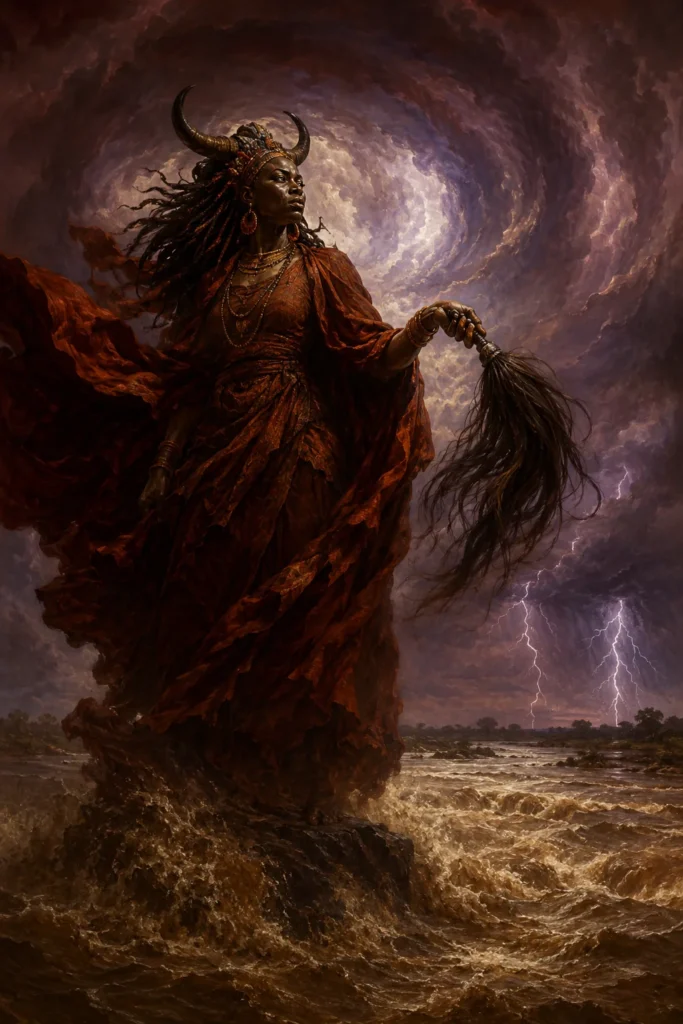
Appearance: brown and red, buffalo horns
Textual history
Period of the Texts
Oral Ifá tradition, whose verses were only recorded in writing through colonial and ethnographic work in the 19th/20th century.
Area of Diffusion
Yorubaland in south-western Nigeria along the Niger, along with the diaspora in Brazil and Cuba.
Sources
Good: Ifá verses, field research and the monograph by Judith Gleason.
Name and variants
Yoruba: The name roughly means she tore; the epithet Iyansan refers to the nine tributaries of the Niger.
Buffalo Horns, Lightning and Marketplace
Appearance
Brown and dark red, in Candomblé mainly red; her number is nine, her symbol the buffalo horns.
Effect
She acts through storm and whirlwind and keeps watch at the threshold of death.
Profile: Oya
The most important points at a glance.
Yoruba religion; worshipped in Brazil as Iansã and in Cuba within Santería.
Storm, wind and the passage of the dead, linked to the Egungun masquerade.
A powerful figure in brown and red, with buffalo horns and distant flashes of lightning.
Forces sudden change; mistress of shifting market fortunes.
Offerings, music and dance in brown and red, linked to ancestor veneration.
Married Three Times: Ogun, Shango, Oko
Oya originates from the oral Ifá tradition of the Yoruba, recorded in writing only late. As patroness of the Niger, she bears the epithet Iyansan: nine tributaries, nine children.
In myth, she was married three times, to Ogun, Shango and Oko; from Shango she took the lightning.
From Odù Narrative to World Literature
Oya is a fixed part of Candomblé, worshipped there as Iansã, and of Santería, where she is identified with Saint Teresa of Ávila. Gleason’s 1987 monograph made her widely known.
In religious studies, she illustrates the Orisha concept: a natural force and an ancestor-mediating deity at once.
Worship Rather Than Warding Off
The traditional approach to Oya is one of worship, not warding off: offerings, music and dance, together with an amulet as a sign of her support. Incense honours the deity, and bells call her in the cult. Characteristic are brown and red, the number nine and ancestor worship.
Storm and Guidance of the Dead in Comparison
Frequently Asked Questions about Oya
Why is Oya called mother of nine?
Iyansan refers to the nine tributaries of the Niger and to nine children, and is also her sacred number.
Why is Oya regarded as a deity of the dead?
She keeps watch at the threshold between life and death, linked to the Egungun masquerade.
Literature (selection)
More in the bibliography.
Speaking of Oya the Orisha means the goddess of the Niger: mistress of the storms, who guides the departed at the threshold of death.