Ceridwen, Welsh mythological figure or goddess of inspiration
By Ralf Ittermann · last reviewed on
Ceridwen, also Cerridwen, is a central figure of Welsh mythology and is described in the medieval tradition as mistress of the cauldron of inspiration.
Her tale stands at the heart of the “Hanes Taliesin”, the life story of the legendary Welsh poet Taliesin, whose oldest fragmentary attestations reach back to the 9th century, although its complete version survives only in early modern manuscripts.
Table of Contents
Sources and literary tradition
The most important source for Ceridwen is the “Hanes Taliesin”, which survives in complete form in Elis Gruffydd in the 16th century and in John Jones in the “Llanstephan Manuscripts”. Fragments that point to a markedly older tradition are found in the “Book of Taliesin” and the “Book of Aneirin”, from the 14th and the 13th century respectively.
In “The Mabinogi and Other Medieval Welsh Tales” (1977), Patrick K. Ford worked through the text-historical complexity of the Ceridwen tradition and showed that the central tale of the cauldron transformation exists in several Welsh and Breton variants.
In her studies of the “Book of Taliesin”, Marged Haycock pointed out that many of the poems attributed to Taliesin arose only in the 9th to 12th centuries, whereas the narrative around Ceridwen contains literarily older layers. Scholarship thus faces the typical problem of reconstructing a possibly ancient mythic substance from an early modern textual form.
The tale of the cauldron
The central tale relates: Ceridwen lives with her husband Tegid Foel by the lake Llyn Tegid (today Bala Lake in Gwynedd) and has two children, the beautiful Creirwy and the ugly Morfran (also Afagddu).
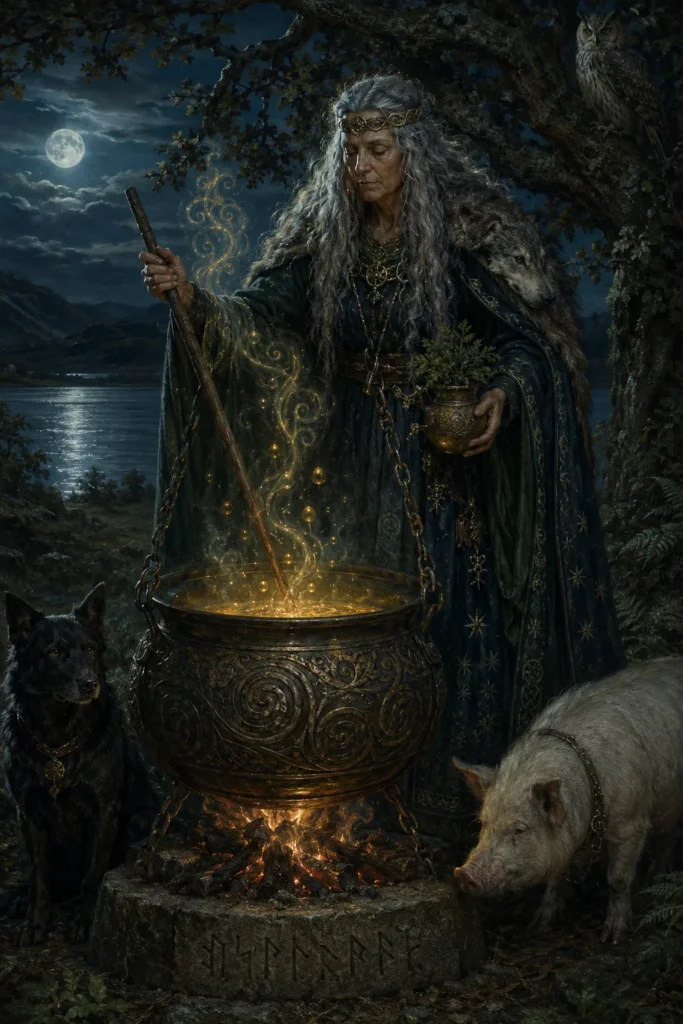
To endow Morfran, despite his unlovely appearance, with wisdom and inspiration, Ceridwen brews a special potion in the cauldron of inspiration (“pair awen”). The potion must simmer for a year and a day, and only the first three drops possess the magical effect; the rest is deadly poison.
The boy Gwion Bach tends the cauldron. While stirring, three drops splash onto his thumb, which he instinctively puts into his mouth. Instantly he gains the comprehensive knowledge that was actually intended for Morfran. Terrified, he flees, and the cauldron shatters.
Ceridwen pursues him through a series of transformations: Gwion becomes a hare, she a hound, he a fish, she an otter, he a bird, she a hawk, he a grain of corn, she a hen that swallows the grain.
Nine months later she gives birth to the child Taliesin, whom she casts into the sea in a leather bag, where the young prince Elphin finds and raises him.
Symbolism of the cauldron
The cauldron of Ceridwen belongs to the most significant symbols of the Welsh tradition. It stands in a line with other miracle-working cauldrons, such as the cauldron of Bran in the “Mabinogi”, which revives the dead, or the cauldron of the Dagda in the Irish tradition, which dispenses immeasurable food.
In “Kelten” (1997), Helmut Birkhan identified the cauldron as a central sacral object of Celtic religion, made concretely tangible in archaeological finds such as the Gundestrup cauldron and the cauldrons of Brå and Rynkeby.
In “The Quest for the Shaman” (2005), Miranda Aldhouse-Green considered the possibility that the cauldron symbolism goes back to shamanic rites of inspiration and initiation, in which an ingredient in liquid form was connected with the attainment of extraordinary knowledge.
This hypothesis remains speculative, but it is motivated by the frequency of the cauldron motif in Celtic visual art and narrative tradition.
Ceridwen as a goddess?
Whether Ceridwen was originally a goddess is contested in scholarship. The “Hanes Taliesin” presents her as a powerful enchantress, without explicitly designating her as a goddess.
In “Die Religion der Kelten” (2001), Bernhard Maier classifies her rather as a literarily formed figure who unites in herself the qualities of older deities of inspiration and transformation. John T. Koch, by contrast, has argued in several essays for an identification with an ancient Welsh goddess of poetry and transformation.
There is no Gallo-Roman goddess of inspiration attested by name, but the inscriptions to Sirona, Belisama and Brigantia show the existence of female local deities with competences of inspiration and healing. The structural closeness to the Irish Brigid, who among other things rules over poetry, was worked out early by Marie-Louise Sjoestedt.
She rejects a direct identification, however. The present majority opinion sees Ceridwen as a literarily shaped mythic figure in which older mythic substance resonates, without a closed “religion of Ceridwen” being reconstructable.
Ceridwen and Taliesin
The rebirth of Gwion Bach as Taliesin connects the Ceridwen tradition with the historically tangible Taliesin, a Welsh court poet of the 6th century to whom the “Book of Taliesin” attributes part of his poems.
In the later tales, Taliesin becomes the archetypal figure of the inspired poet, who knows all ages and transformations. His famous autobiographical poems (“I was at the creation of the world”; “I was a blue salmon”) presuppose the experiences of the mythic pursuit by Ceridwen.
Ceridwen thus has a double function: she is at once the pursuer and the bearer of the poet. Marged Haycock interpreted this aspect as a model of an initiatory mother figure who, through her pursuit, first brings forth the later skill of the initiate at all.
Ceridwen thereby belongs to the typological line of teachers and antagonists such as the Irish Scáthach, who trains Cúchulainn, or the Norse Gunnlöd, who guards the mead of poetry.
Llyn Tegid and the landscape connection
The lake Llyn Tegid (Bala Lake) in the northwest of Wales is the principal setting of the Ceridwen tale. At 6 kilometres in length, it is the largest natural lake in Wales and has, since antiquity, been connected with numerous legends.
The medieval texts present it as the dwelling place of Tegid Foel, whose name means “Tegid the Bald” and could point to an older lake deity. The connection of Ceridwen with the lake places her within the linking of female figures with standing water that is typical of Celtic mythology.
In his studies of Welsh toponymy, Brynley Roberts pointed to the possibility that the lake originally served as a sanctuary at which rites of inspiration and initiation took place. Archaeological evidence is lacking, but the density of the legends connected with Llyn Tegid supports the assumption of an ancient sacral significance.
Reception and modern reshaping
In Welsh Romanticism of the 18th and 19th centuries, Ceridwen experienced a literary renaissance, above all through Iolo Morganwg (Edward Williams), who invented a large part of the modern “Celtic” bardic tradition and presented Ceridwen as the supreme goddess of the Welsh druids.
This reconstruction is today recognized as a 19th-century invention, but it has lastingly shaped the public image of Ceridwen. In “Blood and Mistletoe” (2009), Ronald Hutton worked through this history of reception in a differentiated way.
In the modern neo-pagan tradition, above all in the Welsh-inflected druidry current and in the Wicca movement, Ceridwen is a central goddess of inspiration and witchcraft. Her cauldron is regarded as a symbol of transformation, creative insight and female power.
This modern reception rests less on the medieval texts than on the image of the druids created by Iolo Morganwg and his successors. A direct line to pre-Christian Welsh religion is not attested, as Bernhard Maier and Ronald Hutton have repeatedly emphasized.
Awen as a central concept
Closely connected with Ceridwen is the term awen, which in the Welsh tradition denotes the “divine inspiration” that makes a poet into a perfect bardd. The term already appears in the early Taliesin poems and is discussed in the medieval bardic school as an indispensable quality of poetry.
The three drops from Ceridwen’s cauldron are understood in the texts as a material manifestation of the awen, which here appears not as an abstract quality but as a physically transmissible substance.
In “Religion and Literature in Western England, 600-800” (1990), Patrick Sims-Williams showed that the conception of awen was deeply rooted in Celtic-Christian transitional forms in both the Welsh and the Irish tradition.
The Ceridwen tale is regarded as its most important mythic condensation in the Welsh sphere. The later Welsh bardic school, in particular within the milieu of the Eisteddfod tradition, preserved awen as a fundamental concept, though without the immediate mythic binding to Ceridwen.
Manuscript transmission of the Hanes Taliesin
The most important source for Ceridwen is the “Ystoria Taliesin” or “Hanes Taliesin”.
It is not contained in the oldest Welsh collective manuscripts, the “Llyfr Aneirin” and the “Llyfr Taliesin” of the 13th and 14th centuries, but survives only in a prose narrative form, whose oldest complete textual witness is the manuscript “NLW MS 5276D” (also the “Elis Gruffydd Chronicle”, mid-16th century).
In “Ystoria Taliesin” (Cardiff 1992), Patrick Ford reconstructed the editorial history and showed that the tale is markedly older in oral tradition, yet in its literary form exhibits early-modern layerings.
The edition with English translation first appeared in the “Mabinogion” volumes of Lady Charlotte Guest (1838 to 1849), who incorporated the text as an appendix into the Mabinogi canon.
In “Legendary Poems from the Book of Taliesin” (Aberystwyth 2007, and second edition 2015), Marged Haycock philologically opened up the so-called “legendary” poems contained in the oldest Taliesin manuscripts and shows that the figure of Ceridwen is named there several times as “peiryanvic ceridwen”, the “battling Ceridwen”, or as keeper of the cauldron (“peir ceridwen”), without a narrative episode being unfolded.
These brief references are the oldest dense textual witnesses for the figure and probably date to the 9th to 11th centuries. They show that the cauldron complex is markedly older than the elaborated narrative of the early-modern prose.
Awen, inspiration and bardic culture
The substance central to the Ceridwen tale, the three drops from the cauldron of inspiration, is designated in the Welsh original as “awen”. The term is linguistically connectable to the root *au- “to blow, to breathe” and means literally “inspiration”, “divine breath”.
In the “Cyfraith Hywel Dda” (“Laws of Hywel Dda”, manuscripts from the 12th century onward), “awen” is already attested as a technical term of the court poets (pencerdd).
The Welsh poet Iolo Goch (14th century), who was court poet to Owain Glyndŵr, refers in several poems to “awen Ceridwen” as the source of his poetic power.
Iolo Morganwg (Edward Williams, 1747 to 1826) transferred this line into a neo-druidic context in the 18th and early 19th centuries and, in “Barddas”, connected the awen symbolism with the graphic sign of three rays, which lives on in today’s Eisteddfod tradition.
In “Celtic Culture. A Historical Encyclopedia” (Santa Barbara 2006) and in his essays on Welsh bardic culture, John T. Koch emphasized that the conception of awen fulfilled a technical function both in medieval bardic training and in the later Eisteddfod regulations: it served as a self-legitimation of the professional poets, enabling them to present their art as divinely conferred rather than merely learned.
The Ceridwen tale, with its alternation between laborious preparation over a year and the sudden inspiration through the three drops, codifies this double aspect of the bardic art in literary form.
The transformation motif in comparative perspective
The pursuit between Ceridwen and Gwion belongs to a widespread narrative motif known as the “transformation contest”.
Comparable sequences are found in the Greek tradition (the pursuit of Nemesis by Zeus, Apollo and Daphne), in the Celtic sphere (the pursuit of Étaín in “Tochmarc Étaíne”), in the Norse Edda (Loki and Heimdallr) and in the Scottish folk tradition.
Stith Thompson catalogued this motif under D610 in his “Motif-Index of Folk-Literature” as a universal narrative pattern.
Within the Celtic tradition the sequence is especially elaborate, because it contains not only a drama of pursuit but also a teacher-pupil relationship and a bearer-child relationship.
John Carey interpreted this multilayeredness as a pointer to an archaic initiation structure, in which the initiate is symbolically swallowed by the teacher and reborn. A direct ritual attestation of this practice is lacking, but the motif can be made plausible from numerous comparative examples in the study of religion.