Idun, Goddess of Youth and the Golden Apples
By Ralf Ittermann · last reviewed on
Idun (Old Norse Iðunn) is the goddess of the apples of rejuvenation in the Germanic pantheon. In her basket she keeps the apples that preserve youth and vitality for the gods.
Without Idun’s apples, the Aesir age and become subject to death. Her abduction by the giant Thiazi and her recovery by Loki belong to the classic episodes of Norse mythology. Idun is regarded as the wife of Bragi, the god of poetry.
Profile: Idun
Idun: the most important aspects at a glance. The following fields summarise origin, function, appearance, veneration, symbols and parallels.
Germanic goddess and Asynje, wife of Bragi, the god of poetry. Her origin is unclear; Snorri calls her a daughter of the dwarf Ivaldi. Her name is often interpreted as “the one who rejuvenates again”. The oldest attestation of the apple myth is the “Haustlong” of Thjodolfr of Hvin (c. 900).
Idun keeps the apples that preserve the gods’ youth and vitality. Without them the Aesir age and are exposed to death. As an indispensable provider, Idun secures the vitality of the entire pantheon; after her abduction by the giant Thjazi, Loki brings her back.
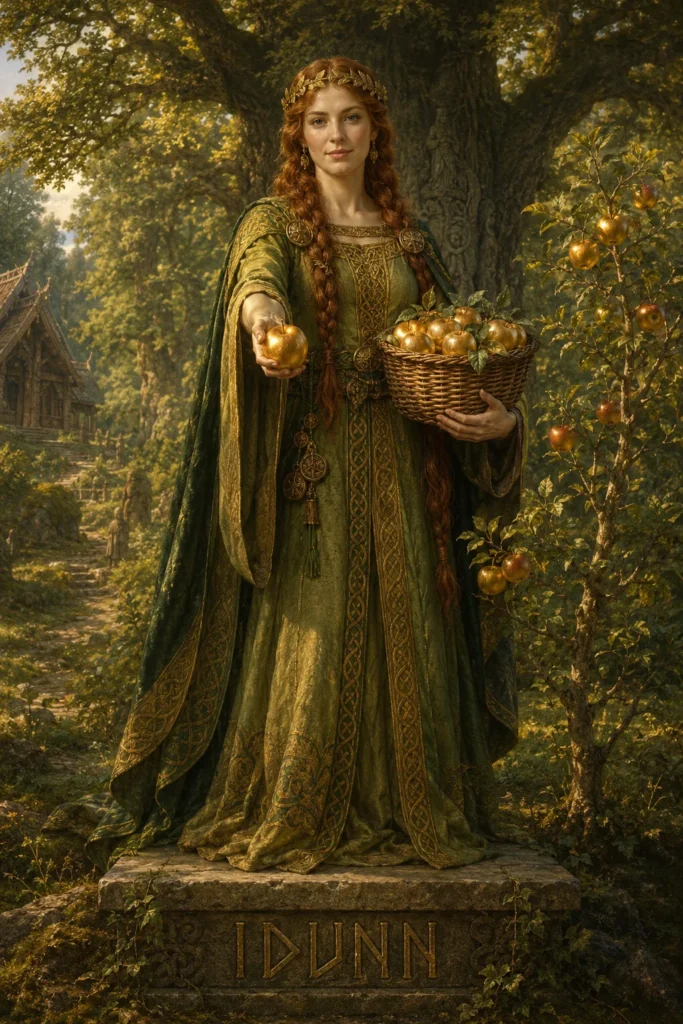
In the visual art of Nordic Romanticism the typical depiction shows Idun with a basket full of golden apples, often surrounded by Aesir reaching for the fruit. Her usual appearance is not described in the Eddic sources.
Independent evidence of cult is largely lacking: there are no temple or festival reports, and the name is not clearly represented in place names. Idun is therefore regarded primarily as a mythic function within the Aesir pantheon. In skaldic poetry her name serves as a circumlocution for women.
The central symbol is the apples, which later tradition depicts as golden apples. They lie in an ash-wood box or basket; the ash is linked with the world tree Yggdrasil. In Scandinavian folk tradition apples are regarded as a symbol of fertility and long life.
Parallels exist to soma and amrita of the Vedic tradition as well as to nectar and ambrosia of the Greeks, further to Hebe, who hands the gods nectar, and to Indian apsarases, who serve soma. Georges Dumézil read Idun as the Nordic sister of Sarasvati and Hebe, a thesis now regarded in a more nuanced way.
Myth and Origin
In the «Prose Edda» (Gylfaginning 26 and Skaldskaparmal 1), Snorri Sturluson names Idun as one of the goddesses who keeps apples in an ashwood box, from which the Aesir eat when they grow old. By this they all become young again.
Her name Iðunn has been interpreted etymologically in various ways. A widespread etymology relates it to id («again») and unna («to love, to grant»), thus «the one who grants again» or «the one who renews again». Rudolf Simek favours this reading in his «Lexikon der germanischen Mythologie» (3rd ed. 2006).
Idun’s origin is genealogically unclear. Snorri calls her the daughter of the dwarf Ivaldi, which places her in a connection with the dwarven world. Other sources see her as one of the goddesses without a traceable genealogy.
This uncertainty has led research from Jan de Vries to Margaret Clunies Ross to the assumption that Idun is an old vegetative deity whose original myth revolves primarily around the apples and the motif of rejuvenation, less around an elaborated genealogy.
By way of comparison, Indo-European mythology offers several parallels to fruits or drinks that grant immortality: Soma and Amrita in the Vedic tradition, nectar and ambrosia among the Greeks, the water of life in many Indo-European traditions.
In «Le festin d’immortalite» (1924), Georges Dumezil advanced the thesis that all these notions go back to a common Indo-European heritage. Idun’s apples are the Norse expression of this motif.
The source situation for Idun is thin compared with goddesses such as Freyja or Frigg, yet the «Haustlong» of Thjodolfr of Hvini (around 900) offers the oldest literary attestation of the apple myth and is therefore of great importance. The poem is a shield poem describing the images on a decorated shield.
One of these images shows Idun’s abduction by Thiazi. The detailed description of this image in skaldic high form shows that the myth was not only known in the late ninth and early tenth century but also widely represented iconographically.
Snorri Sturluson’s «Skaldskaparmal» 1 expands the «Haustlong» material with narrative details that were not present in the older skaldic layer. Since Eugen Mogk (1923), research has debated whether Snorri had a complete narrative that he paraphrased, or whether he constructed his own narrative on the basis of the shield poem.
Andy Orchard, John Lindow and Margaret Clunies Ross tend toward the assumption that Snorri had at his disposal an elaborated narrative tradition that has since been lost.
Symbols and Attributes
Idun’s outstanding attribute is the apples. Snorri does not describe them in detail, but the later tradition depicts them as golden apples.
In the «Haustlong» of Thjodolfr of Hvini (around 900), the apples are called «the old remedy of the Aesir against age». This skaldic poem is the oldest literary attestation of the Idun myth and therefore of great importance for the study of myth.
The ashwood box or basket in which Idun keeps the apples also has symbolic meaning. The ash is connected with the world ash Yggdrasil and thus provides a cosmological anchoring of the rejuvenation motif. The apples themselves are regarded in Scandinavian folk tradition as a symbol of fertility and long life.
Idun’s ordinary form is not described in detail in the Eddic sources. In the abduction episode Loki transforms her into a nut and himself wears Freyja’s falcon cloak, which establishes a connection to transformation notions of a shamanistic character.
This bird metamorphosis has parallels in numerous traditions within comparative religious studies, for instance the Greek tradition of Aithon, who is turned into a bird.
Cult and Veneration
Independent cultic evidence for Idun is largely lacking. There are no temple or festival reports. Her name is not clearly represented in place names. This thin evidence has led research to read Idun primarily as a mythical function within the pantheon of the Aesir, less as an independent cult goddess.
Folk reflexes of apple rejuvenation, however, are found in abundance. In the fairy tales of Scandinavia and Germany, the apple appears as an emblem of immortality, rejuvenation or knowledge.
In «Deutsche Mythologie» (1835), Jacob Grimm collected numerous such traces, for instance the Danish custom of offering a divided apple between bride and groom on the wedding day as a symbol of a shared lifespan.
In the Icelandic sagas, Idun appears not as a cult goddess but only in mythical digressions, above all in Snorri’s «Skaldskaparmal». Her name serves in skaldic poetry as a kenning for women («gold-ring Idun», «mead Idun»).
This poetic function overlays the cultic trace and partly explains why Idun is more present in the literary tradition than in religious practice.
Important Myths
The principal myth is Idun’s abduction by Thiazi. Snorri recounts in «Skaldskaparmal» 1: Odin, Hoenir and Loki travel over mountains and wastelands. They want to roast an ox, but the meat will not cook.
An eagle high in an oak reveals itself: it is the giant Thiazi in bird shape. He demands his share. Loki strikes at him, but the eagle carries Loki off on a pole. Loki must promise to bring him Idun and her apples.
Back in Asgard, Loki lures Idun out of Asgard by telling her of more wondrous apples in the forest. Thiazi seizes her and takes her to Thrymheim. The Aesir grow old. They compel Loki to bring Idun back.
Loki borrows Freyja’s falcon cloak, flies to Thrymheim, transforms Idun into a nut and brings her back. Thiazi follows in eagle shape, but the Aesir kindle a fire at the wall of Asgard that burns Thiazi’s plumage. He falls and is slain. Skadi, his daughter, comes to Asgard to demand satisfaction.
This myth is already attested in elaborated form in the «Haustlong» of Thjodolfr (around 900), which secures its great age.
It is one of the few mythical episodes preserved almost completely in a skaldic composition before 1000. The structural composition (loss, search, recovery, destruction of the adversary) corresponds to an old narrative pattern that also occurs in other Indo-European traditions.
The second myth is Idun’s appearance in «Lokasenna» 17-18. Here Loki mocks Idun as the «most man-craving of all women» because she had laid her own arms around the slayer of her brother.
This dark allusion is taken up in no other source text. Klaus von See interprets it as a lost or invented myth that connects Idun’s brother with an incident not specified further. The passage remains enigmatic.
A third episode is preserved by the Eddic poem «Hrafnagaldr Odins» («Odin’s Raven Magic»), whose authenticity is disputed. Here Idun dreams a dream of doom and falls from the world ash.
In her edition (2011), Annette Lassen has shown that the poem probably dates from the sixteenth or seventeenth century and does not belong to the classical Eddic layer. Nevertheless, it offers an insight into the late reception of the Idun material.
The abduction of Idun is a classic example of the mythic pattern of loss and recovery of the fullness of life. Gods and Aesir are exposed to aging without the goddess and her apples.
This mythic constellation has numerous parallels in Indo-European and non-European traditions: Demeter’s withdrawal after the abduction of Persephone, solar eclipse as a consequence of the theft of the sun in numerous folk myths, Inanna’s descent to the underworld in Sumerian myth.
The structural constancy of these narrative patterns was first systematised by Vladimir Propp in «Morphology of the Folktale» (1928) and later generalised by myth researchers such as Joseph Campbell.
The myth also contains an element of moral critique: Loki is the cause, yet the Aesir persuade him through pressure to carry out the recovery. The trick by which Idun was handed over (the «more wondrous apples in the forest» of another place) is undone by a second trick (transformation into a nut).
This doubling of cunning is a typical trickster pattern. In «Trickster Makes This World» (1998), Lewis Hyde worked out the double function of the trickster as disruptor and resolver, and Loki is one of the most pointed examples of this figure.
Relationships within the Pantheon
Idun is the wife of Bragi, the god of poetry. Snorri names this connection in Gylfaginning 26 and Skaldskaparmal 1. Bragi is a late figure, probably hypostasised from the skaldic poet Bragi Boddason of the ninth century. The Idun-Bragi connection is therefore probably a literary construction of the late Viking Age.
Idun stands in an ambivalent relationship to Loki. Loki is the instrument of her abduction and of her recovery.
This ambivalent role of Loki as the cause and the resolver of the problem is a recurring pattern: it is similar in the building of the wall of Asgard, the mistletoe killing of Baldr, the theft of Sif’s hair. Loki brings about crises and resolves them.
Toward the other Aesir, Idun acts as an indispensable provider. Without her apples the entire pantheon ages. This dependence of the gods on a single goddess is mythologically remarkable and underscores Idun’s cosmic function.
In «Prolonged Echoes» (1994), Margaret Clunies Ross interpreted this dependence as a structural element of Eddic mythology: the pantheon is not self-sufficient but reliant on mediators such as Idun, Freyja and Frigg.
Reception and Influence
In medieval Icelandic literature, Idun is present above all through the «Skaldskaparmal». Skaldic kennings such as «the Aesir’s noble Idun» (Bragi’s goddess) or «old apple Idun» serve as circumlocutions for women. In the thirteenth and fourteenth centuries the specific mythological function increasingly receded into the background, while the literary presence remained.
In the nineteenth century, Idun became popular in Nordic Romanticism. Adam Oehlenschläger took her up in several works, including «Nordens Guder» (1819). In Sweden, a group of national-romantic writers founded the Gothic League in 1811, devoted to the cultivation of Norse mythology. Its journal «Iduna» appeared from 1811 to 1824. Esaias Tegner was among its members.
In the visual art of Nordic Romanticism, too, Idun is depicted several times, for instance by the Swedish painter Nils Blommer («Idun», 1850) and the Norwegian painter Peter Nicolai Arbo. The typical depiction shows Idun with her basket full of golden apples, often surrounded by the Aesir reaching for the fruit.
In modern reception, Idun appears in novels, comics and films, mostly as a secondary figure. What remains scientifically relevant is above all the position of the apple myth in comparative religious studies, as the Norse expression of the universal motif of the fruit that grants immortality.
Religious-Studies Classification
Idun belongs to the type of vegetative deities who secure the vitality of the pantheon. Comparative religious studies, represented for instance by Mircea Eliade in «Patterns in Comparative Religion» (1958), places her in the circle of mediators who grant immortality.
Parallels exist with Hebe in Greek mythology, who hands nectar to the gods, and with the Indian apsaras, who serve Soma.
In «Le festin d’immortalite» (1924), Georges Dumezil read Idun as the Norse sister of the Vedic goddess Sarasvati and the Greek Hebe, a thesis that is judged more cautiously today.
The apples as the food of immortality are an old Indo-European motif, yet the specific expression of Idun as goddess of rejuvenation is a Germanic peculiarity.
From a folkloristic point of view, Idun belongs to the circle of fairy-tale figures who have command over the food of life and rejuvenation.
In their «Notes» to the «Children’s and Household Tales», the Brothers Grimm repeatedly referred to the Idun material in connection with tales such as «The Water of Life» (KHM 97) and «The Golden Bird» (KHM 57). This connection is typological, not genetic.
The typological classification of Idun as a goddess who grants immortality connects her with the Indian apsaras, the Greek Hebe and other female embodiments of the eternal food of life. This typological series was first systematically assembled by Georges Dumezil in «Le festin d’immortalite» (1924).
Research of recent decades, in particular by Edgar Polome and Jens Peter Schjodt, has refined the list with detailed critique: not all goddesses described as granting immortality are functionally identical, yet the basic pattern of the female mediator of divine vitality remains recognisable.
In Norse religious history, Idun is one of the few examples of a goddess characterised not primarily by sexual relationships or maternal functions but by an economic, provisioning function. She has no love stories in the sources, no prominent children, no political role.
Her significance lies in securing the generation of the gods through the apples. This specific profiling makes her an important corrective against the assumption that female divine figures in Norse mythology are fundamentally reduced to sexual and fertile functions.
Sources and Further Reading
Primary sources: «Prose Edda» (Snorri Sturluson, Gylfaginning 26 and Skaldskaparmal 1), «Lokasenna» and «Hrafnagaldr Odins» (Poetic Edda), «Haustlong» (Thjodolfr of Hvini, around 900). Skaldic texts in Finnur Jonsson «Den norsk-islandske Skjaldedigtning» (1912-15), edition of the «Haustlong» in Richard North «The Haustlong of Thjodolfr of Hvinir» (1997).
Secondary literature: Jan de Vries «Altgermanische Religionsgeschichte» (1956/57), Rudolf Simek «Lexikon der germanischen Mythologie» (3rd ed. 2006), Georges Dumezil «Le festin d’immortalite» (1924), Margaret Clunies Ross «Prolonged Echoes» (1994/98), Annette Lassen «Hrafnagaldur Odins» (2011), John Lindow «Norse Mythology» (2001), Régis Boyer «La religion des anciens Scandinaves» (1981), Klaus von See et al. «Kommentar zu den Liedern der Edda» (1997 ff.).