Freyr, Vanir God of Fertility
By Ralf Ittermann · last reviewed on
Freyr is a Vanir god of fertility, peace and the fortune of harvest, who enjoys high standing in Norse tradition. Freyr (also Frey) is one of the most important gods in the Germanic pantheon.
He comes from the lineage of the Vanir, came to Asgard as a hostage after the Vanir war, and is regarded as the god of fertility, peace, rain, harvest and prosperity.
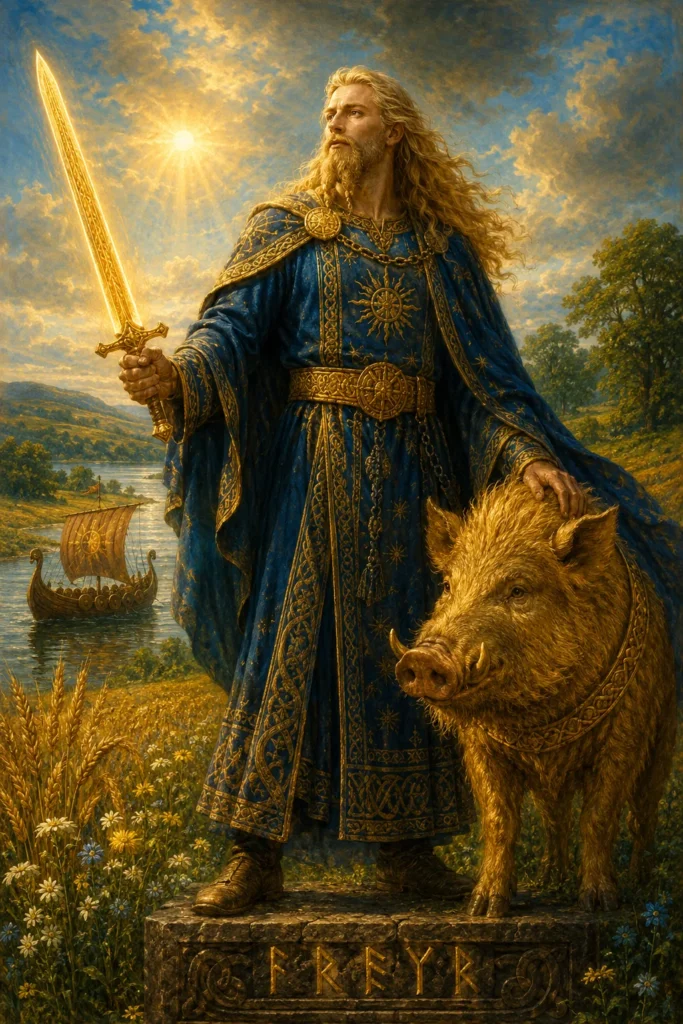
His seat is Alfheim, his ship Skidbladnir, his boar Gullinbursti. Adam of Bremen names him as Fricco alongside Thor and Wodan among the three principal gods of the temple of Uppsala.
In religious studies, Freyr is regarded as the central fertility deity of the North Germanic region, whose cult remained alive deep into the 11th century.
Profile: Freyr
Freyr: the most important aspects at a glance. The following fields summarise origin, function, appearance, veneration, symbols and parallels.
Vanir god, son of Njord and his nameless sister, brother of Freyja. He came to Asgard as a hostage after the Vanir war. His name means “lord” and is originally a title. Through his son Fjolnir the Swedish royal line of the Ynglings is regarded as descending from him.
According to Snorri, Freyr rules over rain, sunshine and the growth of the earth; people call on him for a good harvest and peace. He is regarded as god of fertility and prosperity and, through his ship Skidbladnir, also of seafaring.
Adam of Bremen describes the image of Fricco in the temple at Uppsala with an enormous phallus. The bronze statuette from Rällinge in Sweden shows a seated, bearded man with a clearly recognisable phallus and a pointed helmet.
Under the name Fricco, Freyr is one of the three principal gods of the temple at Uppsala. At Yule and at the Disablot he played a special role; at Yule people laid a hand on the boar’s back and swore oaths. Place names with the element Freyr are very numerous in Sweden and Norway.
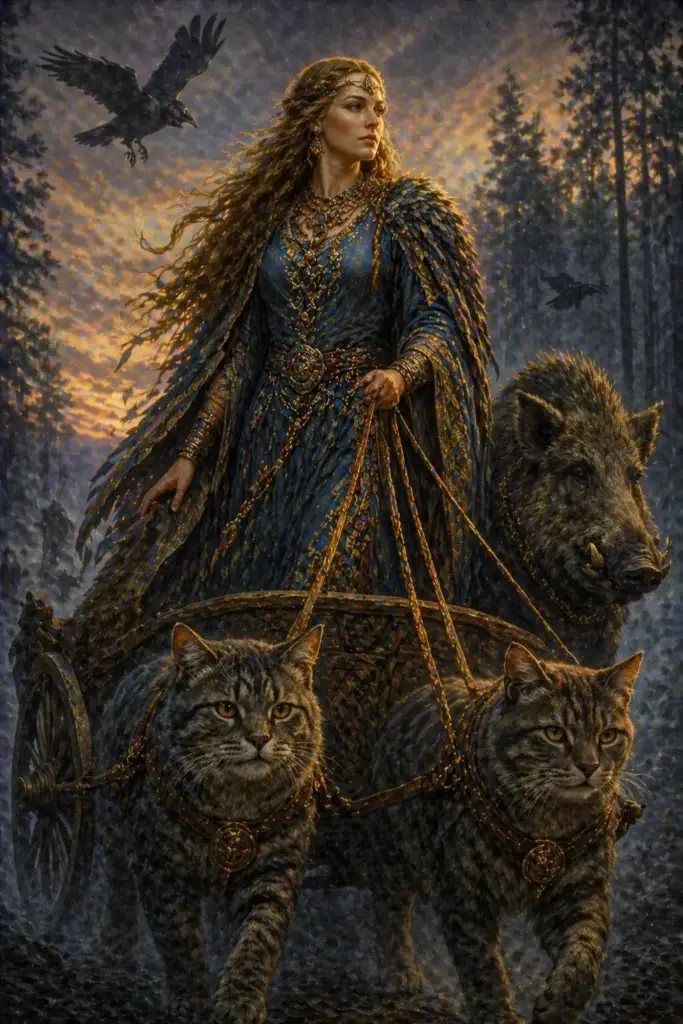
His boar Gullinbursti (“Golden Bristles”) runs through air and water and lights up the night with its brilliance. The ship Skidbladnir always has a fair wind and can be folded up like a cloth. To these are added his sword and his seat Alfheim, the “land of the elves”.
Freyr’s functions correspond typologically to the Celtic Cernunnos, the Indian Vasus and part of the Greek tradition around Demeter and Persephone. His phallic representation is comparable to depictions of Hermes in Greece and Priapus in Rome.
Myth and Origin
Snorri Sturluson introduces Freyr in the Prose Edda (Gylfaginning 24): “Freyr is the most glorious of the Aesir; he rules over rain and sunshine and the growth of the earth, and it is good to call upon him for good harvest and peace.
He also governs the prosperity of men.” This brief description captures the range of his functions: weather, agriculture, peace, material well-being.
The name Freyr literally means “lord” and was originally a title (comparable to the Latin dominus), not a personal name. This semantic fact shows that the true, old name of the figure was lost or replaced by the taboo word Freyr.
The same applies to Freyja, whose name means “lady”. Edgar Polome proposed in Essays on Germanic Religion (1989) that the originally nameless chief god of the Vanir lived on in the tradition under the title Freyr.
Freyr’s father is Njord, his mother Njord’s unnamed sister. Freyja is his sister; he is married to Gerd, the giantess whom he acquires by force.
The Ynglinga saga names Fjolnir, a semi-mythical king of the Swedish Ynglings, as Freyr’s son. Thus the Swedish royal house of the Ynglings is regarded as descended from Freyr.
Freyr is the Norse principal figure of male fertility, yet not simply a single-function deity. His narratives encompass weather regulation, sunshine, rain, agriculture, seafaring (through Skidbladnir) and peace.
This functional breadth has led scholarship to classify Freyr not as a pure third-function god, but as a complex composite figure whose profile comprehensively reflects the framework of well-being.
The titular character of the name Freyr (“lord”) has repeatedly prompted scholars to ask what the original name of this god may have been. Edgar Polome suspected in his essays a forbidden, tabooed name that was replaced by the title word.
This taboo thesis is linguistically plausible but empirically difficult to prove. Other scholars (Jan de Vries, Rudolf Simek) assume that Freyr and Freyja were title names from the outset, without an original personal name ever existing.
Symbols and Attributes
Freyr’s boar Gullinbursti (“Golden-bristle”) is described in detail in Snorri’s Skaldskaparmal. The dwarves Brokk and Eitri forged it from a pigskin. The boar can run through air and water, faster than any horse, and its radiance lights up the night.
The boar is more strongly linked with war and fertility in Norse symbolism than elsewhere. Beowulf, the Anglo-Saxon helmet of Sutton Hoo (England, 7th century) and numerous Scandinavian sword hilts show boar imagery.
His ship Skidbladnir, likewise made by dwarves, is the best of all ships. It always has a fair wind as soon as the sails are set, and can be folded up like a cloth and tucked into a pouch.
The ship is a symbol of his maritime powers (inherited from his father Njord) and of his practical, pragmatic function.
His sword is mentioned in the Skirnismal and in the Gylfaginning. It fights of its own accord when wise ones wield it. Freyr gives the sword to his servant Skirnir as a reward for the wooing of Gerd.
At Ragnarok, Freyr therefore falls against the fire giant Surt because he no longer has the sword. This detail is hinted at in Voluspa 53.
His seat Alfheim, literally “elf-land”, is named in Grimnismal 5 as a gift to Freyr at the cutting of his first tooth. This connection with the light elves (Liosalfar) has received various interpretations in scholarship.
Edgar Polome saw in it a link between fertility and ancestor cult; Rudolf Simek reads the passage as a sign of an old relationship of rule between Freyr and the elves.
Cult and Veneration
Adam of Bremen describes in the Gesta Hammaburgensis ecclesiae pontificum (around 1075) the temple of Uppsala with three divine images: Thor in the center, Wodan and Fricco on either side. Fricco is Freyr.
Adam reports that the image of Fricco was depicted with an enormous phallus. This phallic representation is supported by archaeological finds, such as the statuette of Rallinge (Sweden, 10th/11th century), a small bronze figure with a clearly recognizable phallus.
The Voluspa, the Ynglinga saga and several Icelandic sagas report on the Yule festival and the Disablot, in which Freyr played a special role. His boar Gullinbursti gave the Yule boar (sonargoltr) its name.
At Yule, the hand was solemnly laid on the boar’s back and oaths were sworn. This custom is described in detail in the Hervarar saga ok Heidreks (13th century, with older material).
Place names containing the Freyr element are extremely numerous in Sweden and Norway: Frysta, Frola, Frostad, Fryskos, Froshulf, alongside numerous toponyms with the element Frey-, Fro- and Freys-. Magnus Olsen collected around two hundred such toponyms in Hedenske kultminder (1915).
This dense trail underscores Freyr’s central cultic significance, above all in central Sweden and southeastern Norway.
The Flateyjarbok (end of the 14th century, with older material) reports a wagon journey of a Freyr statue through Sweden, accompanied by a priestess who was regarded as Freyr’s wife (gydja).
The journey ended with a fertility blessing of the fields. This account corresponds typologically to the Nerthus procession in Tacitus and shows the continuity of wandering fertility rituals across centuries.
Important Myths
The central myth is Freyr’s wooing of Gerd, the giantess. The Eddic poem Skirnismal recounts it in detail: Freyr secretly sits on Odin’s high seat Hlidskjalf, from which all worlds are visible. He sees Gerd in Jotunheim and is inflamed with love. Sick with longing, he sends his servant Skirnir to woo Gerd.
Skirnir rides on Freyr’s horse through fire-flames to Jotunheim. He offers Gerd eleven golden apples, then the ring Draupnir, and finally threatens her with the sword and a devastating curse. Gerd consents. She becomes Freyr’s wife. Freyr, however, has given away his sword and will have to face Surt at Ragnarok without a weapon.
In religious studies, the Skirnismal is one of the richest sources. Magnus Olsen, Ursula Dronke and John Lindow have read it as a marriage ritual that mythologically depicts the union of sun (Freyr) and earth (Gerd, from gardr “enclosed”).
The threat of the curse has been interpreted as a reflex of a ritual wooing sequence: Freyr-sun must soften the earth goddess through promises, gifts and threats in order to secure fertility.
The second myth is Freyr’s death at Ragnarok. The Voluspa 53 and Snorri’s Gylfaginning 51 report briefly: Freyr fights against Surt and falls. Snorri adds that Freyr fights without his sword and therefore loses.
This key scene shows that Freyr’s wooing of Gerd is not merely a love story but has cosmic consequences: by giving up the sword, Freyr seals his own eschatological downfall.
The third myth is Freyr’s role as forefather of the Ynglings. The Ynglingatal of Thjodolfr of Hvini (around 880) and the Ynglinga saga of Snorri Sturluson (around 1230) list the Swedish kings descending from Freyr (also called Yngvi-Freyr) through Fjolnir down to the historical kings of south-eastern Norway.
This genealogy is of high significance in the history of religion because it shows how a fertility god became the forefather of a historical dynasty.
The Skirnismal is one of the most important Eddic poems. It deals with Freyr’s wooing of Gerd, but beneath the narrative surface it offers a rich body of evidence for religious studies.
Skirnir’s threats with the curse (stanzas 26-36) belong to the genre of magical curses and contain terms that have parallels in runic magic and in Vedic incantation practice. Scholarship from Magnus Olsen through Anatoly Liberman to Ursula Dronke has evaluated these stanzas as precious material for the reconstruction of Norse cursing practice.
An alternative reading of the Skirnismal was put forward by Anatoly Liberman in In Prayer and Laughter (2016). Liberman sees in the poem a humorous, almost satirical depiction of a divine wooing process that mirrors the arrogant courtship practice of the Viking Age warriors.
This reading contrasts with the traditional sacral interpretation of Magnus Olsen and shows the multilayered nature of the Eddic texts.
Relationships in the Pantheon
Freyr is the son of Njord, brother of Freyja. With Gerd he is married according to Aesir custom; their son is Fjolnir, the first mythical Yngling king.
With Skirnir, his servant, there is a close relationship. Skirnir is his messenger, his wooer, his second self.
Some scholars (Magnus Olsen, Folke Strom) saw in Skirnir a hypostasis of Freyr himself, a second form of the figure of light. This reading is contested, yet the close connection between the two figures in the Skirnismal is striking.
Toward Odin and Thor, Freyr appears in the sources mostly as an equal principal god. The Voluspa, Grimnismal and the sagas often mention the three in the same breath.
Adam of Bremen’s triad Thor-Wodan-Fricco confirms this hierarchy for the final phase of the Viking Age. The Lokasenna 36-37 shows a dispute between Loki and Freyr, in which Loki mocks Freyr’s surrender of the sword.
Reception and Influence
In the Icelandic sagas, above all in the Hrafnkels saga Freysgoda (13th century), Freyr plays a central role. Hrafnkell is a Freyr-godi, a priest who consecrates a horse to the god. Whoever rides the horse is killed.
The saga tells of a conflict over this horse, in the course of which Hrafnkell loses his faith and turns his back on his god’s temple. This psychological conversion in the midst of a mythically colored narrative is among the most interesting documents of religious history in saga literature.
In folklore studies, the memory of Freyr lives on in the Yule boar. The Swedish custom of the Julgrisen (Yule boar, often woven from straw) remained alive in rural areas into the 19th century. The Norwegian custom of the Sonargoltr oath (swearing on the boar at Yule) has also survived in remnants.
In Norse Romanticism, Freyr was taken up by Adam Oehlenschlaeger and Esaias Tegner, yet remained behind Thor and Odin. Richard Wagner included him, as Froh, only in a minor role in the Ring of the Nibelung.
In the 20th century, Freyr gained significance in comparative religious studies, above all through Folke Strom’s Diser, nornor, valkyrjor (1954) and Edgar Polome’s essays.
Classification in Religious Studies
Freyr is the Norse principal expression of the third Indo-European function (fertility, economy, prosperity) according to Georges Dumezil’s classification. This classification is not undisputed in scholarship, since Freyr, because of his functional breadth, is not regarded as a pure third-function god. Freyr’s functions correspond typologically to the Celtic Cernunnos, the Indian Vasus and part of the Greek Demeter-Persephone tradition.
The close connection between Freyr and the historical Swedish dynasty of the Ynglings is remarkable in the history of religion.
Folke Strom showed in Nordisk hedendom (1961) that this connection probably goes back to an old sacral notion of kingship, in which the king was regarded as the embodiment of the land’s fertility. This sacral-kingship theory is contested in scholarship, but the case of the Ynglings is one of its strongest examples.
The phallic representation of Freyr at Uppsala and in the statuettes of Rallinge fits the image of a fertility god whose cult places male procreative power at its center.
Comparable are depictions of Hermes in Greece and Priapus in Rome. Mircea Eliade classified the phallus as a universal fertility symbol in Patterns in Comparative Religion (1958) and placed Freyr in this series.
The phallic representation of Freyr at Uppsala and in the statuettes of Rallinge is among the clearest iconographic evidence of a fertility deity in Germanic religious history. Adam of Bremen describes the Uppsala image with unusual directness: “cum ingenti priapo” (with a mighty phallus).
The bronze statuette of Rallinge (Sodermanland, Sweden, 10th/11th century, today in the Statens Historiska Museum Stockholm) shows a seated, bearded man with a clearly recognizable erect member and a pointed helmet.
This iconographic directness has repeatedly led to discussions in scholarship about cultic practice. Folke Strom advanced in Nordisk hedendom (1961) the thesis that Freyr’s fertility ritual contained real sexual components, such as ritual marriages or symbolic unions.
Adam of Bremen mentions in his description of the Uppsala temple chants during the sacrificial ceremonies that he found indecent. These indications suggest an ecstatic, bodily dimension of Freyr veneration that was largely lost in the Christian-influenced 13th century.
The scholarship of recent decades, above all through the archaeological investigations at Uppsala (Else Rosdahl, Anders Andren) and the phenomenological work of Jens Peter Schjodt, has refined the picture of Freyr.
He is not only a peasant god but also a royal god of the Ynglings, not only a lover but also a political embodiment of the Swedish dynasty. This complexity makes him one of the most multilayered divine figures in Norse religious history.
Sources and Further Reading
Primary sources: Prose Edda (Snorri Sturluson, Gylfaginning 24, Skirnismal paraphrase in Skaldskaparmal), Poetic Edda (Skirnismal, Grimnismal, Lokasenna, Voluspa), Ynglinga saga and Ynglingatal, Hrafnkels saga Freysgoda, Gesta Hammaburgensis (Adam of Bremen, around 1075), Flateyjarbok (end of the 14th century). Skaldic texts in Finnur Jonsson, Den norsk-islandske Skjaldedigtning (1912-15).
Secondary literature: Jan de Vries, Altgermanische Religionsgeschichte (1956/57), Rudolf Simek, Lexikon der germanischen mythology (3rd ed. 2006), Folke Strom, Nordisk hedendom (2nd ed. 1985) and Diser, nornor, valkyrjor (1954), Edgar Polome, Essays on Germanic Religion (1989), Anatoly Liberman, In Prayer and Laughter (2016, on Skirnismal), Magnus Olsen, Hedenske kultminder (1915), Ursula Dronke, Edda vol. 2 (1997, Skirnismal commentary), Jens Peter Schjodt, Initiation between Two Worlds (2008).