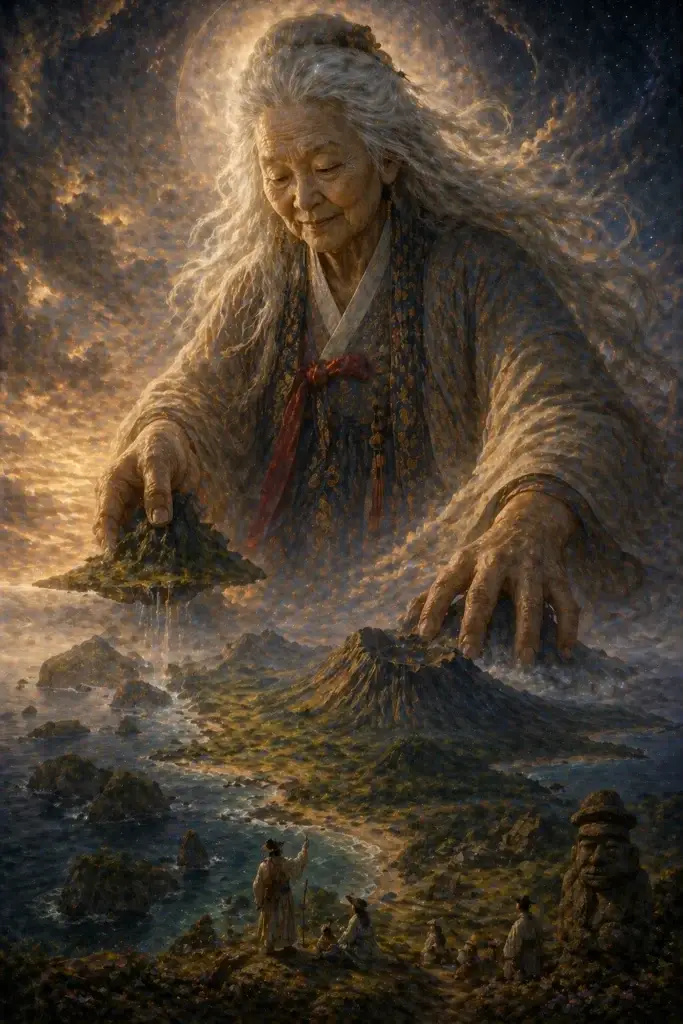
Yeomra, god of the Korean tradition
By Ralf Ittermann · last reviewed on
Yeomra (염라왕, Yeomra-wang, also Yomra) is the god of death and judge of the underworld in Korean mythology, influenced directly by the Indian figure Yama. He is portrayed as a powerful, sometimes stern judge who decides the fate of the dead.
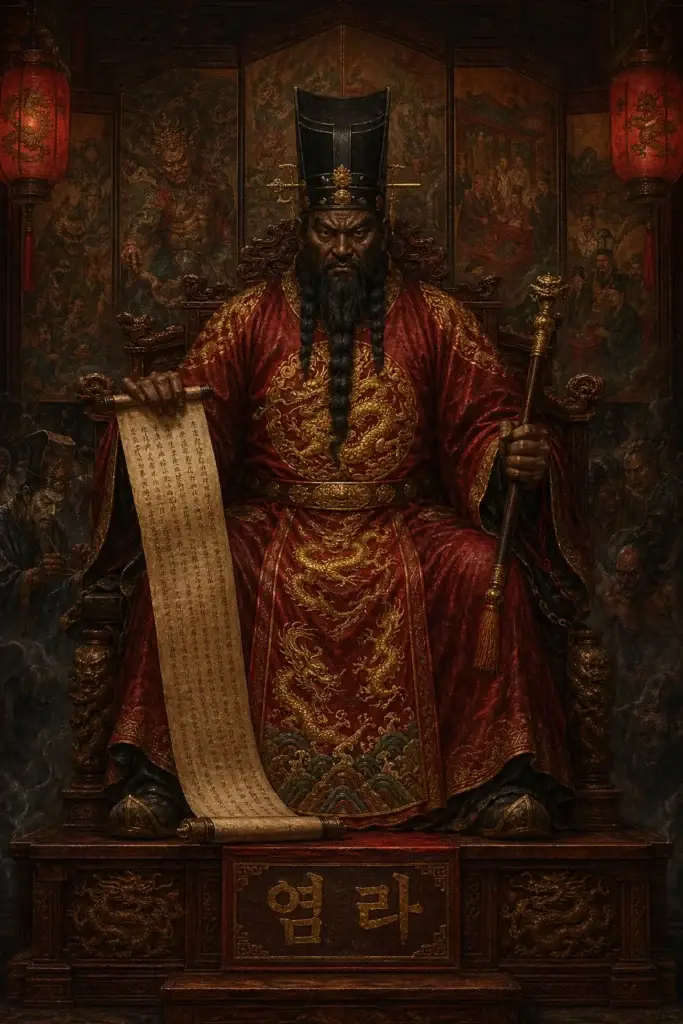
Yeomra
Yeomra is portrayed as a serious, authoritative god with judicial functions. He keeps records of the deeds of the living and determines their fate after death. In shamanic rituals Yeomra is invoked to guide the deceased and to settle supernatural matters.
His figure combines Indian death mythology (the Yama tradition via Buddhism) with Korean shamanism practice. In contrast to benevolent gods such as Samsin, Yeomra is ambivalent, respected and feared at the same time.
Brief profile: Yeomra
Yeomra is invoked in gut rituals (shamanic seances), but is less attested in classical sources than in ethnographic records on shamanism. His figure was brought to Korea through the spread of Buddhism (cosmology of the beyond, cosmology).
James H. Grayson documents Yeomra in the context of Korean syncretistic Buddhism. Kim Tae-gon and other ethnologists report active Yeomra rituals in mourning and spirit-appeasement ceremonies up into the 20th century.
Historical classification
Period of the texts
Yeomra is mentioned explicitly in Korean text collections from the 9th century onwards, with direct parallels to the Indian Yamaraja and the Chinese Yanluo Wang. His presence in Korean spirituality is probably older, but definitely reaches back to the Buddhist canonizations of the 11th century.
The Korean interpretation has taken on syncretistic features: Buddhist characteristics (administration of karma) are mixed with Daoist elements (administration of fate). The written tradition is consistent: Yeomra is continuously the central figure of underworld administration.
Mythological classification
Yeomra (염라, “King of Hell”) is the Korean god of death and the underworld, analogous to the Chinese Yanluo and the Japanese Enma. He exists in Korean traditions that were influenced by Buddhism and Daoism. His genealogy connects Buddhist and Daoist concepts of the underworld and of death.
Area of distribution
Yeomra was venerated across the entire Korean peninsula, with particular intensity in regions with a strong Buddhist influence. His depictions are found in most of the larger Korean Buddhist temples.
The veneration is not spatially concentrated but universal: everyone who dies comes before Yeomra. His places of cult are therefore not specific physical locations but rather metaphysical: the underworld itself, accessible only through death.
State of the sources
Yeomra is present less in Korean primary sources such as the Samguk yusa than as an adaptation of the Indian Yama figure, which came to Korea via Buddhist texts (Sukhavati narratives, Jataka stories) and Chinese reworkings.
Buddhist sutras, especially those on the beyond and on the jurisdiction of karma, are indirect sources. In the history of religion, Yeomra is understood as a product of syncretism: Indian origin, Buddhist transmission, Korean adaptation. Ethnographic studies (Kim Tae-gon, late 20th century) document active cults.
Name
Yeomra is portrayed as a tall, serious man, often with a stern, almost angry facial expression. His body is muscular and powerful, but not animalistic or fantastical: he is human, yet awe-inspiring in his presence. He sits on a highly elevated throne, elaborately carved and adorned with royal ornaments.
In his two hands he holds two central insignia: on the right side a rod of discipline or staff of judgment, on the left a large writing tablet or an unrolled scroll on which all the deeds of the living and the dead are listed.
His robes are dark red or dark violet, the royal colors of the underworld. Sometimes he is depicted with several arms, to represent his manifold capacity to judge many souls simultaneously. The background is typically the dim realm beneath the earth, with stylized mountains or underworld architecture.
Characteristics
Yeomra is the central figure of a universal system of judgment. After death a soul is led through the underworld and finally brought before Yeomra.
There a presentation takes place: the deeds of life are recited (sometimes through documents, sometimes through direct recollection), and Yeomra renders judgment. The judgment is not individual but follows cosmic laws of karma: every action has a moral weight that Yeomra calculates precisely.
If the karma is positive, the soul is reincarnated into higher forms of life (possibly again as a human, but in better circumstances). If negative, it is sent to lower realms, possibly as an animal, possibly into hell regions with various torments, depending on the gravity of the sins.
Yeomra is not venerated through regular prayers like other deities. Instead, he is respected through moral conduct in life.
When someone dies, prayers to Yeomra are in fact not addressed to him directly but rather offered on behalf of the deceased soul: one prays that Yeomra will be merciful, that he will recognize the good deeds and that they will outweigh the bad.
In modern Korean mourning rituals, special sutras are recited to support the deceased soul before Yeomra.
Appearance and symbolism
Yeomra is portrayed as a serious, majestic ruler with robe and crown. He sits on a throne in the underworld. His attributes are a scepter (symbol of power) and a book of deeds (where all actions are recorded). He is stern but just. His color is red or black.
Profile: Yeomra
The Profile treats Yeomra in six aspects: his mythological origin from Indian and Buddhist tradition, the believers and occasions of his veneration (mourning, guidance of the dead), his iconography and attributes, his role in protection against evil spirits and parallels in related religions. These dimensions show his position within the religious system of the beyond.
Yeomra is located geographically in the underworld or an otherworldly realm, not on the earthly world. His cultural origin is Indian (Yama), transmitted through Buddhism. The adoption into Korea probably occurred from the 4th to 5th century onwards with the spread of Buddhism.
His Korean form is syncretistic, connecting with indigenous shamanism conceptions of the realm of the dead. In the history of religion, Yeomra is a case of the acculturation of foreign mythology into local religious systems.
Yeomra was invoked primarily by the bereaved and surviving relatives to guide deceased family members into the underworld. Shamans invoked Yeomra during ceremonies to appease the dead (Saenam-Gut). The social setting was private and familial in mourning, institutionalized in temple rituals and memorial services.
In modernized Korea everyday veneration declined, but Buddhist temples preserve Yeomra rituals for the deceased. The veneration was less a plea for favor than a negotiation with an instance of power.
Yeomra is portrayed as a stern, bearded judge with crown or headdress, often in darker or formal garments. His attributes are the judge’s book (register of deeds), a staff or scepter, sometimes also chains or symbols of the underworld (fire, bones).
In temples he is shown with a serious or stern face. The colors are black, red (for fire/hell) and gold. The iconography is official and forbidding, in order to signal authority and incorruptibility.
Area of effect: Yeomra (also Yeongyok, Korean for Yama) is the judge of the underworld; he passes judgment on souls according to their life. He is not evil, but just and stern. In Korean folk tales he sits in his hell and examines the deeds of every deceased person.
This connects Buddhist cosmology with shamanistic conceptions of the beyond and some elements of Daoism. Yeomra is a figure onto which moral judgment is projected, in this life as well as beyond.
Yeomra is not evil, but feared and demands respect. Veneration takes place through rituals for the dead, the memorial meal (Jesa) and prayers for a good fate in the beyond. Shamans appeased Yeomra through gut rituals, especially when a spirit was restless or had died unnaturally.
There were no apotropaic protective rituals against Yeomra himself, but rituals for protection against evil spirits under Yeomra’s rule. The veneration was marked by respect, in order to appease Yeomra and not to anger him.
Comparable are other judges of the dead: Hades in the Greco-Roman tradition (ruler of the underworld), Osiris in Egyptian mythology (judge after death), and the Diyu kings in the Chinese cosmology of the beyond.
Common to all of them is power over the realm of the dead and the determination of the fate in the beyond according to ethical or fatalistic criteria.
Yeomra, parallels in other cultures
Yeomra is often compared with Indian Yama teachings, according to which the deeds of life (karma) determine the fate in the beyond. In Buddhist terms he is depicted in mandala worlds, enthroned over the realm of the dead.
In Korean shamanism practice, Yeomra is conceptualized as an incorruptible ruler whom one approaches with respect. In contrast to Western gods of the underworld, who are ambivalent, Yeomra is regarded as just, stern but fair according to cosmic law.
Jewish tradition
In Judaism there is no direct god of the dead as a judge like Yeomra. The god YHWH is judge of all, including the dead, but not specialized in a single realm of the dead.
Rabbinic Judaism knows the concept of Gehenna (a hell of purification), but it is not determined by a goddess or god with Yeomra’s judicial power.
Greco-Roman world
Hades is the ruler of the realm of the dead and functionally most similar to Yeomra. Hades, however, is not actively judging like Yeomra, but rather an administrator and guardian of the boundary.
Minos and the Erinyes are more active judges. The distinction: Hades is sovereign of the underworld, Yeomra is an actively judging judge with a concept of karma.
Mesopotamia
Nergal and Ereshkigal are deities of the realm of the dead, but are not depicted as active judges. The Mesopotamian underworld is gloomy and inescapable rather than morally judged. No direct parallels to Yeomra’s judicial function.
India/Asia
Yama (Indian) is Yeomra’s direct origin, god of death and ruler over the underworld with judicial functions. In Buddhism, Yama is depicted in mandala cosmologies.
In the Chinese context, the Diyu concept (hell kingdoms) is similar, with judging gods over various levels. All these traditions connect rulership over the dead with ethical judgment according to karma.
Yeomra and the ten kings of the underworld
Yeomra, also called Yeomna or Yeombul in the Korean tradition, is not an isolated figure but part of an ordered system of otherworldly judges. The Korean conception of the underworld adopted from Chinese Buddhism the scheme of the ten kings, the Siwang.
Each of these kings presides over a court of judgment, which the soul of the deceased passes through in a fixed sequence. Within this series, Yeomra is the fifth king and thus the best known and most powerful; his name often serves as a collective term for the entire instance.
The soul is examined in each of the ten courts, with the stations spaced out in time: the first seven judgments correspond to the seven weeks after death, further ones follow after a hundred days, after one year and after three years.
This scheme explains why Korean mourning practice provided for rituals for the dead at precisely these dates. The bereaved could influence the judgment in favor of the soul through prayers and the transfer of merit.
The origin of the ten-kings system lies in the Chinese Sutra of the Ten Kings, an apocryphal text from the Tang period that reached Korea through Buddhist writings.
Yeomra himself goes back to the Indian Yama, the Vedic lord of the dead, who migrated to East Asia through Buddhism and through Chinese transmission as Yanluo.
In Korea this imported figure merged with indigenous shamanic conceptions of the beyond. Research on Korean religious history emphasizes that Yeomra thereby acquired a twofold anchoring: in the Buddhist temple context and in the shamanic ritual of the Gut.
Yeomra in the shamanic ritual for the dead
Whereas the Buddhist context depicts Yeomra as a judge in a cosmic system of bureaucracy, in Korean shamanism he appears in more vivid narratives. The most important testimony is the Bari-gongju narrative, the legend of the cast-out princess Bari.
She is abandoned as the seventh daughter because the king had expected a son, but returns to fetch the water of life from the underworld for her ailing parents.
On her journey she encounters the powers of the beyond. After her return she herself becomes the protective goddess of the deceased and the mythical foremother of the shamanesses.
In this narrative Yeomra appears less as an inexorable punishing judge than as one of the powers with whom it is possible to negotiate.
This is precisely the role that the shaman takes on in the ritual: in the Jinogwi-gut, the ritual for guiding a soul into the beyond, the shamaness mediates between the bereaved and the powers of the underworld.
She sings the Bari-gongju narrative, embodies the princess and leads the soul station by station through the courts of judgment.
The religious-studies finding here is that Yeomra serves two cultural registers in Korea. In the temple he is the fixed, doctrinal instance of a moral order of retribution. In the shamanic Gut he is part of a dramatically narrated, emotionally accessible journey through the beyond, in which the consolation of the bereaved is the focus.
The two registers do not contradict each other but exist side by side, a coexistence of Buddhism and shamanism characteristic of the Korean religious landscape. Comparable mediating figures are found in other East Asian cults of the dead, for example in the Chinese conceptions surrounding Yanluo.
Iconography and temple painting
Yeomra is present in Korean temples above all through the pictorial tradition of the ten-kings halls. Larger monasteries had their own devotional room, the Myeongbujeon or Hall of the Underworld, in which the ten kings were arranged as statues or as painted picture panels.
At the center stands usually not Yeomra himself, but the bodhisattva Jijang, the Korean name for Kshitigarbha, who is regarded as the redeemer of the beings of hell and who complements the punishing function of the kings with a counterweight of compassion.
On the picture panels Yeomra appears as a dignified judge in the dress of a high official, with an official’s cap and writing utensils, surrounded by scribes, messengers and torturers.
East Asian pictorial language consistently models the underworld on the example of earthly administration: there are registers, files, witness statements and a graduated scale of punishment.
The lower picture registers often show drastic hell scenes in which the punishments for particular offenses are vividly depicted, a didactic means intended to underline the moral message of the pictorial program.
Surviving examples of such picture panels from the Joseon period are located in several Korean temples and in museum collections. Dating is often possible through donor inscriptions that name the occasion and commissioner of the picture. Art-historical research uses these inscriptions to reconstruct the spread of the ten-kings cult and its social bearers.
It is striking that such pictures were frequently donated by lay associations or by individual families who thereby wished to acquire merit for deceased relatives. The material culture thus confirms what the texts suggest: the Yeomra cult was closely connected with the need to influence the fate of one’s own dead.
The administration of death: messengers and registers
A recurring motif of the Korean Yeomra tradition is the apparatus of subordinate functionaries who serve the king. Particularly well known are the Jeoseung Saja, the messengers from the otherworldly realm.
In narratives they are sent to fetch a soul at the appointed time. The notion that every death has an officially fixed appointment recorded in the registers of the underworld shapes numerous folk narratives.
A widespread narrative type concerns a confusion of names: the messengers mistakenly fetch the wrong person because two people bear the same name, and must bring the soul back again.
Such stories explain near-death experiences and sudden recoveries and at the same time show that even the bureaucracy of the beyond was thought of as fallible. Another group of narratives reports how the living change the messengers’ minds through hospitality, bribery or clever argument, a mirror of experiences with the earthly officialdom.
The religious-studies analysis of this material emphasizes that the Korean underworld is not a place of blind arbitrariness but a thoroughly regulated administrative space. This bureaucratization of the beyond is a common feature of the East Asian religions and clearly distinguishes them from conceptions of the beyond in other cultural spheres.
It has practical consequences for ritual practice: if the beyond functions according to files and appointments, then it can be influenced through correctly performed rituals, through submitted prayers and through transferred merit.
The bereaved are therefore not powerless but can act as advocates for the soul. It is precisely on this logic that the Korean rituals for the dead are built.