Samsin, Goddess of the Korean Tradition
By Ralf Ittermann · last reviewed on
Samsin (삼신, literally “Three God” or “Three Goddess”) is the female tutelary deity of birth and fertility in Korean folk religion and shamanism. She is invoked especially in rituals for pregnancy, birth and childhood, and she serves as a protector of the household.
Samsin
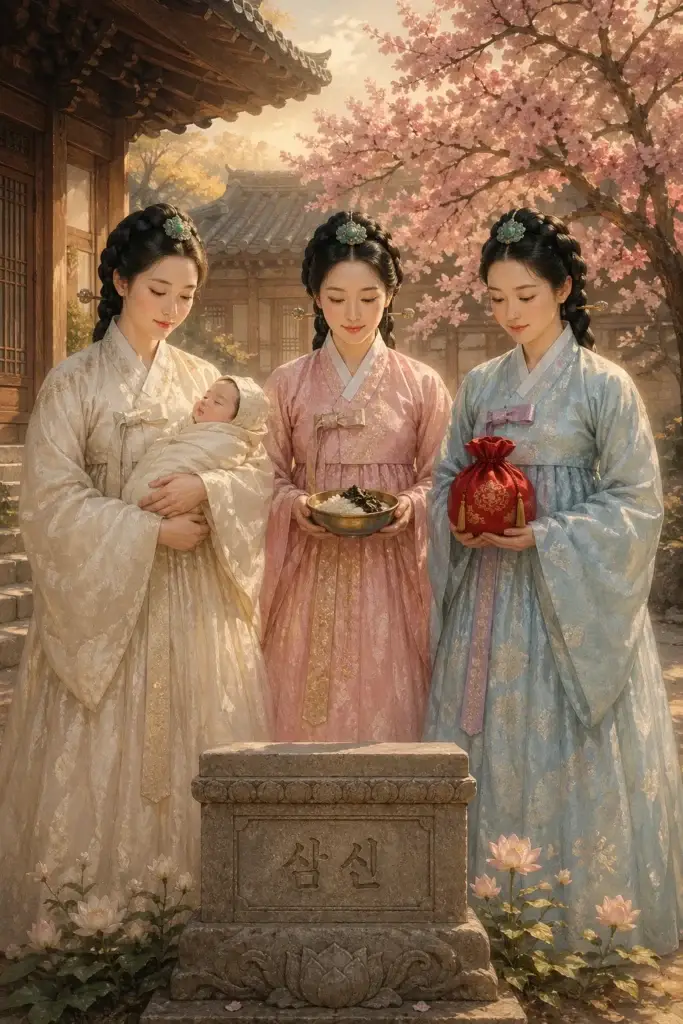
Samsin is depicted as an old woman or goddess who protects women during childbirth. She is closely associated with fertility, childhood and the household.
In shamanic rituals (gut) Samsin is invoked to ease difficult births and to protect newborns from evil spirits. She is female, wise and motherly, often portrayed with white hair or white garments. Unlike Hwanung, who represents cosmic order, Samsin embodies concrete everyday protective functions.
Short Profile: Samsin
Samsin is documented in ethnographic collections and anthropological studies of Korean folk religion, but appears less in classical literary sources such as the Samguk yusa. She is primarily a shamanism deity with strong regional distribution across all of Korea.
Scholars of religion such as James H. Grayson treat her in the context of the folk syncretism between Buddhism, Daoism and indigenous shamanism. Kim Tae-gon and other ethnologists documented active Samsin cults well into the twentieth century.
Context
Period of the Texts
The birth goddess. She protects newborns.
The continuity is remarkable and shows deep cultural rootedness. Even in modern times the memory is alive, often transformed, but recognizable in its basic features.
Mythological Classification
Samsin (삼신, “Three Goddess”) is a Korean birth and fertility goddess with roots in shamanic traditions. She exists in folk traditions of Northeast Asia and is venerated as a protector of pregnant women and newborns. Her genealogy connects her with prehistoric fertility cults.
Area of Distribution
Samsin was not limited to particular regions but was universally known and venerated throughout the Korean world. Whether in urban centers or rural regions, whether among the elite or ordinary people, her spiritual significance was consistently acknowledged and respected.
This shows a central role in the cultural self-understanding. Trade, migration and cultural exchange spread and stabilized the veneration, which led to a remarkably uniform depiction across large geographical and temporal spans.
State of the Sources
The state of the sources on Samsin Halmoni is primarily ethnographic and only secondarily textual. The figure does not appear in the classical historiographical works such as Samguk yusa (1281) or Samguk sagi, but is transmitted through Korean folk religion (musok) and oral traditions.
Important secondary sources include James H. Grayson, Korea, A Religious History (London 2002), Laurel Kendall, Shamans, Housewives, and Other Restless Spirits (Honolulu 1985), and Boudewijn Walraven, Songs of the Shaman (London 1994).
David A. Mason treats the birth goddess in Spirit of the Mountains (Seoul 1999). The oldest tangible ritual evidence comes from Joseon-period (1392, 1897) folk customs.
Name and Variants
Samsin is depicted with particular iconographic elements that are symbolically coded and carry deep meaning. These elements centrally convey the functions, sources of power, areas of responsibility and cosmic role of this entity.
The visual system allows the initiated and the culturally educated to grasp the deep meaning. Colors, sacred objects or weapons, bodily attributes, specific accessories: everything is significant and traditionally handed down. The system remains stable and recognizable across generations, which points to fundamental archetypal structures.
Characteristics
Samsin was central to the religious practice and the everyday understanding of the Korean people. People turned to this entity in critical situations or at particular ritual times of the year, with structured rituals, prayers or offerings.
The practice was precisely handed down and often led by priests or specialists. The continuity of these practices across many generations shows that she was regarded as effective and necessary. Her functions were manifold: preventive (warding off misfortune), healing (relieving suffering), transformative (accompanying transitions) and protective (continuous watching).
Appearance and Symbolism
Samsin is depicted as an old or middle-aged woman, sometimes with three manifestations (hence the name). She is often shown in domestic shrines, accompanied by symbolic objects such as wheat or rice. Her color varies, but white or red are common. She often sits on straw or is surrounded by symbols of abundance.
Profile: Samsin
The profile shows Samsin in six dimensions: her origin as a birth goddess, the target groups of her veneration (women, those giving birth, parents), her iconography and attributes, her protective functions at birth and in childhood, and parallels in related cultures. These perspectives reveal her function in the everyday religious system.
Samsin (삼신) is the birth goddess; the mountain connection belongs not to her but to Sansin (산신), the mountain god. She is distributed pan-Korean, with regional variants. Her mythological origin lies in the proto-shamanic nature cult, probably prehistoric; in literary terms she is attested late (ethnographies of the nineteenth and twentieth centuries).
In the history of religion she is understood, in her cult, as a fertility and birth goddess.
Samsin was venerated primarily by women, especially pregnant women, women giving birth and mothers. Occasions were pregnancy, birth, childhood illnesses and the blessing of newborn children. Midwives and healers also invoked Samsin.
The cult was decentralized and often private, less formally institutionalized than state cults. In the twentieth century the veneration declined with modernization, but in tradition-conscious communities it remains present.
Samsin is depicted as an old woman with white hair and white clothing, sometimes with gold or silver accessories. Her attributes are the blessing of children, often shown as an infant or child on her lap.
She sometimes wears a diadem or a crown to indicate her divine nature. Her colors are white, red (for life force) and gold. The depiction is warm and grandmotherly, not frightening.
Area of effect: Samsin (“Three Spirits”) protects pregnant women and newborns. They are not individual gods but a threefold power, often depicted as old women, midwives or ancestors.
In Korean shamanism they are invoked when a woman becomes pregnant, and their blessing follows until the birth. They stand for the continuity of the family and the knowledge of the grandmothers, which is passed on from life into the next lives.
Samsin is a benevolent, protective goddess. Veneration takes place through household altar rituals (kosa), through thanksgiving offerings after a successful birth, and through prayers for the blessing of children.
Pregnant women presented offerings (rice, sweets, oil) to ask for her help. After the birth a formal thanksgiving offering (Samsin-kut) took place. The veneration was private devotion, less publicly ritual. Protective measures against evil spirits concerning the newborn were part of the comprehensive Samsin cult.
Comparable are other birth and fertility goddesses: Artemis/Diana in the Greco-Roman tradition (goddess of birth and the care of children), Brigid in Irish mythology (goddess of the healing arts and birth), and Hindu goddesses such as Hariti (protective mother).
What they all share is the protection of birth, fertility and early childhood through female, motherly power.
Samsin, Parallels in Other Cultures
Samsin as a birth-grandmother triad belongs to the East Asian tradition of collective female protective figures. Comparable are the Hindu Saptamatrika (seven mothers) and the Chinese Niangniang veneration.
In the Western spectrum one finds the Greek Moirai as three goddesses of fate and the Norse Norns, though without the specific infant-protection function of Samsin. Various cultures recognized the same thing and manifested it in local, adapted forms. Universal patterns are more significant than specific variations.
Jewish tradition: In Judaism there is no direct goddess of birth, but there are protective figures such as Lilith (originally ambivalent, later demonic). Closer is the figure of “Lady Wisdom” (Chokhmah) as a motherly creative power, though not formalized as a birth goddess.
Greco-Roman world: Artemis and her Roman equivalent Diana were goddesses of birth and the care of children. Eileithyia (Greek) too was specialized in assistance at birth. They were invoked by women giving birth, similar to Samsin. These goddesses, however, were formally instituted in public cults, not privately within the family like Samsin.
Mesopotamia: The goddesses Nintur and Damgalnunna had functions as birth and creator goddesses. They were invoked to create and protect life. The Sumero-Akkadian tradition documents female protective figures at birth, parallel to Samsin’s function, but without the everyday household-altar privacy.
India/Asia: In Hindu traditions, goddesses such as Hariti, Kali (as protector) or Durga are protective figures at birth and in childhood. In the Chinese and Japanese traditions there are similar protective goddesses for fertility and childhood. The Chinese Guanyin in particular is invoked by women for the blessing of children, similar to Samsin.
The Three-Gods Grandmother and Assistance at Birth
Samsin, also invoked in Korean folk religion as Samsin Halmoni, the Grandmother Samsin, is the deity responsible for conception, pregnancy, birth and the early thriving of children.
The name is usually explained as the three gods or the threefold spirit, although the exact interpretation of the number three is judged differently in scholarship: some relate it to a triad of deities, others to the three domains of conception, birth and rearing.
In traditional Korea, Samsin was one of the most important household deities, precisely because birth and child mortality were central concerns of every family.
Her area of responsibility extended from the wish for a child, through the protection of the pregnant woman and safety at delivery, to the preservation of the infant in the first, most dangerous years of life. She was regarded as the one who literally brings the child into life and watches over its first steps.
This function made Samsin a deity venerated predominantly by women, within the sphere of the home, the family and the female world of life. Unlike the great gods of state or Buddhist cults, she was a deity of everyday life and of immediate bodily need.
Her significance points to a fundamental feature of Korean folk religion. Alongside Buddhism, Confucianism and later Christianity, there always existed a broad layer of household deities and protective spirits responsible for concrete areas of life.
Samsin is among the most prominent of these deities, because the domain she protects was indispensable for the continuation of every family.
The Household Altar and the Rites After Birth
The veneration of Samsin was tied to fixed places and actions within the house.
Her place was traditionally a particular area of the main room, often a corner or a wall shelf, where a simple sanctuary was set up. This frequently consisted not of an image but of a vessel of rice, a folded piece of cloth or paper and sometimes a jar: objects that indicated the presence of the deity.
The simplicity of this sanctuary is characteristic of Korean household religion.
Around the birth a dense web of rites unfolded. Even the wish for a child could be an occasion to ask Samsin for one. During pregnancy, rules of conduct applied that were meant to protect the unborn child.
Immediately after the birth, the deity was thanked for the happy delivery, traditionally with an offering of rice and seaweed soup, the same soup that the new mother also received for her strengthening.
These food offerings were repeated on appointed days, for example on the third, the seventh, the fourteenth and the twenty-first day, as well as on the hundredth day and the first birthday of the child.
A period of seclusion followed the birth, in which the house was marked as ritually protected and barred to outsiders by a straw rope stretched across the gate.
Into this rope different objects were woven depending on the sex of the child. These customs were meant to preserve both the vulnerable newborn and the protective presence of Samsin.
The rites show that Samsin was not a distant deity, but was closely bound into the bodily and temporal course of pregnancy, birth and early childhood. Her veneration was practical religion, embedded in the concern for the survival of mother and child.
Korean Shamanism and the Myth of Samsin
In Korean shamanism, the musok, Samsin is firmly anchored, and a distinct mythic narrative is connected with her, recited by shamans, the mudang, at certain rituals.
This narrative has been transmitted in several regional versions, above all through the records of Korean folklorists in the twentieth century, who collected the oral chants of the shamans.
The myth tells, in differing variants, of the origin of the birth goddess, frequently in the form of a competition between two female figures for the office of bringing children.
One of the two, often the younger or initially disadvantaged one, proves to be the rightful Samsin, who from then on guides children into life, while the other is entrusted with a less favorable domain, such as illnesses or the realm of the dead.
The narrative thus at the same time explains why birth and early death, thriving and misfortune, lie close together.
These mythic chants were recited in the context of gut, the shamanistic rituals in which the deities are summoned, hosted and asked for help. A gut to request offspring or to protect children bound Samsin into a larger series of deities.
In the study of religion, the Samsin myth is a good example of the function of such narratives. It explains an order of the world, here the responsibility for birth and childhood, and anchors it in a prehistory.
At the same time, the multitude of regional versions shows that there was no canonical text, but a living, oral tradition rooted in the practice of the shamans. Samsin thus connects the plain household religion with the richer mythic world of Korean shamanism.