Hanuman, god of the Hindu tradition
By Ralf Ittermann · last reviewed on
Hanuman is a god of the Hindu tradition.
The monkey god, servant of Rama and embodiment of strength and devotion.
Hanuman
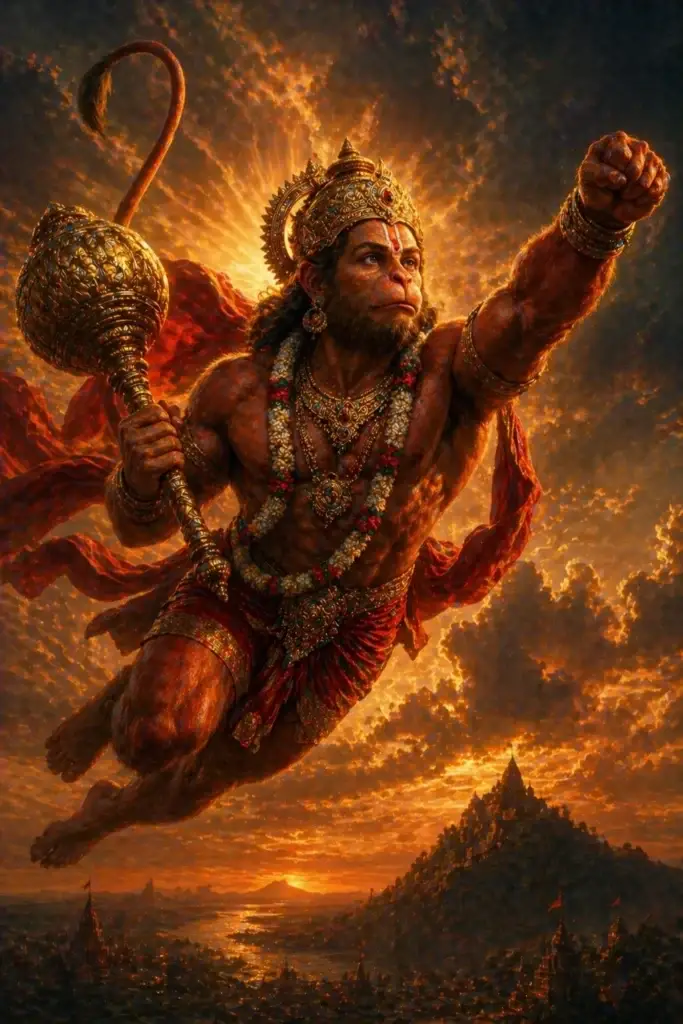
Hanuman is one of the more beloved figures of Hinduism, not as a remote deity, but as the embodiment of loyalty and strength. With his reddish fur, massive arms and illuminated brow, he leaps across vast distances, lifts mountains, and serves the hero Rama with unconditional love.
In the *Ramayana*, Hanuman is the general of Rama’s monkey army, yet in a spiritual sense he is the yogi, the perfect disciple who has surrendered his ego in favor of the one he venerates.
At a glance: Hanuman
Type: Hindu principal deity, monkey god and supreme Bhakti devotee of Rama
Pantheon: Hinduism (especially Vaiṣṇavism and folk religion), Buddhism (possibly Sun Wukong, disputed in scholarship)
Function: loyal Bhakti, physical strength, protection from demonic powers, yogi and ascetic
Main attributes: monkey face, club (Gada), mountain in hand (Gandhamadana), torn-open chest with image of Rama and Sita
Main cult sites: Hampi (Karnataka, mythical birthplace), present in every Hindu temple as a protective figure
Son of: Vayu (wind god) and Anjana
Classification
Period of the texts
Hanuman has been central to Hindu mythology since the Ramayana (composed ca. 5th/4th c. BCE, canonical ca. 200 BCE onward). Main flowering of Hanuman Bhakti: the medieval period (from the 16th c. with Tulsidas’ Ramcharitmanas and the Hanuman Chalisa).
Today one of the most popular Hindu deities worldwide, present in every Hindu temple, often with its own cella. The Hanuman Chalisa (a 40-verse hymn) is one of the most widely spoken religious texts of India, recited daily by hundreds of millions.
Area of distribution
Main cult sites: Hampi (Karnataka, mythical birthplace on Anjaneya hill), Sankat Mochan Hanuman temple in Varanasi, Salasar Balaji (Rajasthan, one of the largest Hanuman temples), Mehandipur Balaji (Rajasthan, famous for its healing tradition), Maruti mandirs in Maharashtra.
Internationally present in every larger Hindu temple complex. Central in the Hindu-Bali context on Bali. In East Asian Buddhism possibly indirectly through Sun Wukong (disputed in scholarship).
Source situation
Central sources: Ramayana (Valmiki, ca. 200 BCE, Hanuman as a central figure in the Sundara Kanda), Mahabharata (minor mentions), Ramcharitmanas (Tulsidas, 16th c., Hindi Ramayana), Hanuman Chalisa (Tulsidas), Hanuman Purâṇa. Secondary literature: Lutgendorf, Hanuman’s Tale. The Messages of a Divine Monkey (standard work); Goldman/Goldman, The Râmâyaṇa of Vâlmîki; Michaels, Der Hinduismus.
Designation and spellings
Hanuman is depicted as a clever, athletic monkey, frequently with red-bronze or golden skin. He has a thick, muscular body, huge ears and arms, swinging an enormous club. He often wears chest and upper-arm armor.
His tail is powerful and agile, sometimes bearing a banner. Sometimes his chest is also shown open, with Rama and Sita in his heart, a symbol of his complete devotion. A glowing forehead mark and blazing eyes show his spiritual enlightenment.
Characteristics
Hanuman is the god of strength, courage and unconditional love, Bhakti. His veneration is popular, especially on Tuesdays and before challenges. The Hanuman Chalisa, a 40-verse hymn, is recited daily to overcome fear and obstacles.
In temples Hanuman is often depicted as the first figure; many devotees visualize him as an inner mentor. His ability to change size (small as an atom, large as a mountain) shows cosmic flexibility.
Appearance and symbolism
Hanuman is depicted as a muscular, monkey-headed warrior, often with a glowing, golden skin tone. He wears a prayer chain and armor. His open heart shows Rama’s name. He has no mount.
Profile: Hanuman
The most important aspects of Hanuman at a glance. The following fields summarize origin, function, appearance, veneration, symbols and cultural parallels.
Hanuman is the son of Anjana (an Apsara cursed into the form of a monkey) and the wind god Vâyu, hence his immense physical strength and his gift of flight. In some traditions he is also begotten of an aspect of Shiva (as an incarnation of Rudra).
In the Ramayana he meets Rama in the forest, joins him as his most loyal companion, flies to Lanka, finds the abducted Sita, delivers Rama’s ring, helps in the war against Ravana, and even tears out an entire mountain of healing herbs (Gandhamadana) to save the wounded Lakshmana.
Embodiment of total Bhakti (devotion) to Rama; the most famous image: Hanuman tears open his chest and reveals within the image of Rama and Sita, his sole sense of self.
Patron of physical strength (wrestlers, weightlifters, bodybuilders), of yoga, of Brahmacharya (sexual abstinence). Protection from demonic powers, evil spirits, illness. Patron of students, the educated and examinees (through his function as scribe in the tradition).
Monkey face with a human body, golden-orange skin tone, very muscular, kneeling in a pose of devotion. Club (Gada) in the right hand, his main attribute. Gandhamadana mountain in the raised hand (in the healing-herb episode).
A torn-open chest with the image of Rama and Sita within (the most famous Hanuman image). Long tail, often with flames at the end (he set Lanka ablaze with his burning tail). Frequently before a seated trio of Rama, Sita and Lakshmana in a pose of devotion.
Sphere of influence: Hanuman is invoked several times a day in every Hindu temple. The Hanuman Chalisa is recited daily by hundreds of millions of Hindus, especially on Tuesday and Saturday (his days).
In the personal cult of illness, invocation for protection from demonic causes of disease; in Mehandipur Balaji the exorcistic tradition is especially strong. In wrestling and bodybuilding circles he is the patron of physical strength. Widespread worldwide in ISKCON and other modern Bhakti movements. Present as a folk deity in Indonesia, Malaysia, Thailand and Bali.
Club (Gada), Gandhamadana mountain, torn-open chest with the image of Rama and Sita within, monkey face, long tail with flames, yoga seat (Padmasana), pose of devotion before Rama. Sacred plants: Tulsi (basil), Bilva tree. Sacred animals: monkey (his own face). Sacred colors: orange-gold. Sacred days: Tuesday and Saturday.
Sun Wukong (China, monkey king in Journey to the West, possibly inspired by Hanuman, disputed in scholarship), the Mahasun-Wukong tradition in Chinese-Buddhist folk religion, Bhima (Hinduism, son of Vâyu, half-brother of Hanuman), Pan (Greece, half-animal wild forest spirit), Eshu (Yoruba, partly a trickster function).
In a broader comparison: all trickster-with-loyalty double-aspect figures share aspects of Hanuman. Hanuman is the most famous monkey deity in world mythology.
Practical defense
Veneration rituals
Hanuman is the monkey-shaped servant of Rama (Ramayana) and is considered an incarnation of Shiva’s life force. Daily Hanuman veneration is performed with sindur (red powder), jasmine oil and sweet laddu balls.
Tuesday and Saturday are his weekdays. Hanuman temples are widely distributed in the north and south of India, notably: Sankat Mochan (Varanasi), Salasar Balaji (Rajasthan), Hanuman Temple Connaught Place (Delhi) (cf. Lutgendorf, Hanuman’s Tale).
Mantras and invocations
The Hanuman Chalisa (40 verses) by Tulsidas (16th c. in Avadhi Hindi) is one of the most popular devotional texts of India.
The bija mantra „Hum” and the invocation „Om Hanumate Namaḥ” are part of many protective rituals. The Sundara Kanda (Book 5 of the Ramayana, Hanuman’s leap to Lanka) is frequently performed as a protective reading.
Amulets and protective symbols
Hanuman Yantra (a complex geometric diagram with the central name of Hanuman) on copper plates as protection from spirits, black magic and adversaries. His vahana is none, he is his own mount.
Symbol: Gada (club), mountain (he carries the Sanjeevani mountain), tail in flames. Red sindur stripes on the forehead as a Hanuman mark of recognition for his devotees.
Hanuman, parallels in other cultures
Hanuman resembles the Greek Hermes (messenger, speed) and the Valkyrie of Norse mythology (brave, unconditionally loyal). In the Western context he is often understood as an archetype of the loyal warrior or the spiritual disciple.
The image of the monkey who is a god also fascinates Western esotericists as a symbol of overcoming the lower nature through love.
Hanuman in the Ramayana: the leap to Lanka
The central source for Hanuman is the Ramayana, the Sanskrit epic attributed to the poet Valmiki. Hanuman appears in it in the fourth book, the Kishkindha Kanda, as a minister of the monkey king Sugriva, and gains the leading role in the fifth book, the Sundara Kanda.
This book is named after Hanuman’s deed and is considered by many Hindus to be the most venerable part of the epic.
The plot: Rama searches for his abducted wife Sita, whom the demon king Ravana has carried off to the island of Lanka. Hanuman is sent out with a search party. Arriving at the strait, he enlarges his body and leaps across the sea to Lanka.
Along the way he passes several trials, including the encounter with the demoness Surasa and with Simhika. In Lanka he finds Sita imprisoned in a grove, delivers to her a ring of Rama’s as a token of recognition, and takes back from her a piece of jewelry as a message.
Before he leaves the island, Hanuman allows himself to be seized so that he may stand before Ravana. The demons set his tail on fire, but Hanuman escapes and sets large parts of the city ablaze with his burning tail.
This episode of the burning tail is one of the most popular scenes of the epic and is depicted many times in art.
Hanuman’s mission as messenger is what first makes Rama’s campaign possible. In the sixth book he also carries an entire mountain of healing herbs, because he cannot identify the single needed plant. This deed saves the wounded Lakshmana. Throughout the epic Hanuman appears as the embodiment of devoted loyalty toward Rama.
The theology of Bhakti: Hanuman as the ideal devotee
Hanuman’s religious significance lies less in his strength than in his attitude. In the Hindu tradition, especially in Vaishnava piety, he is regarded as the model of the bhakta, the devoted worshipper.
His relationship to Rama is described as dasya bhava, the attitude of the servant who serves his lord in perfect humility and without self-interest. A much-cited verse has Hanuman say that in body he is Rama’s servant, in soul a part of him.
This theological interpretation gained particular weight through the Sant and Bhakti movement of northern India. The poet Tulsidas, who in the 16th century composed the Ramcharitmanas in a North Indian language, made Hanuman a central figure of devotion.
He is also credited with the Hanuman Chalisa, a forty-verse hymn of praise that to this day belongs to the most recited devotional texts of Hinduism. Millions of people recite it daily or on certain weekdays.
In this theology Hanuman unites apparent opposites. He is of immense power, yet uses this power exclusively in the service of another. He is learned, a master of grammar and of the scriptures, yet remains modest. This combination makes him a model for how strength and knowledge should be placed in a religious order.
He is moreover considered immortal, one of the chiranjivi who remain on earth until the end of the world age. From this follows the widespread belief that Hanuman is present wherever the story of Rama is told or recited.
Iconography and temple cult
Hanuman is among the most frequently depicted figures of Hinduism. His image is present in countless temples, at roadside shrines and in households. The iconography follows recognizable patterns.
Hanuman is depicted with the face of a monkey and a powerful human body, often in red or orange color, which relates to the application of vermilion, the sindur.
A popular tale relates that Hanuman smeared his whole body with vermilion when he learned that Sita painted a mark of it on her forehead to wish Rama a long life.
Frequent representational types show Hanuman carrying the mountain with the healing herbs, standing with a club in a combative posture, or kneeling with folded hands while Rama and Sita become visible in his chest. This last motif, the torn-open heart with the divine pair within, gives pictorial expression to his complete devotion.
In the temple cult Hanuman is especially associated with Tuesday and Saturday, on which his worshippers fast or say special prayers. He is offered oil, vermilion and sweet dishes. A distinct tradition is the building of especially large Hanuman statues, which have arisen at many places in India since the late 20th century.
Hanuman is moreover regarded as a protective power against evil influences and against the influence of the planet Saturn, which is why his invocation in folk-religious practice is often connected with defense and protection. This broad cultic presence makes him one of the most vital deities of present-day Hinduism.
Hanuman's origin and his place in the pantheon
The tradition concerning Hanuman’s birth is not uniform. According to the most widespread version, his mother is Anjana, a celestial nymph who lived on earth as a female monkey. His father is the wind god Vayu, which is why Hanuman bears the epithets Pavanaputra or Maruti, son of the wind.
The connection to the wind explains his extraordinary speed and his ability to fly. Alongside this there is a tradition that understands him as a partial incarnation or as a son of the god Shiva. This dual attribution of origin shows that Hanuman was claimed for itself by various religious currents.
A well-known childhood story relates that the young Hanuman mistook the rising sun for a fruit and leapt up toward it. Indra, the king of the gods, then hurled his thunderbolt and struck Hanuman on the jaw.
From this incident some explanations derive the name, which is connected with the Sanskrit word hanu, jaw. The enraged Vayu then withdrew and deprived the world of breath, until the gods appeased Hanuman and bestowed numerous gifts upon him, among them invulnerability and the power to change his form at will.
Within the structure of the Hindu pantheon Hanuman occupies a special position. He is not one of the great creator or preserver deities, but a helper and servant; yet precisely this role secured him his own, very broad cult.
From the perspective of the history of religion, scholarship discusses whether older, perhaps non-Vedic forms of veneration of monkey-like protective spirits stand behind Hanuman, which over time were integrated into the Rama narrative.
This cannot be securely established. What is certain is that Hanuman rose from a minor figure of the epic to one of the most important independent devotional deities.
Hanuman beyond India and in modern culture
With the spread of the Rama narrative, Hanuman reached many cultures of South and Southeast Asia, where he in part acquired his own forms. In Thailand he appears in the Ramakien, the Thai version of the epic, with a markedly different character profile, livelier and less ascetic than the Indian figure.
In traditional Thai dance drama and in shadow theater he is among the most popular figures. In Cambodia, Laos, Indonesia and Malaysia too, Hanuman is known from the local Ramayana traditions.
In India itself Hanuman is to this day exceptionally present. He is the protective figure of wrestlers and athletes, whose training grounds often have a Hanuman shrine, because physical strength, discipline and abstinence are attributed to him. The traditional wrestling schools known as akhara have long cultivated this connection.
In modern popular culture Hanuman appears in comics, animated films and television series, through which he takes shape especially for younger generations. The major television adaptation of the Ramayana in the late 1980s decisively shaped the image of Hanuman for a mass audience.
In addition, Hanuman has acquired a role in political and identity-related debates of present-day India, which is observed attentively in religious studies, because here an old devotional figure enters new contexts of meaning.
The range thus extends from the quiet domestic recitation of the Hanuman Chalisa to publicly charged forms of expression. Scholarship emphasizes that this modern diversity cannot be separated from the centuries-old devotional tradition from which it arises.
Further links
Literature (selection)
Further standard works in the literature index.
Frequently asked questions about Hanuman
Who is Hanuman in Hinduism?
Hanuman is one of the most popular divine figures of Hinduism, the monkey-headed god of loyalty, strength and devotion (Bhakti).
In the Ramayana he plays the central role as the most loyal servant of Rama (avatar of Vishnu): he searches for Sita on Lanka, leaps across the sea with divine powers, and carries an entire mountain in the Himalaya on his back to bring a healing plant.
Hanuman is considered an incarnation of Shiva or a servant of Shiva, and is the patron of wrestlers, warriors and spiritual seekers. His statues are usually painted orange-red.
What is the Hanuman Chalisa?
The Hanuman Chalisa (forty verses to Hanuman) is one of the most popular devotional poems of the Hindi-speaking world, written by the mystic Tulsidas in the 16th century. It consists of 40 verses that praise Hanuman’s qualities, heroic deeds and aid.
Millions of Hindus recite the Chalisa daily, often on Tuesdays (Hanuman’s day) and Saturdays. It is regarded as an effective protective prayer against fear, illness and supernatural threats; Hanuman is invoked as a protector especially against spirits and Shani (Saturn).