iWell Guard

Yhych-Khan, Yakut Guardian of Horses and Keeper of the Ysyakh

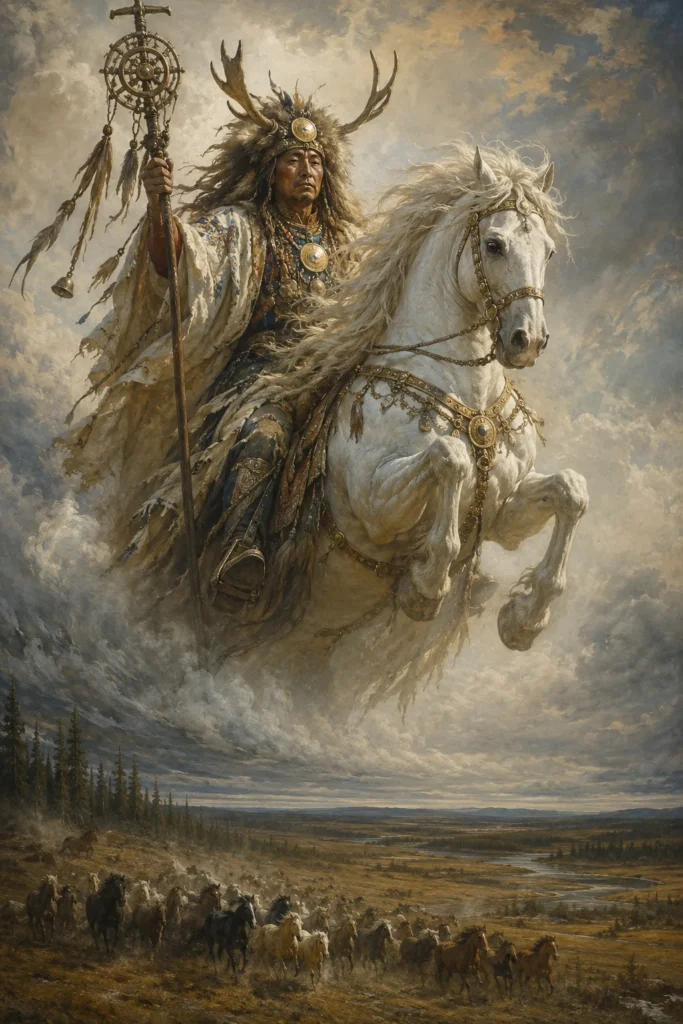
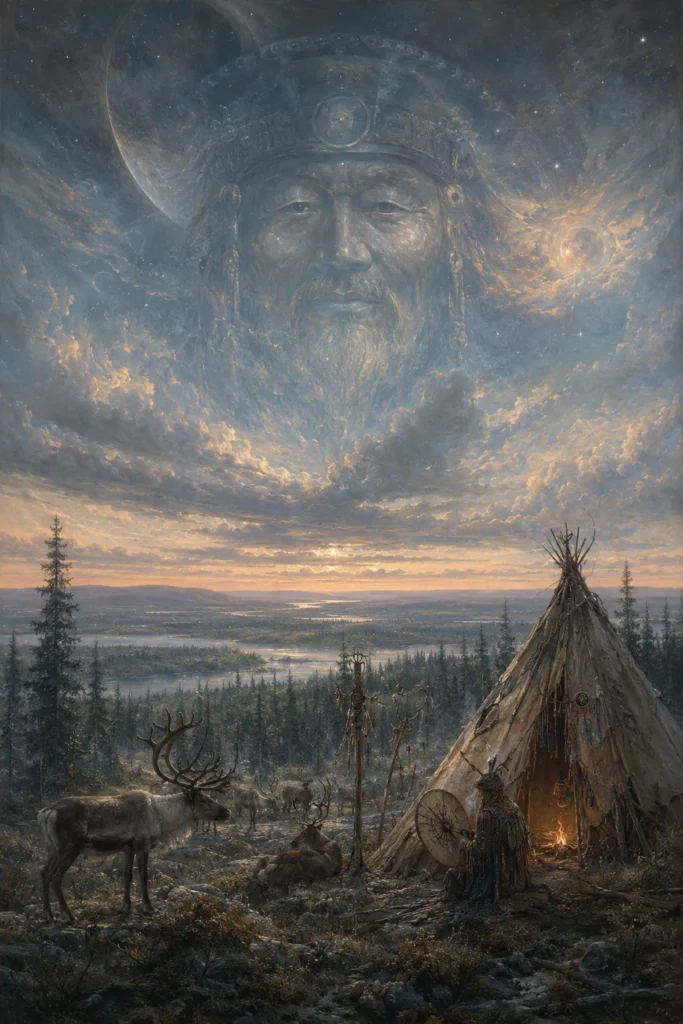
Yhych-Khan is the guardian of horses and their herds in the Yakut religion. He stands at the centre of the great summer festival Ysyakh, celebrated each year after the summer solstice.

GodSiberia / TengrismProtective God of Horses

Table of Contents

Yhych Khan - Gods from the Siberian-Tengrism tradition, historical-illustrative

Classification and Brief Profile

The Yakut religion structures its world of gods in three layers: the upper sky (aiyy), the middle earth (spirits of forest, water, horse, cattle), and the lower world (abasy).

Yhych-Khan belongs to the first layer and specialises in the horse, the central creature of Yakut economy and identity. Other high figures of the first layer include Ajisit, Ürün Aar Tojon, and the cattle-bestower Ynakhsyt.

Within the Siberian-Tengrist tradition, Yhych-Khan is an instructive example of how the cosmic high-god function divides into animal-specific specialisations. This specialisation follows the economic logic of Yakut horse-breeding under extremely cold subarctic conditions.

The Yakut Sakha horse breed (tabuun) represents a remarkable adaptation to the cold, surviving temperatures below minus 60 degrees, and is both religiously and economically the backbone of the tradition. Yhych-Khan is the religious reflection of this central economic position.

Name and Etymology

The name derives from yhyaq (“mare’s milk, kumys”). Yhych-Khan is thus literally the “kumys lord”. The etymology anchors him directly in the Yakut festival complex Ysyakh, whose central act is the drinking and pouring of kumys.

In older ethnographic texts one also finds the variant Yhyaqtaaq, “the one with the kumys-festival right”, which links the name to the Ysyakh festival. This name form is linguistically instructive, as it attests to the inseparability of deity and festival form.

The Yakut language belongs to the Turkic language family, and the name fits well within the pan-Turkic religious vocabulary; comparable would be formations with other animal-related high-god names such as the Altaic Tabyt-Khan (horse lord) or Kazakh special deities.

Description and Iconography

Yhych-Khan is described as a mature man with a long light-grey beard, seated on a milk-white stallion, holding a large ladle carved from birchwood. His coat is embroidered with horse symbols; on the ritual posts (serge) of the Ysyakh he is depicted in stylised form as a rider with a raised cup.

The serge posts are among the most important religio-anthropological materials of Yakut culture. They are erected before every yurt and on the festival grounds and can contain highly complex cosmological references in their carvings; Yhych-Khan appears here often in the third position, after the upper gods and Ajisit.

Several historical serge posts are displayed in the collections of the Sakha Republic National Museum in Yakutsk; they demonstrate the iconographic stability of the tradition over approximately 200 years.

Mythological Narratives

In the Olonkho corpus, Yhych-Khan appears as the messenger whom Ürün Aar Tojon sends in the creation narrative with the task of bringing horses to the first human beings. Without horses, the narrative holds, life in the Yakut tundra would be impossible; Yhych-Khan fills this gap.

A second narrative describes how, after a famine, he makes the mares so rich in milk that humans are able to produce kumys for the first time, whereupon the Ysyakh is established as an annual festival of thanksgiving.

A third narrative tells of Yhych-Khan’s conflict with a lower abasy harmful being that seeks to curse the horse herds; Yhych-Khan drives it away with a milk-filled ladle that transforms into a spearhead. Such cosmic conflict narratives are typical of the Yakut Olonkho tradition.

Cult and Veneration

The central cult devoted to Yhych-Khan is the Ysyakh festival: three days in June, with horse sacrifice (today symbolically replaced by the release of a white horse), kumys libations in all four directions, ritual dances (osuokhai), and competitions. The ladle of the Algyschyt (ritual speaker) is directed towards Yhych-Khan at the opening.

The Ysyakh festival has received official recognition in the Sakha Republic since 1991; it is officially observed as a “popular festival” and draws thousands of participants to the large festival ground Ürgel near Yakutsk. The central invocation of Yhych-Khan remains the religious core of the event.

During the Soviet period the festival was suppressed, then permitted again from 1956 in a strongly secularised form; after 1991 it recovered its religious depth. These three stages are well documented in the history of religions, notably by Marjorie Balzer (1999).

Protective Practice and the Apotropaic

Described from a religious-studies perspective: apotropaic practices around Yhych-Khan target the purity of the horse herd. Iron must not lie near the mare’s tethering post; women in a state of postpartum impurity may not milk the mares; the tying of white horse-hair tufts to the serge post is understood as a petition for Yhych-Khan’s protection.

A particular protective practice is the Algys: a ritual blessing spoken by the Algyschyt before each horse race. The text of this Algys is preserved in several Olonkho collections and is once again practised regularly today.

From the insider perspective of the tradition, violation of these purity rules is associated with concrete consequences: illness in the herd, birth complications among mares. From the ethnographic outsider perspective, these are everyday-structuring rules that give cultural form to the economic vulnerability of horse-breeding.

Parallels in Other Cultures

Parallels can be found in the Vedic conception of the horse Ashvins, the Greek Hippios epithet of Poseidon, the Celtic Epona, the Old Prussian Pergrubrius, and in Siberia in the Mongolian horse-protective spirits (guriin tngri) as well as the Buryat Asbuiga.

From a phenomenology-of-religion perspective, the close coupling of the high-god aspect with an animal function is particularly interesting. Comparable might be the Old Persian Verethragna, the victory god often identified with a war-horse. But Yhych-Khan is more compact in terms of the religious system and more clearly defined as an animal deity.

The Yakut specificity: whereas in most other cultures horse gods tend to be middle-ranking deities, Yhych-Khan belongs to the highest layer, a reflection of the outstanding position of the horse in Yakut economy.

Contemporary Reception and Research

The Ysyakh festival has once again been an official public holiday in the Sakha Republic since 1991. Yhych-Khan is there a figure of cultural identification. Scholarly references: Sereshevskij (1896), Ksenofontov (1928/1992), Roberte Hamayon (1990), Marjorie Balzer (The Tenacity of Ethnicity, 1999), N. A. Alekseev (Traditionnaja religia jakutov, 1980).

Marjorie Balzer’s studies are particularly valuable here because they document the re-establishment of the Yhych-Khan cult after 1991 as an anthropological process. She shows how the ethnic self-affirmation of the Sakha was advanced through the revival of this festival.

A particular role in contemporary scholarship is played by Yakut researchers themselves, such as Andrej P. Reshetnikova or the Academy of Sciences of the Sakha Republic. These internal voices are reshaping the research landscape, which was long dominated by Russian and Western outsider perspectives.

Research Debates and Open Questions

Two research debates are currently active. First: how continuous is the Yhych-Khan cult from the pre-Russian period (before 1632) to the present? The archaeological findings from the oldest Sakha settlements (Tujmaada valley) show horse burials whose religious interpretation remains unclear.

Second: what role does Yhych-Khan play in the neo-Tengrist movement of the 2000s? Here a dispute exists between scholars who see Yhych-Khan presented as an “authentic tradition” and those who see in the modern festival culture a new invention (“invented tradition” in the sense of Eric Hobsbawm).

Finally, and this is a question of current urgency, how does the Yhych-Khan cult relate to climate change, which massively threatens the subarctic region and with it the horse-breeding of the Sakha? Initial studies (for example by Susan Crate) have opened a religio-ecological discussion here.

Yhych-Khan in the Context of Sakha Economy

The central religious position of Yhych-Khan correlates with the central economic position of the horse in the Yakut tradition. The Sakha horse breed, which survives cold below minus 60 degrees, was what made the settlement of the subarctic tundra possible in the first place.

From a religio-anthropological perspective, the religious veneration of the horse is therefore not coincidental but a cultural reflection of economic necessity.

In the 20th century, Soviet collectivisation fundamentally altered traditional horse-breeding; many families lost their mare herds, which effectively suspended the Yhych-Khan cult. After 1991, a re-privatisation took place, and with it the revival of religious practice. This economic-religious connection has been described in detail by Marjorie Balzer.

A current challenge is climate change: the permafrost is thawing, threatening Sakha horse-breeding. Susan Crate, in her ethnographic work Cows, Kin, and Globalization (2006), documented the religious responses to this ecological crisis; Yhych-Khan becomes here the reference figure of an indigenous climate debate.

Sources and Reference to the Culture Hub

Those wishing to study the Yhych-Khan complex in its full breadth will find on the overview page Siberian-Tengrist Tradition the most important cross-references to related figures such as Ajisit (mother-bestower) and Asbuiga (Buryat horse-helper spirit).

W. Sereshevskij’s Yakuty (1896) remains the most important primary ethnographic source. N. A. Alekseev’s Traditionnaja religia jakutov (Novosibirsk 1980) and G. V. Ksenofontov’s Schamanizm. Izbrannye trudy (reprint 1992) are the most important Russian-Soviet syntheses.

Marjorie Balzer’s The Tenacity of Ethnicity (Princeton 1999) is the most important contemporary work and offers rich ethnographic documentation of the Ysyakh festival after 1991.

Yhych-Khan in the Cosmos of the Yakut Aiyy

Yhych-Khan is embedded in the Yakut aiyy system, a structured layering of “upper light beings” organised hierarchically. Ürün Aar Tojon is the high god; below him are ranked Ajisit (mother), Yhych-Khan (horse), Ynakhsyt (cattle), Bayanai (forest and hunt), and further specialised beings.

This systematic layering is instructive from a history-of-religions perspective, as it shows how a high-god function differentiates itself in an economically differentiated society: for each central economic basis of life there is its own heavenly address.

N. A. Alekseev, in Traditionnaja religia jakutov (1980), presented a complete map of this aiyy system, which to this day represents the most important systematic overview. Yhych-Khan stands in this map at the second hierarchical level, equal in rank to Ajisit and Bayanai.

Methodological Reflection

Several methodological problems arise in Yhych-Khan research. First: the oldest sources (Sereshevskij 1896) date from a period of political exile; their ethnographic depth is considerable, but is also shaped by the circumstances of that exile.

Second: the Soviet folklorisation of the Ysyakh festival partially obscured the religious dimension of Yhych-Khan; the post-Soviet re-establishment is a re-sacralisation with its own tensions.

Third: the contemporary climate crisis confronts the Yhych-Khan complex with existential challenges. If Sakha horse-breeding becomes ecologically impossible, what does that mean for the religion? Susan Crate has conceptualised this question as “climate anthropology”.

Yhych-Khan and the UNESCO Olonkho Heritage

The Yakut Olonkho epic was recognised by UNESCO in 2005 as a “Masterpiece of the Oral and Intangible Heritage of Humanity”. Yhych-Khan is present in practically all Olonkho epics: as creator of the horse herds, as patron of heroes, as heavenly commissioner in tribal destiny.

This UNESCO recognition has institutionally strengthened the Olonkho; several Olonkho theatres, a state Olonkho Institute in Yakutsk, and cultural festivals keep the tradition alive. Yhych-Khan is a central figure here, both religiously and literarily.

From a religious-studies perspective, this institutionalisation is demanding: it transforms what was once a living religious tradition into a cultural heritage object, which changes the practice itself. A reflexive ethnology of religion takes this change seriously.

Yhych-Khan and the Climate Crisis

A particularly current research perspective links Yhych-Khan to the climate crisis in the subarctic region. The permafrost is thawing, the mare pastures are drying out, and many traditional horse-breeding areas are becoming uninhabitable. Susan Crate, in Cows, Kin, and Globalization (2006), showed how the Sakha respond religiously to this crisis.

The Yhych-Khan cult becomes here the reference figure of an indigenous climate critique: if the horse disappears, the religion disappears. This existential connection makes Yhych-Khan a key figure in a religiously significant climate debate.

At the annual Ysyakh festivals since 2010, ecological messages have frequently been part of the invocations; Yhych-Khan is addressed as “Preserver”, entrusted with concern for the climatic future. From a sociology-of-religion perspective, this re-addressing is a remarkable development.

Yhych-Khan and the Ysyakh Festival in the UNESCO Context

The Ysyakh festival, at whose centre Yhych-Khan stands, has been on the UNESCO tentative list for intangible cultural world heritage since 2018. This nomination documentation contains a detailed description of the Yhych-Khan invocations, the horse rituals, and the cosmological references.

The UNESCO documentation is an important new source level for religious-studies research on Yhych-Khan. It contains interviews with contemporary Algyschyt speakers, recordings of the festival sequences, and iconographic materials.

From a sociology-of-religion perspective, this UNESCO inclusion is ambivalent: it secures the festival institutionally but also transforms it into a “world cultural heritage object”, which changes the religious practice itself.

Yhych-Khan and the Re-Tengrisation in the Sakha Republic

The re-Tengrisation in the Sakha Republic since 1991 has reactivated Yhych-Khan as a central figure of identification. At the large Ysyakh festivals, contemporary Algyschyt speakers perform invocations drawn directly from the Olonkho epics and from Sereshevskij’s records.

This re-establishment is, from a sociology-of-religion perspective, an interesting case of a tradition mediated and consolidated through scholarly texts.

Marjorie Mandelstam Balzer, in The Tenacity of Ethnicity (1999), showed that the Yhych-Khan invocations today fulfil a dual function: religious practice and ethnic self-affirmation. This dual function is characteristic of many post-Soviet indigenous religions.

From a religious-studies perspective, this re-establishment is a rewarding object of research. It shows how a religious tradition is reorganised after long repression, by what means continuity is established, and what ruptures are accepted in the process.

Bull and Frost: the Image of the Cosmic Bringer of Cold

Among the spirits of the Yakut-Siberian tradition, the frost lord, who appears in Western descriptions under names such as Yhych-Khan or related forms, occupies a distinctive position.

He does not belong to the high creator deities of the upper world but embodies a natural force that poses an existential threat to life in the north.

The Yakut winter cold in the region around Verkhoyansk and Oymyakon reaches values that are among the lowest of any inhabited area on earth. A religious figure who personifies this frost is therefore not a poetic device but the expression of a persistent threat.

A recurring visual motif in the traditions of the frost lord is the winter bull. This concept, encountered in several Siberian records, conceives of winter as an enormous bull-creature that rises from the northern sea in late autumn and at first grows with each successive month, then in spring loses one limb at a time.

First one horn falls, then the second, then the head, until the creature disappears entirely with the breaking of the ice. In this image, frost is not a condition but a being with a life cycle, and the severity of the cold is bound to the body parts of this animal.

Whether the frost lord and the winter bull were identical in the original tradition or two separate concepts that merged only later cannot be determined with certainty from the sources.

The records of the 19th and early 20th centuries are inconsistent here, and some ethnographers have understood the bull more as a weather calendar than as a deity. What is certain is that both concepts serve the same need: to translate the unpredictable and deadly cold into a tangible, observable form.

Notably, the frost lord, unlike certain illness spirits, was not the object of an elaborate petitionary cult. Winter could not be negotiated, only endured. Ritual attention was therefore directed less towards appeasement than towards the transition, that is, towards the spring festivals with which the end of the bull’s reign was welcomed.

This reflects a basic trait of North Asian religiosity, which treats natural powers not uniformly as negotiable partners but partly as facts to be accepted.

Selected Bibliography

  • W. Sereshevskij: Yakuty (1896)
  • G. V. Ksenofontov: Schamanizm. Izbrannye trudy (1928 / 1992)
  • N. A. Alekseev: Traditionnaja religia jakutov (1980)
  • Roberte Hamayon: La chasse à l’âme (1990)
  • Marjorie Balzer: The Tenacity of Ethnicity (1999)
  • Andrei Znamenski: Shamanism and Western Imagination (2007)
  • Vladimir Basilov: Shamanism in Siberia (1984)

Yhych-Khan is, in the Yakut tradition, the guardian of horses and at the same time the keeper of the Ysyakh, the summer new-year festival of the Sakha.

In the records of Yakut ethnographers he appears as an intermediary between the bright Aiyy powers and the herd owners: he watches over the mares and foals, ensures the fertility of the herd, and receives the ritual kumys libations during the Ysyakh.

As keeper of this festival, he unites livestock-rearing, the calendar order, and the cult of the gods into a distinct functional domain within the Yakut pantheon.

Among the Yakuts of Siberia, Yhych-Khan is regarded as the horse lord, whose blessing was sought at the summer Ysyakh festival with kumys libations and prayers; the ethnographic records of Vassili Serosevsky document the cult in the late nineteenth century.

Related key terms: Yhych-Khan Ysyakh Kumys Sakha Olonkho horse-bestower serge.

iWell Guard and Protective Traditions

iWell Guard connects with the cultural-historical tradition of wearable protective objects, in the tradition of Siberia / Tengrism and many other cultures worldwide. 41 layers, real gold, platinum, silver, crafted in Germany. 30-day return policy.

Personal experiences may vary. Not a medical device. No promise of healing.

Classification & Protection

ILEVEL
The Protection Compass assigns this being to influence level I, Minor influence.

Against its influence, cross-cultural tradition names these protective means:

Compare in the Protection Compass →

Recommended protective means

iWell Guard

The simplest protective means in this collection: 41 layers of fine gold 999, platinum, silver and silicon, manufactured in Ruhla, Thuringia. It requires no activation, is bound to no person, and is effective within a radius of around 50 meters, even without being worn.

All protective means at a glance →