Žaltys, the house snake at the milk bowl
By Ralf Ittermann · last reviewed on
The Žaltys is a spirit of Baltic tradition.
The grass snake at the hearth, guardian of luck and the milk blessing.
The Žaltys, Latvian zalktis, is the sacred house snake of the Balts: a harmless grass snake kept beneath the hearth that brings luck, prosperity and fertility. Killing it was considered a grave misfortune.
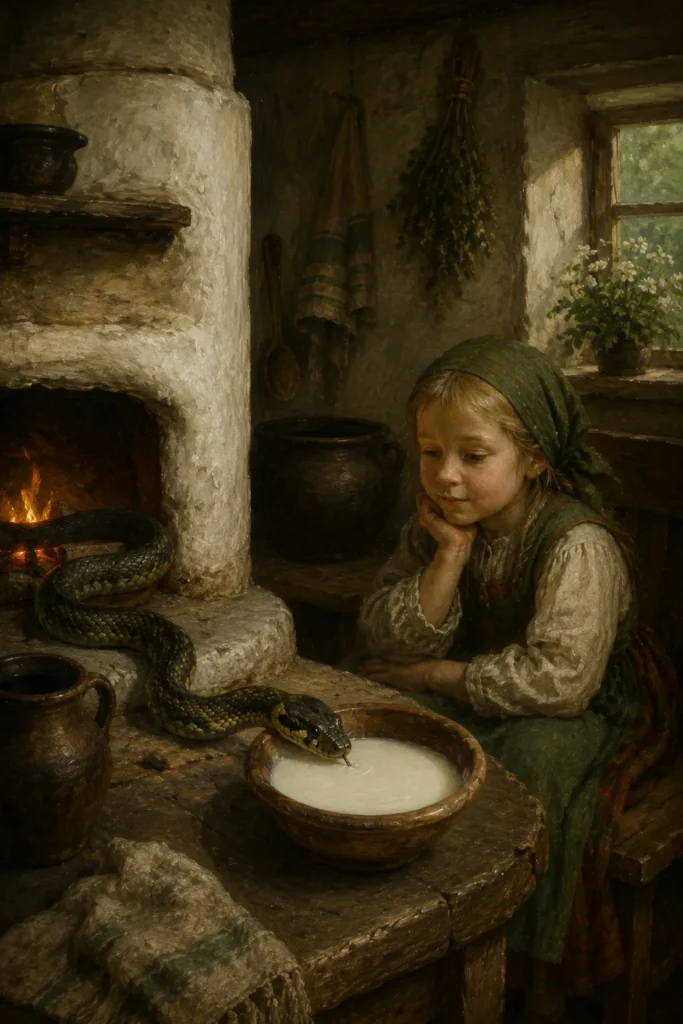
The cult is attested by a dense, at times eyewitness-close chain of sources from the 15th to the 18th century, among others Hieronymus of Prague, Długosz and Herberstein. In folklore, each cow has her own snake, and snake and child eat from the same milk bowl.
Type: Sacred, luck-bringing house snake
Origin: Baltic folk belief of Lithuania and Latvia
Texts: Chain of sources from the 15th to the 18th century, including Hieronymus of Prague, Długosz, Herberstein
Period: 15th to 18th century, folklore beyond
Appearance: harmless grass snake beneath the hearth or stove
Source context
Period of the Texts
Baltic folk belief; the cult is attested by sources from the 15th to 18th centuries and survives in folklore.
Area of Diffusion
Lithuania, Latvia and Old Prussia: throughout the Baltic region the grass snake was tolerated and honoured in the home.
Sources
Very well documented: a dense, at times eyewitness-close chain of sources from Hieronymus of Prague through Długosz to Herberstein, alongside the study by Luven.
Name and variants
Lithuanian: žaltys, Latvian zalktis. The etymology leads to Lithuanian žalias, green or yellow: the link to the green grass snake is popular, and this is also how the etymological dictionaries record it.
Form and effect
Appearance
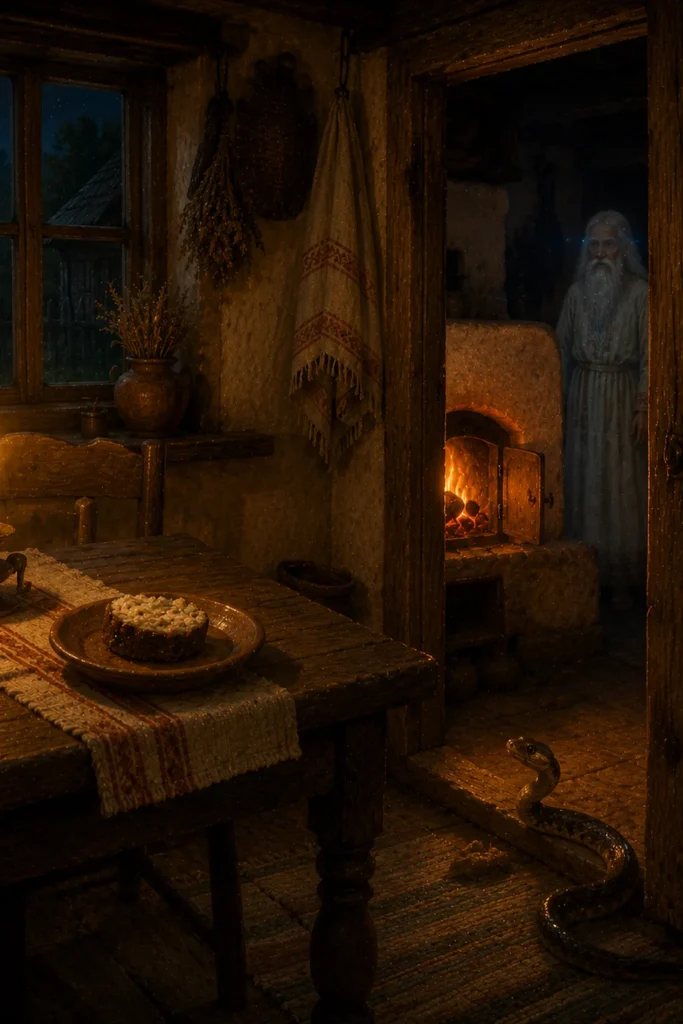
The Žaltys is a harmless grass snake, kept beneath the hearth or stove, in the sacred corner by the table or in the stable, sometimes in a small willow basket. In folklore, every cow has its own snake, and snake and child eat from the same bowl of milk.
Effect
It brings luck, prosperity, fertility and a good harvest, guards the house, protects against thunder, illness and murder, and secures the cows’ milk flow. Milk offerings ensure its goodwill; neglect brings misfortune.
Profile: Žaltys
The key aspects of the house snake at a glance.
Sacred house snake of Baltic folk belief, with one of the region’s best-documented cults: milk feeding, hearth keeping, taboo on killing.
House, hearth and livestock: the Žaltys guards the homestead, secures the cows’ milk flow and watches over the family’s wellbeing.
A harmless grass snake kept beneath the hearth or stove, in the sacred corner or in the stable, sometimes in a small willow basket.
Luck, fertility and a blessing of milk; protection from thunder, illness and murder for the household that honours the snake.
Milk in a bowl at the centre of the house; killing or mistreating the snake is consistently regarded as a grave offence with disastrous consequences.
The Roman house snake in the cult of the Lares and Penates and the Greek Agathodaimon; in the Baltic region the Kaukas and Aitvaras stand alongside it.
A chain of sources from the hearth fire to Herberstein
The etymology of the name leads to Lithuanian žalias, green or yellow: the link to the green grass snake is popular, and this is also how the etymological dictionaries record it.
The cult itself is among the best attested in the Baltic region: a dense, at times eyewitness-close chain of sources from the 15th to 18th centuries runs from Hieronymus of Prague through Długosz to Herberstein. It describes the snake beneath the hearth, the bowl of milk at the centre of the house, and the taboo that links its killing to misfortune, from the death of a child to the drying up of milk.
From house cult to national symbol
The Žaltys is a national cultural symbol of Lithuania. The tale Eglė žalčių karalienė, Eglė the Queen of Serpents, first printed in 1837, is the best-known Lithuanian narrative and combines the motifs of snake, tree and transformation; in Baltic neopaganism, the snake is central.
From a religious-studies perspective, the Žaltys is a sacred, benevolent house snake. Two clarifications are important: milk feeding, hearth keeping and the taboo on killing are excellently documented. The frequently cited link to the sun goddess Saulė, said to mourn a killed snake, is by contrast a modern interpretation, chiefly associated with Gimbutas, and is not attested in the early modern period.
The bowl of milk and the taboo on killing
The cult of the Žaltys is one of care, not warding off: milk is placed for the snake in a bowl at the centre of the house, and it is kept by the hearth. Killing or mistreating a house snake is consistently regarded as a grave offence with disastrous consequences, from the death of a child to the drying up of milk; this taboo on killing is one of the best-documented features of the entire cult.
House snakes from Rome to Lithuania
Early modern authors already compared the Žaltys to the Roman house snake in the cult of the Lares and Penates and to the Greek Agathodaimon. Within the Baltic region it stands alongside the Kaukas and the Aitvaras as a bringer of household blessing; in Korea, too, a snake, Eopsin, watches over the house.
Frequently asked questions about the Žaltys
What is a Žaltys?
The sacred house snake of the Balts: a harmless grass snake kept beneath the hearth, bringing luck, fertility and a blessing of milk.
Why was it forbidden to kill it?
Killing it was considered a grave misfortune with disastrous consequences, from the death of a child to the drying up of the cows’ milk.
Does the sun goddess mourn it?
This tale about Saulė is a modern interpretation, chiefly associated with Gimbutas, and is not attested in early modern sources.
Further links
Further reading:
- Kaukas – the benevolent earth dwarf of the Lithuanian homestead
- Aitvaras – the fiery wealth spirit of the Lithuanians
- Lares – the Roman household spirits with their own house snake
- Salt, Amulet, Smoke cleansing – traditional protective means
- Protection Compass – protective means at a glance
Literature (selection)
Further standard works in the bibliography.
As both a Lithuanian house snake and a sacred grass snake, the Žaltys shows how closely everyday life and cult were interwoven in the old Baltic region: an animal by the hearth became the guardian of luck, milk and home.