Lakshmi, Hindu goddess of fortune and prosperity
By Ralf Ittermann · last reviewed on
Lakshmi is the Hindu goddess of fortune and prosperity and is regarded as the consort of Vishnu and the emblem of abundance. Lakshmi (Sanskrit Laksmi) is, in Hinduism, the goddess of prosperity, fortune, beauty and fertility. She is the consort of Vishnu and is regarded as his constant companion.
In Hindu popular religion, Lakshmi is venerated as a bestower of material and spiritual abundance. Her annual festival Diwali, the night of lights, is among the largest religious celebrations in India. In religious studies, Lakshmi is considered one of the few Vedic goddesses venerated in an unbroken tradition from the Rig Veda to the present.
Profile: Lakshmi
Lakshmi: the most important aspects at a glance. The following fields summarise origin, function, appearance, veneration, symbols and parallels.
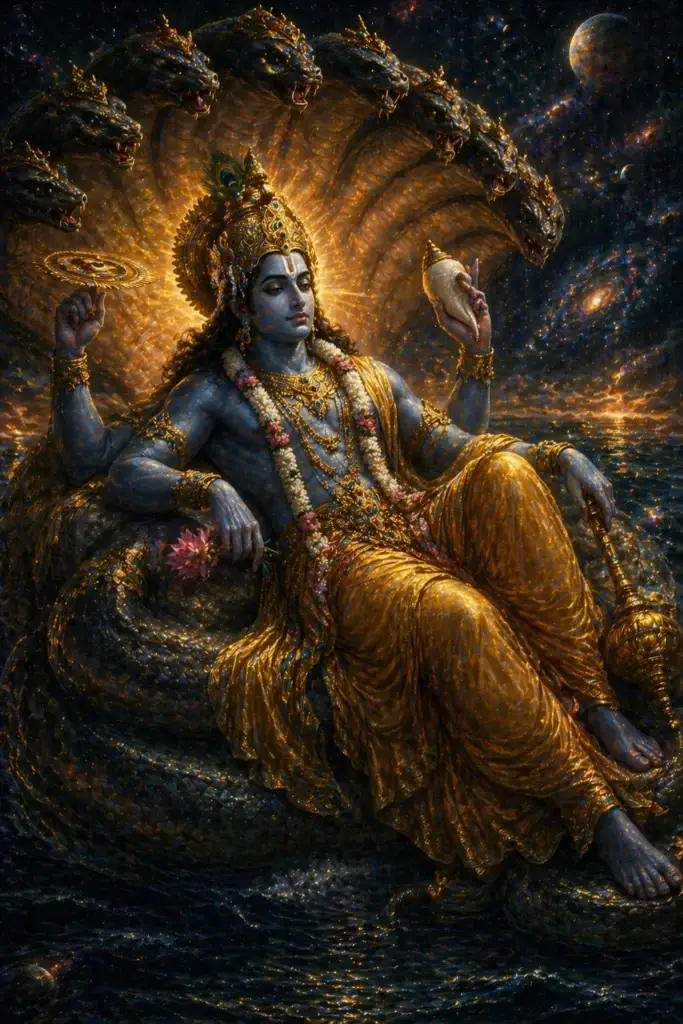
Hindu goddess, consort of Vishnu and his constant companion. In the Rig Veda (about 1500 to 1200 BCE) she still appears as an abstract principle of good fortune; in the Sri Sukta she is invoked as a goddess for the first time. After the churning of the ocean of milk she rises from the waves on a lotus blossom and chooses Vishnu as her husband.
Lakshmi is the goddess of prosperity, good fortune, beauty and fertility and is worshipped as giver of material and spiritual abundance. In Sri Vaishnavism she is also regarded as mediator between human and god and as Vishnu’s shakti, without whom he is unthinkable.
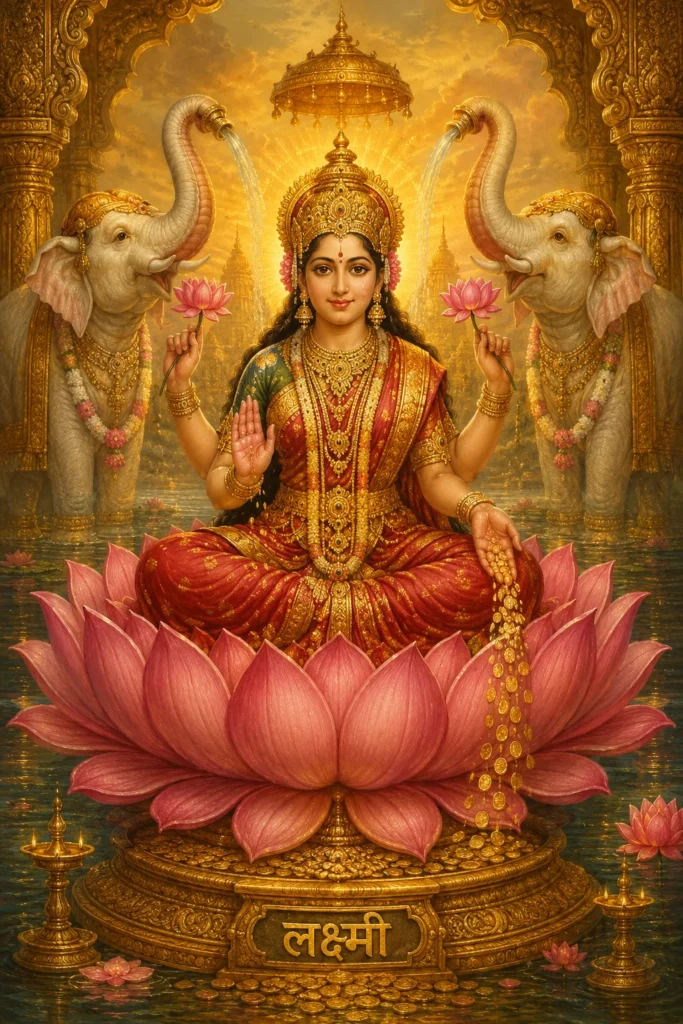
Lakshmi sits on a fully blossomed lotus and has four arms: two hands hold lotus flowers, one gives blessing, the fourth scatters gold coins. She wears a red garment with gold thread and rich jewellery. White elephants pour water over her, and the owl is her animal companion.
The main festival is Diwali, the “night of lights” in October or November: houses are decorated with oil lamps, families perform the puja for Lakshmi, and accountants give their account books to the goddess’s blessing. Important temples are the Sri Venkateshwara Temple in Tirumala and the Mahalaxmi Temple in Mumbai.
The main symbol is the lotus, which signifies the spiritual purity that rises from the mud of the material world. The gold coins stand for abundance, the elephants for royal power and rain, the owl in Bengal for vigilance over wealth.
Saraswati (learning) and Parvati (power) form with Lakshmi (prosperity) a triad that in Tantra is read as the manifestation of the one great goddess Mahadevi. Her sister Alakshmi personifies misfortune and poverty.
Myth and Origin
In the Rig Veda (around 1500-1200 BCE), Lakshmi does not yet appear as a fully developed goddess, but as an abstract principle of fortune and promise. In the Sri Sukta (an appendix to the Rig Veda) she is first invoked as a personified goddess.
There it reads: “Bring me the goddess Lakshmi, golden in color, with golden ornaments, of fair form, shining like the moon.” This early hymn is the basis of later Lakshmi theology.
The central mythic narrative about Lakshmi’s origin is the churning of the milk ocean (Samudra Manthana), recounted in the Mahabharata (Adi Parva 18) and in several Puranas, above all in the Vishnu Purana (Book 1, Chapter 9) and the Bhagavata Purana (Book 8, Chapter 8).
Gods and demons together churn the primordial ocean, using Mount Mandara as the churning rod and the serpent Vasuki as the rope.
From the churning emerge many precious beings and things, among them the sun, the moon, the wish-fulfilling tree, the wish-granting cow and finally Lakshmi herself. She rises upon a lotus blossom from the waves, radiant in beauty, and chooses Vishnu as her consort.
This birth from the primordial ocean is one of the best-known mythologemes of Hinduism.
Wendy Doniger, in “Hindu Myths” (1975) and “The Origins of Evil in Hindu Mythology” (1976), analyzed the cosmological significance of the churning: it is a creation through the mixing of opposing forces (gods and demons, ascent and descent, light and darkness), and Lakshmi emerges as the fruit of this cosmological tension.
The mythic narrative of the churning of the milk ocean (Samudra Manthana) is among the most iconographically present episodes of Hindu mythology.
It is depicted in many temple reliefs of the subcontinent and of Southeast Asia, including the famous reliefs of Angkor Wat (Cambodia, 12th century), which unfold the entire scene across a wall length of over 50 meters. This iconographic spread shows the fundamental significance of the myth for Hindu and Hinduized culture.
The theological interpretation of Lakshmi’s birth from the primordial ocean developed its own character in Sri Vaishnavism. Ramanuja (11th/12th c.) and Vedanta Desika (14th c.) conceived of Lakshmi as a Shakti eternally existing within Vishnu, who did not first come into being at the churning but became visible at the churning.
This doctrine of the eternally present, yet at times concealed, goddess stands in contrast to the popular-religious view, which understands Lakshmi as a real cosmic birth process. Both views coexist in modern Hinduism and reflect the complexity of Hindu theology.
Symbols and Attributes
Lakshmi’s most prominent attribute is the lotus flower. She sits upon a fully bloomed lotus, holds lotus blossoms in two hands, and her epithet is Padma (“lotus”) or Kamala (“lotus”).
The lotus symbolizes spiritual purity that rises from the mud of the material world without being soiled by it. This image is among the strongest visual identifiers of Hindu iconography.
She is typically depicted with four arms. Two hands hold lotus blossoms, a third bestows a blessing (varada-mudra), the fourth scatters gold coins. This coin iconography reinforces her character as a bestower of material abundance. She wears a red garment, often embroidered with gold thread, and rich ornaments.
Her companions are white elephants that pour water over her. This motif of Gaja-Lakshmi (Lakshmi with elephants) is one of the oldest forms of representation, already tangible on the reliefs of Bharhut and Sanchi (1st century BCE) and in the Shunga period. The elephants symbolize royal power and rain, both conditions for prosperity.
Her mounts or companion animals are the owl (Ulukam) and the elephant. The owl is associated with Lakshmi above all in Bengal.
This connection is unusual, because the owl is otherwise regarded in many cultures as a symbol of misfortune. David Kinsley, in “Hindu Goddesses” (1986), showed that for Lakshmi the owl symbolizes watchfulness over wealth.
Cult and Worship
Lakshmi’s main festival is Diwali (Sanskrit Dipavali, “night of lights”), celebrated in October or November. Houses are adorned with oil lamps to attract Lakshmi, who is said to enter only bright and clean homes.
On this night families perform Lakshmi Puja, often accompanied by accountants who entrust their account books to the goddess’s blessing. In western India the business year begins at Diwali.
The most important Vishnu-Lakshmi temple is the Sri Venkateshwara temple in Tirumala (Andhra Pradesh, South India). It is regarded as the most pilgrimage-frequented temple in the world, with about 50,000 to 100,000 pilgrims daily.
Here Vishnu is venerated as Venkateshwara and Lakshmi as Padmavati. The Lakshminarayan temple in Delhi (built 1933-1939) and the Mahalaxmi temple in Mumbai are also among the most important centers.
In South Indian Sri Vaishnavism, a tradition systematically developed in the 11th and 12th centuries by Ramanuja, Lakshmi is not only Vishnu’s consort but a mediator (Purushakara) between human and god.
The writings of the Alvars (South Indian Vishnu-Bhakti poets, 6th-9th century) address many hymns directly to Sri (Lakshmi) as a bridging figure. This Lakshmi theology founded a school of its own within Vaishnavism.
Popular Lakshmi worship includes the veneration of the “Eight Lakshmis” (Ashta-Lakshmi). These eight manifestations embody various aspects of prosperity: Adi-Lakshmi (primordial prosperity), Dhana-Lakshmi (monetary wealth), Dhanya-Lakshmi (grain wealth), Gaja-Lakshmi (wealth of animals and royalty), Santana-Lakshmi (wealth of offspring), Vira-Lakshmi (wealth of heroism), Vijaya-Lakshmi (wealth of victory) and Vidya-Lakshmi (wealth of learning).
Important Myths
The principal myth is the birth from the milk ocean (see myth and origin above). An important variant of this birth narrative is transmitted by the Vishnu Purana (1.9). Here Lakshmi is introduced as the daughter of the sage Bhrigu and his wife Khyati.
She incarnates from the primordial ocean, after she had earlier left the world through the curse of the sage Durvasa. This narrative doubling (born twice) accounts for the differing traditions.
A second central myth concerns her avatars as consorts of Vishnu’s incarnations. In the Ramayana she is Sita, the consort of Rama, born from a furrow of a field. In the Mahabharata she is Rukmini, the chief consort of Krishna.
In other avatara narratives she appears as Padma (with Vishnu’s Vamana avatar), as Dharani (with Parashurama) and in further forms. This genealogical interweaving with every Vishnu incarnation underscores the inextinguishable bond of the two deities.
A third myth is Lakshmi’s withdrawal from Indra. In the Vishnu Purana (1.9) Lakshmi leaves heaven because Indra has grown arrogant. The world becomes impoverished. The gods churn the milk ocean to win her back. This story has a moral and admonitory function: prosperity is a gift that presupposes humility; arrogance drives Lakshmi away.
A fourth myth, central to the Sri Vaishnava tradition, is the Doshasringaranama: Lakshmi defends sinful humans before Vishnu and mediates between grace and justice. This theological role is systematically developed in the writings of Ramanuja and Vedanta Desika (14th century).
Lakshmi’s avatar incarnations as consorts of Vishnu’s incarnations are a singular phenomenon in comparative Hindu mythology. In no other god-goddess constellation of Hinduism is the genealogical correspondence so complete. Sita with Rama, Rukmini with Krishna, Padma with Vamana, Dharani with Parashurama: everywhere Lakshmi accompanies her husband through all incarnations.
In terms of religious history, this correspondence is a reflection of the theological conviction that Vishnu is not conceivable without his Shakti. In the Sri Vaishnava writings, above all in Ramanuja’s “Vedarthasangraha” and Vedanta Desika’s “Sri Stuti,” this theology is worked out.
Lakshmi is not only Vishnu’s wife, but his essential self-expression. Without her, Vishnu is sava, lifeless; without him, she is unordered. This complementary theology founded its own schools in the Middle Ages, including the Vadakalai and Tenkalai currents of Sri Vaishnavism, which remain vividly expressed to this day.
Relationships within the Pantheon
Lakshmi’s main relationship is with Vishnu. In all Vishnu avatars she is his consort: Sita with Rama, Rukmini with Krishna, Padma with Vamana, Dharani with Parashurama. This avatara chain is central to the Vishnu-Bhakti tradition and is depicted in numerous temple reliefs.
Her sister (in some traditions) is Alakshmi, the personification of misfortune and poverty. Alakshmi too was born from the milk ocean, before Lakshmi. She is depicted riding on a donkey, with a decayed appearance and inauspicious attributes.
The veneration of Lakshmi implies the warding off of Alakshmi. At Diwali a lamp is lit before the house entrance to attract Lakshmi and to keep Alakshmi away.
Her relationships with other goddesses are complex. Saraswati (learning) and Parvati (power) form, together with Lakshmi (prosperity), a triadic constellation in which the three most important aspects of life are represented. This triad is often read in the Tantra tradition as a manifestation of the one great goddess (Mahadevi).
Reception and Influence
In classical Sanskrit literature Lakshmi is celebrated in numerous Kavyas (art poetry) and Mahakavyas (heroic epics). Kalidasa (probably 4th or 5th century) devotes verses to her in several works.
The Bhakti literature of the Middle Ages, above all the works of the Alvars and Annamacharya (15th c.), gives Lakshmi a central place in the liturgy.
In the visual art of India, Lakshmi has been one of the most frequent representations of a deity from the 1st century BCE to the present. The Shunga period (2nd to 1st century BCE) shows Gaja-Lakshmi reliefs, the Gupta period (4th-6th century) produces the classical lotus form.
In the Pallava and Chola bronze art of South India, Lakshmi appears beside Vishnu upon the serpent Adisesha. This iconography was further developed through Mughal court art and through the bazaar art of the 19th and 20th centuries.
In modern Indian society Lakshmi is omnipresent. She adorns banknotes, calendars and account books. Indian women are often named Lakshmi, which points directly to the wish for prosperity. Banks and insurance companies in India bear the name Lakshmi or one of her aspects (Mahalakshmi, Padmavati).
In the West, Lakshmi became known through the Indology of the 19th and 20th centuries. Heinrich Zimmer devoted a detailed section to her in “Myths and Symbols in Indian Art and Civilization” (1946). In present-day intercultural spirituality she is often interpreted as a universal symbol of abundance.
Classification in Religious Studies
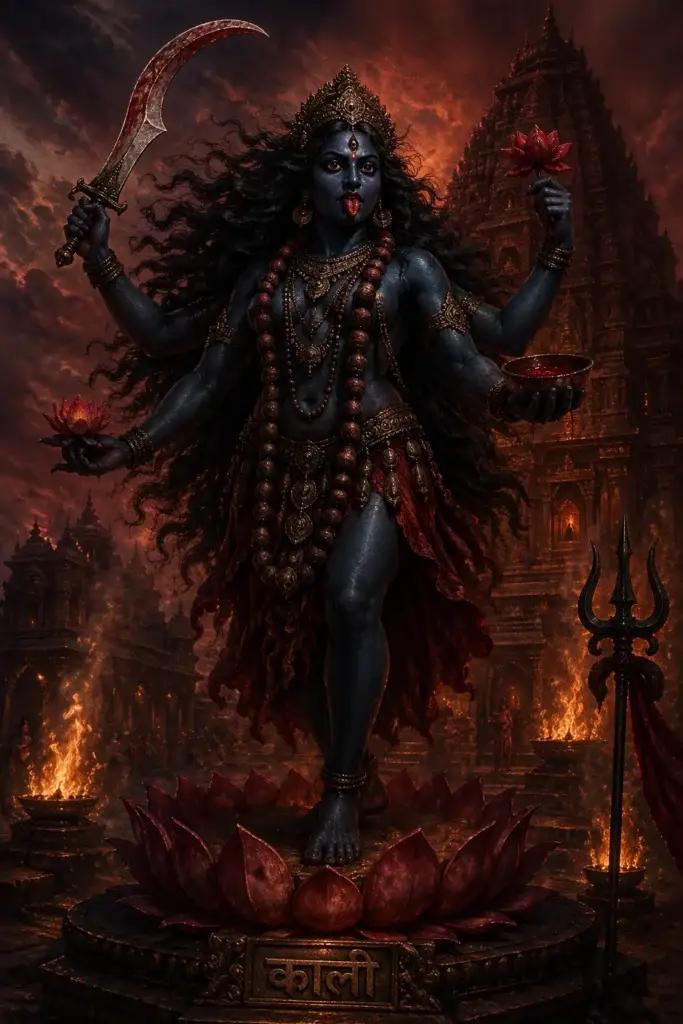
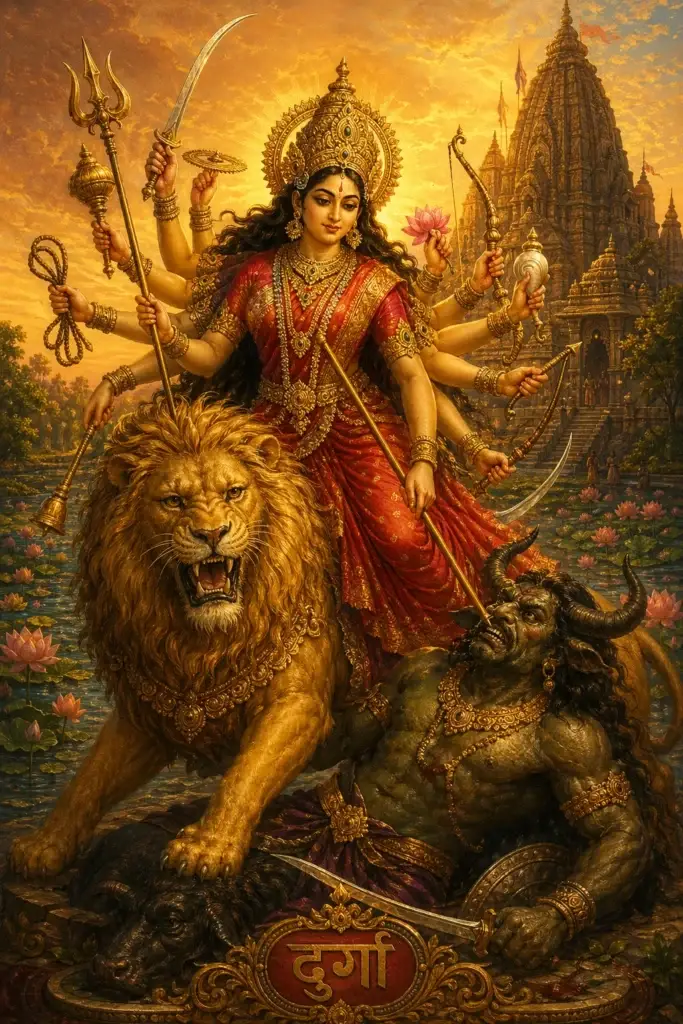
David Kinsley, in “Hindu Goddesses” (1986), classified Lakshmi as a paradigm of the benevolent goddess (saumya), in contrast to warlike goddesses such as Durga or Kali. Her character traits are gentleness, beauty, bestowal. This classification has largely prevailed in scholarship.
In terms of the sociology of religion, Lakshmi is a key example of the relationship between religious cult and economic behavior. Max Weber, in “Hinduism and Buddhism” (1916-17), analyzed Hindu economic ethics without treating Lakshmi specifically.
Later scholars such as C. J. Fuller in “The Camphor Flame” (1992) have precisely documented the connection between Lakshmi worship and mercantile values in India.
In the theological context, Lakshmi is regarded in the Sri Vaishnava tradition as the eternal consort of Vishnu, his co-sovereign (sahacharee). She is Shakti (power) and Aishvarya (sovereignty) of Vishnu; without her, Vishnu is not conceivable.
This theological doctrine was systematically unfolded by Ramanuja in the “Vedarthasangraha” (12th c.) and by Vedanta Desika in the “Sri Stuti” (14th c.). Klaus Klostermaier presented this theology accessibly in “A Survey of Hinduism” (3rd ed. 2007).
The position of Lakshmi in the sociology of religion is singular within Hinduism. She combines the highest theological esteem with comprehensive popular-religious presence.
Business people pray to her at openings, bankers bless transactions with her name, wedding couples invite her as a protecting goddess. This ubiquity in the economy has led scholarship to characterize Lakshmi as a goddess of the Hindu middle class.
C. J. Fuller, in “The Camphor Flame” (1992), examined the close connection between Lakshmi worship and mercantile identity in South India. Banks, insurance companies and trading enterprises bear Lakshmi names, which in the 20th and 21st centuries has led to a veritable commercial iconization of the goddess.
In Tantrism Lakshmi appears in forms of her own. The Lakshmi Tantras (for example the Lakshmi Tantra, 9th-13th c.) belong to the Pancharatra school of Vaishnavism and develop a complex Lakshmi theology in which the goddess is conceived as the cosmic motive force of Vishnu.
These texts were first made systematically accessible in Western scholarship through Vasudha Narayanan and Sanjukta Gupta in the 1980s and 1990s. They show that Lakshmi theology is not a simple female-Vishnu auxiliary figure, but an independent metaphysical construction.
Sources and Further Reading
Primary sources: Rig Veda with the Sri Sukta (around 1500-1200 BCE), Vishnu Purana Book 1, Chapter 9 (around 1st-4th c. CE), Bhagavata Purana Book 8, Chapter 8 (around 9th-10th c.), Mahabharata Adi Parva 18, Ramayana, works of the Alvars (especially Andal, Nammalvar). Ramanuja “Vedarthasangraha” (12th c.), Vedanta Desika “Sri Stuti” (14th c.). English translations: Vishnu Purana by Horace Hayman Wilson (1840, reprint 1972), Bhagavata Purana Book 10 (“Krishna: The Beautiful Legend of God”) by Edwin Bryant (2003).
Secondary literature: David Kinsley “Hindu Goddesses” (1986), Wendy Doniger “Hindu Myths” (1975) and “The Origins of Evil in Hindu Mythology” (1976), Heinrich Zimmer “Myths and Symbols in Indian Art and Civilization” (1946), Klaus Klostermaier “A Survey of Hinduism” (3rd ed. 2007), Axel Michaels “Der Hinduismus” (2nd ed. 2006), C. J. Fuller “The Camphor Flame” (1992), Gavin Flood “An Introduction to Hinduism” (1996), Madeleine Biardeau “Hinduism: The Anthropology of a Civilization” (1989), Vasudha Narayanan “The Vernacular Veda” (1994).