Gwyllion, wandering spirits of the Welsh heights
By Ralf Ittermann · last reviewed on
The Gwyllion are spirits of the Celtic tradition of Wales.
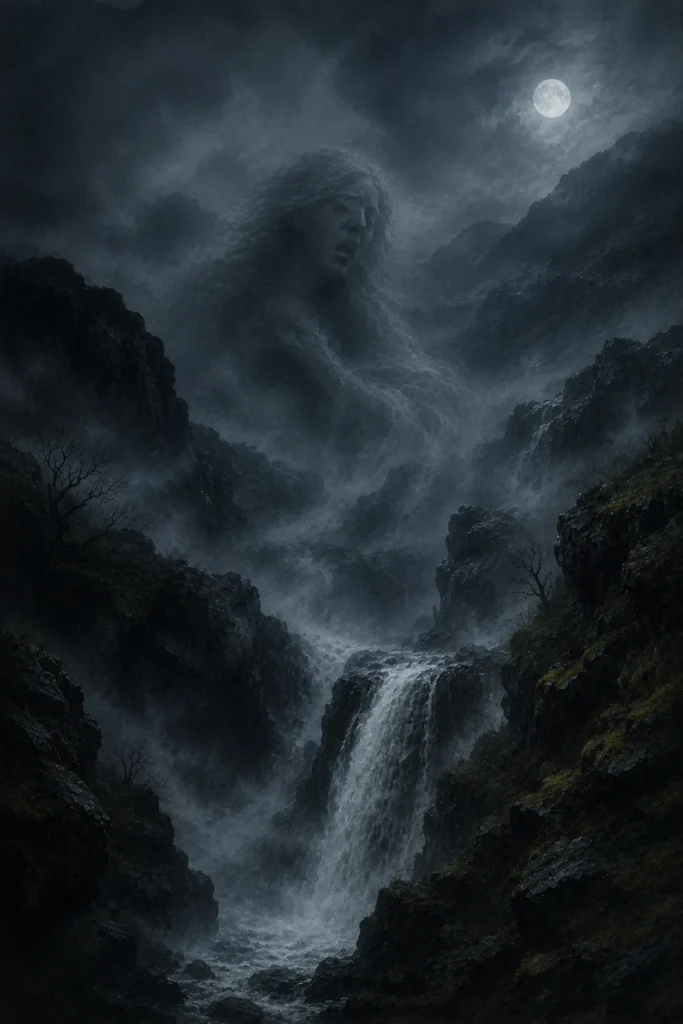
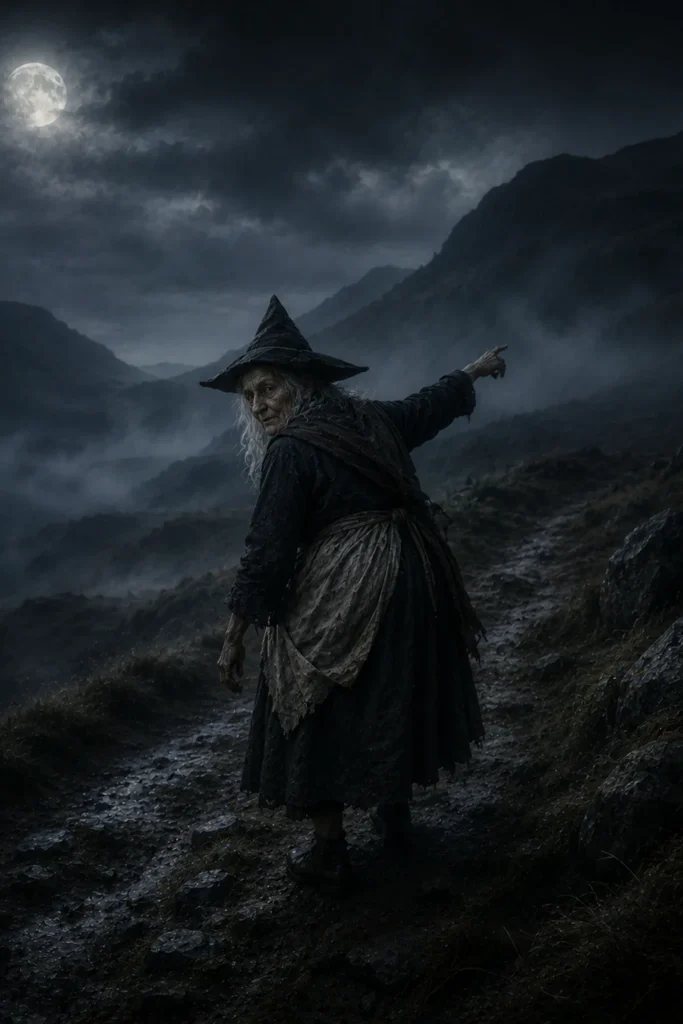
The Old Woman of the Mountain leads travellers astray at night. Wandering spirits of the Welsh heights, the Gwyllion were blamed for travellers led astray at night.
The Gwyllion are Welsh mountain spirits, eerie female beings of the mountains and lonely paths, who lead travellers astray at night. They are considered dark, witch-like and haunting, and are to be distinguished from the friendlier Ellyllon, the Welsh elves.
Their best-known figure is the Old Woman of the Mountain, recorded from Llanhyddel Mountain in Monmouthshire. Anyone who encounters the Gwyllion has a tried and tested remedy: they shun knives and iron, and drawing a knife will drive them away.
Type: Female mountain and night spirits
Origin: Welsh folklore, classically in Sikes 1880
Texts: Sikes, British Goblins; Rhys, Celtic Folklore
Period: 19th-century Welsh folklore, with older roots in folk belief
Appearance: dreadful female figures, the old one as a poor old woman with a four-cornered hat
Textual history
Period of the Texts
The Gwyllion belong to Welsh folklore; they were classically documented by Wirt Sikes in 1880 and by John Rhys.
Area of Diffusion
Wales, more precisely the mountains and lonely paths; the Old Woman of the Mountain at Llanhyddel Mountain in Monmouthshire is named in tradition.
Sources
The source material is good: Sikes and Rhys document the tradition, and Briggs classifies the warding off by iron in comparative terms.
Name and variants
Welsh: The name goes back to gwyll, twilight, darkness or spirit and shadow, related to gwyllt, wild. It refers to female-connoted mountain and night spirits; even the name places them in the twilight zone between darkness and wilderness.
Nature and effect
Appearance
The Gwyllion are terrible female figures. Their best-known representative, the Old Woman of the Mountain, appears as a poor old woman wearing a four-cornered hat, with her apron thrown over her shoulder.
Effect
The Gwyllion lead travellers astray at night. They are considered dark, witch-like and haunting, and are to be distinguished from the friendlier Ellyllon, the Welsh elves; their danger lies not in an intent to kill but in the fact that losing one’s way in the mountains is genuinely dangerous.
Profile: Gwyllion
The key aspects of the Welsh mountain spirits at a glance.
Female-connoted mountain and night spirits of Welsh folklore, named after gwyll, twilight, and classically documented by Sikes.
Night-time travellers in the mountains and on lonely paths of Wales, who are led astray by the Gwyllion.
Terrible female figures; the Old Woman of the Mountain as a poor old woman with a four-cornered hat and her apron thrown over her shoulder.
Leading night-time travellers astray; in tradition dark, witch-like and haunting, without any documented intent to kill.
Drawing a knife drives away the Gwyllion; they shun cold iron. The Old Woman vanished when a man drew his knife.
The Gwyllgi, the hound of darkness, is linguistically related but a different being; the friendlier ones are the Ellyllon, the Welsh elves.
From gwyll to the Old Woman of the Mountain
The name of the Gwyllion goes back to Welsh gwyll, twilight, darkness or spirit and shadow, related to gwyllt, wild. They are female-connoted mountain and night spirits, at home in the Welsh mountains and on lonely paths; the classic documentation comes from Wirt Sikes in 1880.
The Old Woman of the Mountain at Llanhyddel Mountain in Monmouthshire is named in tradition. In popular belief she was interpreted as the spirit of a woman thought to be a witch; however, this witch origin is a local interpretation and not a consistent feature of all Gwyllion.
Afterlife in regional folklore
The Gwyllion are a fixed entry in fairy reference works and are present in modern Welsh regional folklore of the Brecon Beacons.
From a religious-studies perspective, the Gwyllion are misleading and frightening, without documented intent to kill, yet losing one’s way in the mountains is genuinely dangerous. Two clarifications are important: the Gwyllion are not to be equated with the Gwyllgi, the hound spirit. And the witch origin of the Old Woman is a local interpretation, not a consistent feature of all Gwyllion.
The drawn knife: warding off by iron
It is documented that drawing a knife drives away the Gwyllion; the Old Woman of the Mountain vanished when a man drew his knife. The witnesses disagree on the interpretation of this custom: Sikes presents it as a specifically Welsh tradition of banishment, while Briggs interprets it as an expression of the general vulnerability of fairies to cold iron.
Hags, mountain fairies and the Gwyllgi
The Gwyllion stand alongside the hags and mountain fairies in general; in the Alpine region, the Salige Frau represents a very differently toned female mountain figure. Clearly to be distinguished is the Gwyllgi, the hound of darkness, a black spectral hound: it is linguistically related but a different being. Underground in Wales, by contrast, the friendly Coblynau are at work.
Frequently asked questions about the Gwyllion
What are the Gwyllion?
Eerie female mountain spirits of Wales who lead travellers astray at night. Their best-known figure is the Old Woman of the Mountain.
How can they be warded off?
By drawing a knife; they shun cold iron.
Are they the same as the Gwyllgi?
No. The Gwyllgi is a hound spirit; the Gwyllion are female mountain spirits.
Further links
Further reading:
- Celtic – all beings of Celtic tradition
- Coblynau – the friendly mine spirits of Wales
- Salige Frau – the female mountain figure of the Alpine region
- Iron, Amulet, Salt – traditional protective means
- Protection Compass – protective means at a glance
Literature (selection)
Further standard works in the bibliography.
As Welsh mountain spirits, the Gwyllion embody the uncanniness of the nocturnal heights, and the Old Woman of the Mountain remains their best-known face to this day.