Shellycoat, the prankster in a clattering shell garment
By Ralf Ittermann · last reviewed on
Shellycoat is a spirit of Scottish tradition.
A shell-clad trickster who leads travelers in circles. Shellycoat is counted among the water spirits in Scottish legends, and this entry describes what that classification entails. Shellycoat is a prankster among the water spirits of Scottish legend.
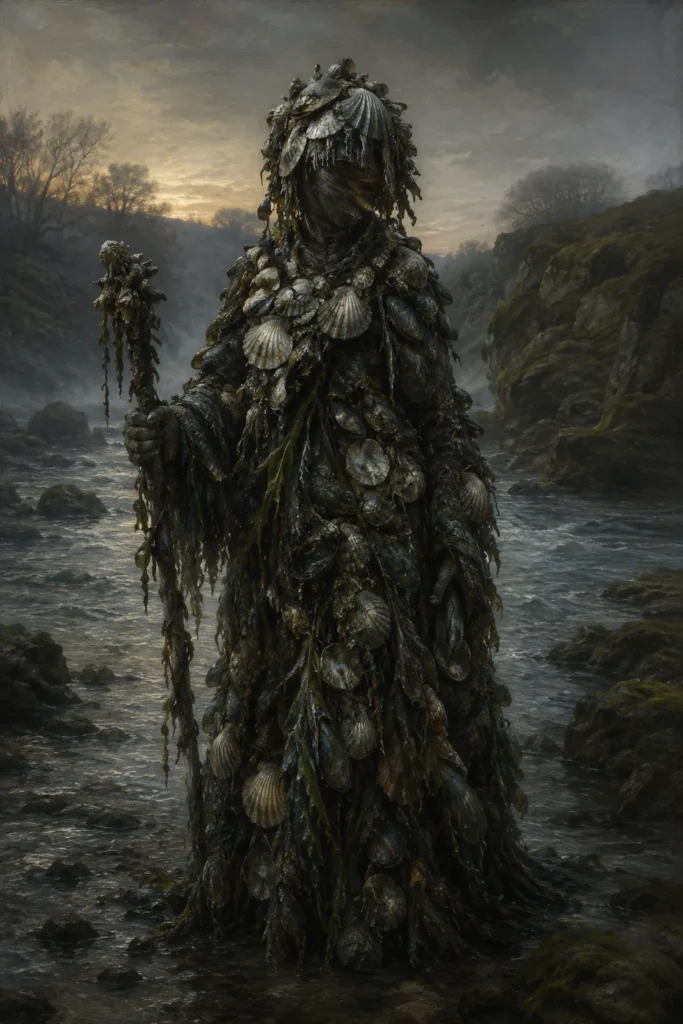
The Shellycoat is a water spirit of the Scottish borderlands, clad in a shell-hung, clattering garment.
Walter Scott recorded him as a bogle in 1802. He teases travellers and leads them in circles, but is considered less dangerous than the Kelpie.
Type: water spirit in a shell-hung garment
Origin: Scottish-English Borders legend cycle
Texts: Scott (1802); Briggs
Period: attested in writing since 1802
Appearance: humanoid, shell-hung figure
Source Context
Period of the Texts
Attested in writing since 1802 in Scott, established as a fixture of fairy lexicons through Briggs.
Area of Diffusion
Southern Scotland, especially the Scottish Borders, and northern England.
Sources
Solid: Scott’s first mention and Briggs’s work form the basis.
Name and variants
Language: Shellycoat, from shell and coat, names the telltale garment.
Form and Effect
Appearance
The clattering shell garment never allows him to be silent.
Effect
He feigns drowning victims, bursts into laughter and vanishes with a splash. He leads night wanderers in circles; his effect remains mockery.
Profile: Shellycoat
The key features at a glance.
Borders legend cycle, put into literary form since 1802.
Travellers at rivers, fords and coasts at night.
Humanoid figure, hung with clattering shells.
Teasing and misdirection, no deadly attack.
Stay calm, do not follow cries for help; protective means are scarcely attested.
Jenny Greenteeth, Grindylow, nix-like beings; Kelpie as a counterpart.
From the bogle of the Borders to a namesake of the coast
Shellycoat is made up of shell and coat. Scott recorded the figure in 1802 as a bogle whose clattering announces its arrival.
Scott notes that the Shellycoat gave its name to rocks on the coast, and describes how it leads travellers in circles and vanishes laughing.
From Borders bogle to literary goblin
Ennobled in literature by Scott, the Shellycoat entered Borders folklore and, through Briggs, belongs to the canon of British fairy lexicons.
In terms of religious studies, it is a warning spirit between land and water, without reaching the demonic type of the Kelpie.
Why no fixed protective means exist
Fixed rites of protection are scarcely attested, as tradition emphasises the harmlessness of the Shellycoat. Anyone who does not follow cries for help escapes the deception, since the clattering and laughter give away the haunting.
Nix-like water spirits of the Borders
The Shellycoat belongs to the English-Scottish water spirits with nix-like character, alongside Jenny Greenteeth and Grindylow. The Kelpie kills where the Shellycoat only fools.
Frequently asked questions about the Shellycoat
Is the Shellycoat dangerous?
Barely: it teases and confuses, unlike the deadly Kelpie.
Where does the name come from?
From the shell-hung garment, from shell and coat.
Literature (selection)
Further standard works in the bibliography.
Anyone searching for the Shellycoat water spirit finds a harmless shell-cloaked goblin: his rattling announces him, his laughter gives him away.