Caoineag, the unseen warner before Glencoe
By Ralf Ittermann · last reviewed on
Caoineag is a spirit of Scottish tradition.
Her nightly wailing heralds the death of a clan member. The article names Caoineag an unseen warner whose nightly wailing foretold the death of a clan member.
Caoineag, the Weeping One, is a wailing spirit of the Scottish Highlands. Usually invisible, her nightly lament heralds the death of clan members, especially those fallen in battle. According to tradition, each clan has its own Caoineag, who foretells the death of its own people and mourns the fallen.
Before the Massacre of Glencoe in 1692, the Caoineag of Clan MacDonald is said to have wailed night after night; whoever took her weeping seriously and left the glen escaped the fate of those who remained. Alexander Carmichael records fragments of her laments in the Carmina Gadelica.
Type: death omen, wailing spirit type of the banshee family, bound to a clan
Origin: oral tradition of the Scottish Highlands
Texts: Alexander Carmichael’s Carmina Gadelica
Period: Highland tradition, put into writing around 1900
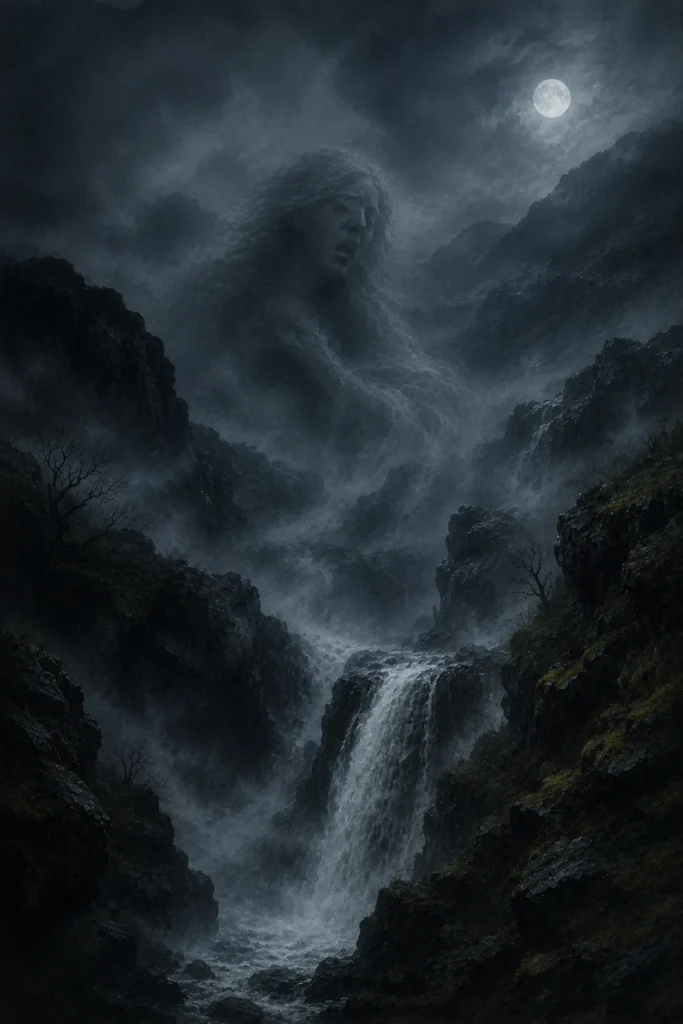
Appearance: mostly invisible, audible only as wailing at a waterfall, stream or ravine
Context of tradition
Period of the Texts
The Caoineag belongs to the oral Highland tradition of Scotland and is documented above all through Alexander Carmichael’s collection Carmina Gadelica.
Area of Diffusion
The Scottish Highlands are her core region; the variant caointeach is attested particularly on the island of Islay.
Sources
Good: above all Alexander Carmichael’s Carmina Gadelica, supplemented by the collections of James MacKillop, Katharine Briggs and Donald A. Mackenzie.
Name and variants
Language: Gaelic from caoin, to weep or lament, related to the Gaelic death-lament: Caoineag means the Weeping One. Further forms are caointeag and caoineachag; the Islay variant caointeach is regarded as a distinct fairy or water spirit.
Appearance
Appearance
The Caoineag remains mostly invisible; only her weeping is heard at a waterfall, stream, loch, in a ravine or on a mountainside. The Islay variant caointeach, by contrast, appears visibly at a death by illness, wearing a green mantle at the door. The invisibility heightens her character as an omen; her lament mirrors the real Gaelic death-lament and concentrates the collective grief of an entire clan.
Effect
The Caoineag is a warning sign of death and misfortune, especially in war, and frightens parents whose sons are on the battlefield. The caointeach variant, if disturbed, strikes the legs of the person concerned with her wet linen cloth, who then loses the use of them, similar to the Bean-nighe of Skye.
Profile: Caoineag
The key aspects of the weeping herald of death at a glance.
A wailing spirit type of the banshee family in the Gaelic-Scottish Highland tradition, bound to a single clan.
An entire clan, whose impending death in battle or through misfortune she heralds with her lament.
Mostly invisible, audible only as weeping; the Islay variant appears visibly wearing a green mantle.
Nocturnal warning sign of death and misfortune, especially in war; cannot be outwitted or questioned.
Heed the warning and leave the endangered place, as happened at the Massacre of Glencoe.
The Bean Nighe and the Welsh Cyhyraeth, with whom she shares the type of the wailing death omen.
The Weeping One and the Massacre of Glencoe
The name Caoineag is Gaelic and derives from caoin, to weep or lament, related to the Gaelic death-lament: it simply means the Weeping One. Other forms include caointeag and caoineachag; on Islay, the variant caointeach is described as a distinct fairy or water spirit. According to tradition, every clan has its own Caoineag, who foretells the death of clan members and mourns the fallen.
Her best-known appearance came before the Massacre of Glencoe in 1692: the Caoineag of Clan MacDonald is said to have lamented night after night before the clan’s hospitality was betrayed and many MacDonalds died in their sleep. According to tradition, those who took her lament seriously and left the glen in time escaped the fate of those who stayed behind. Alexander Carmichael recorded fragments of her laments in the Carmina Gadelica.
Remembering Glencoe
The Caoineag is present in Scottish memory culture chiefly through the Massacre of Glencoe and is regularly listed in collections of Scottish folklore and Highland ghost stories. She has been adapted into popular culture less often than the Bean-nighe or the Ankou.
In terms of religious studies, the Caoineag is a collective death omen tied to a clan, without a psychopomp function: she does not kill and does not guide souls herself, but only announces death. She embodies the Gaelic lament tradition within the supernatural realm and belongs to the Celtic-Scottish circle of the Banshee.
Heeding the warning: dealing with the Caoineag
Unlike the Bean-nighe, the Caoineag cannot be addressed, questioned or forced to grant wishes; according to tradition, outwitting her is not possible. One attested protection is to heed her warning and leave the endangered place, as happened at the Massacre of Glencoe. In one account, the Islay variant caointeach is driven away after being pitied and given a piece of clothing. In further dealings with the wailing herald of death, folk practice turned to holy water, the protective candle of the wake, and cold iron, which in Celtic folklore is regarded as protection against beings of the Otherworld.
From the Bean-nighe to the Welsh death omens
The Caoineag is closely related to the Bean Nighe and the Irish Banshee; she is considered their invisibly wailing type. In Wales, her counterparts are the Cyhyraeth and the Gwrach y Rhibyn, the Welsh wailing death omens. Mythologically related is also the Celtic Cailleach.
Frequently asked questions about the Caoineag
How does the Caoineag differ from the Bean-nighe?
The Caoineag is usually invisible, only audible, bound to an entire clan and cannot be outwitted. The Bean-nighe, by contrast, is visible, washes death shrouds and can be forced to grant wishes.
What connects her to Glencoe?
According to tradition, before the massacre of 1692 the Caoineag of Clan MacDonald lamented for nights on end; those who then left the glen survived.
Can her warning be escaped?
Indirectly, by following it and leaving the endangered place. The Caoineag cannot be forced or questioned.
Further links
Further reading:
- Celtic – the Celtic gods and spirits of Britain
- Bean Nighe – the Scottish washerwoman at the ford
- Cyhyraeth, Gwrach y Rhibyn – Welsh death omens
- Holy water, protective candle, iron – traditional protective means
Literature (selection)
Further standard works in the bibliography.
As a Scottish figure of lament, Caoineag remains above all the Weeping One of the Highland clans: not a being that can be questioned or outwitted, but a voice that announces death and whom only those who leave the glen in time may heed.