Selkie, the seal wife of Sule Skerry and Mikladalur
By Ralf Ittermann · last reviewed on
Selkie is a spirit of Scottish tradition.
A stolen sealskin binds her, her curse strikes wrongdoers. As a seal being of the Scottish islands, the Selkie is closely tied to the motif of the stolen skin.
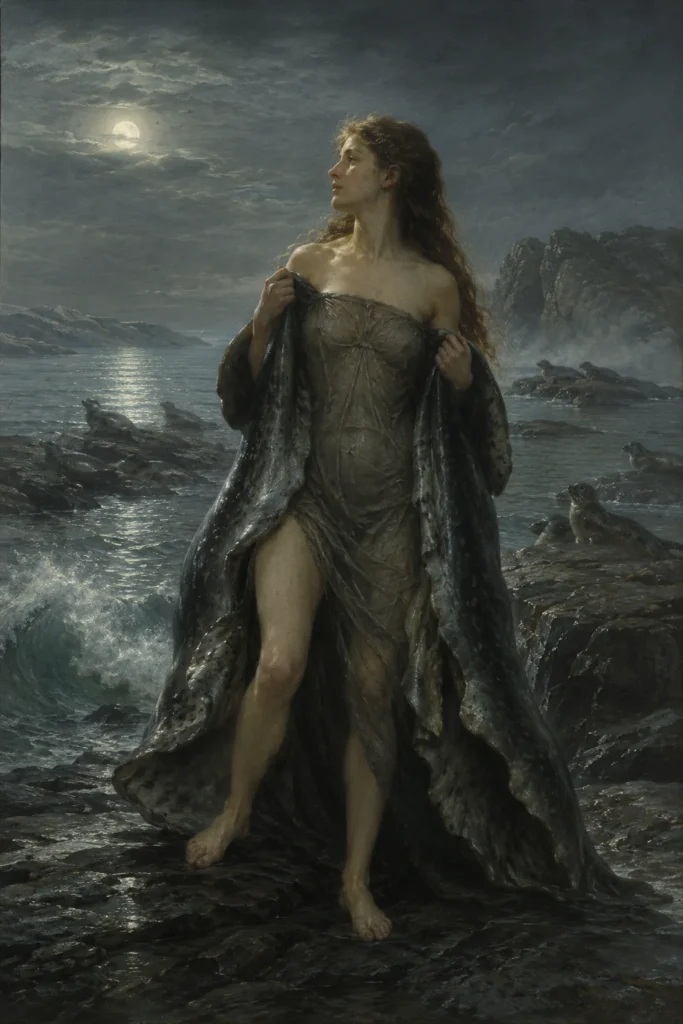
Selkies are the seal folk of the northern Scottish islands: seals in the sea, and on land, after shedding their skin, people of striking beauty. Famous is the ballad of the Silkie of Sule Skerry (1852).
The Kópakonan legend of the Faroes tells of the curse of a betrayed seal wife.
Type: seal person of the northern Scottish islands
Origin: Orkney, Shetland, the Hebrides, the Faroes
Texts: ballads, collections of legends, 19th/20th century
Period: recorded since 1852, older cores
Appearance: seal in the sea, beautiful person on land
Source Context
Period of the Texts
Attested in writing since the ballad printed in 1852, though the narrative cores are considered significantly older.
Area of Diffusion
Orkney, Shetland, the Hebrides and the Faroes.
Sources
Extensive: Child’s ballad collection and Traill Dennison’s records.
Name and variants
Scots: Selkie is the Scots word for seal, older selch. In the Gaelic west the being is called ròn.
Appearance and Behaviour
Appearance
Barely distinguishable from a seal. On land, the skin makes them into people of great beauty.
Effect
Selkies dance on land on certain nights, dangerous almost only as avengers.
Profile: Selkie
The key features of the Selkie at a glance.
A distinct class of being on Orkney, set apart from the finfolk.
Fishing families of the islands, an origin legend for clans such as the MacCodrums.
A seal with large eyes in the sea, a person of great beauty on land.
Legends of marriage and parting, curses only as a response to seal killing or betrayal.
Keep the sealskin safely stored, spare the seals, no protective charm needed.
From Traill Dennison to the Kópakonan of Mikladalur
Selkie is the Scots word for seal. Traill Dennison described the selkie-folk of Orkney and Shetland in the 19th century as a distinct class, separate from the finfolk. The ballad of the Silkie of Sule Skerry, printed in 1852, tells of a seal-man who takes his child back into the sea; the MacCodrum family of the Hebrides was regarded as a seal clan.
Ballads, films and the statue of Kalsoy
The ballad of the Silkie of Sule Skerry has been set to music many times, for instance by Joan Baez in 1961; films such as Song of the Sea take up the material. As a migratory legend, marriage to the sea being only succeeds under duress.
Stored skin instead of protective charms
Tradition knows scarcely any protective ritual, as Selkies are not regarded as harmful beings. Anyone wishing to keep a Selkie wife stored her skin in a chest that was kept locked at all times.
The rule of protection is to spare the seals; talismans, amulets and secured thresholds still take up this motif today.
Roane, Merrow and the animal-bride legends
Closest to the Selkie is the Gaelic Roane, whose legends avoid any revenge, while the Selkie of Mikladalur becomes an avenger. Related are the Irish Merrow and the Breton Marie Morgane.
Frequently asked questions about the Selkie
Are Selkies dangerous?
Barely, harm arises almost only as retaliation for killed seals.
What distinguishes Selkies from mermaids?
The mermaid is a hybrid being, the Selkie a complete shapeshifter.
Further links
Links:
Literature (selection)
More in the bibliography.
As the seal wife of the Orkney coasts, the figure remains above all a Selkie legend of bonding and return, bound by the stolen skin, and in extreme cases, as at Mikladalur, becomes an avenger.