Grindylow, the long-armed terror of the ponds
By Ralf Ittermann · last reviewed on
Grindylow is a demon of English tradition.
A water demon that drags children into the water with its long arms. The account portrays this long-armed demon as a lurking terror at the edge of quiet ponds.
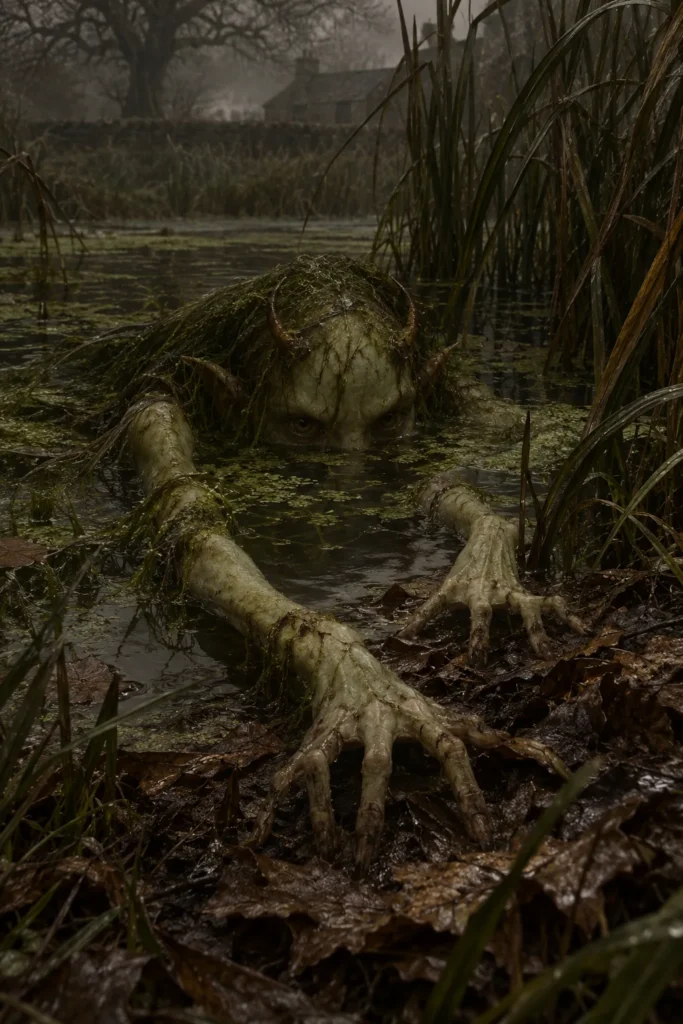
The Grindylow is a water demon from Yorkshire and Lancashire in northern England, a humanlike figure with long arms, brittle fingers, small horns and green teeth. With its long arms it seizes children at the edge of ponds, marshes and slow-moving canals and drags them into the water.
Its core function is deterrence: as a classic bogeyman for children, the Grindylow was meant to keep children away from the dangerous, overgrown waters of northern England. It is chiefly associated with still, shallow waters; the figure is recorded in collections of regional folklore from the early 20th century, also under the spelling Grundylow.
Its range of action is closely bound to the water’s edge, a targeted but place-bound threat whose real purpose is the warning itself.
Type: Water demon and bogeyman of still waters
Origin: Yorkshire and Lancashire in northern England
Texts: regional folklore, recorded in collections from the early 20th century, also as Grundylow
Period: documented since the early 20th century, presumably older in oral tradition
Appearance: humanlike, long arms, brittle fingers, small horns, green teeth
Traditional context
Period of the Texts
Local English folklore, only systematically recorded in collections in the early 20th century; the oral tradition is likely older.
Area of Diffusion
Yorkshire and Lancashire in northern England, associated with still, overgrown waters such as ponds, marshes, wells and slow-moving canals.
Sources
Regional folklore collections, also under the spelling Grundylow; the kinship with related northern English water bogeys is well documented.
Name and variants
English: The name probably derives from grindel, a word linked to the Old Norse term for grimness. It bears a connection to the name Grendel from Beowulf, which appears in Old English records linked to ditches, marshes and lakes.
Form and effect
Appearance
The Grindylow is humanlike, with long arms, long brittle fingers, small pointed horns and small green teeth, partly green-skinned. The green colour represents algae and stagnant water, and the long, grasping arms represent reaching out from the murky water.
Effect
The Grindylow seizes children at the water’s edge and pulls them down to drown them. Its range of action is limited to the edge of ponds, marshes, wells and slow-moving canals, a targeted but place-bound threat whose real purpose is deterrence from dangerous water.
Profile: Grindylow
The most important aspects of the water demon at a glance.
Local bogeyman of the northern English counties of Yorkshire and Lancashire, part of an entire family of water bogeys.
Children who carelessly approach still, overgrown waters: ponds, marshes, wells and slow-moving canals.
Green-skinned, humanlike figure with long arms, brittle fingers, small horns and green teeth.
Deterrence through fear: its tangible terror kept children away from real drowning danger.
Avoidance and rules of behaviour: not going alone and not too close to still, overgrown waters.
Jenny Greenteeth and Peg Powler as related English river bogeys, though the Grindylow is considered the best known of its family.
Grendel, grindel and fear of the pond
The Grindylow is a classic local bogeyman with a clearly didactic function: children were kept away from dangerous waters with sayings such as the warning to stay away from the pond, or the Grindylow would get them. It is closely related to other northern English water bogeys, especially Jenny Greenteeth from Lancashire, a figure with green hair and long arms, and Nelly Longarms from Yorkshire; all were meant to keep the careless away from dangerous water.
From bogeyman to the Hogwarts lake
Of the northern English water bogeys, the Grindylow is the best known. In Harry Potter and the Goblet of Fire, Grindylows appear as small, pale green water demons with horns and long, brittle fingers in the lake of Hogwarts and are classified as dark creatures; they also feature in the companion volumes of the series. J. K. Rowling adopted the name and basic features from genuine Yorkshire folklore; she did not invent it.
The Grindylow is a classic bogeyman with a didactic, deterrent function, not a god and not a spirit of the dead, but a water demon instrumentalised for educational purposes to ward off danger. It is part of a northern English family of water bogeys whose task was to keep children away from the real dangers of still water through fear.
Keeping distance from murky water
What is recorded is avoidance and rules of behaviour: not to go alone and not too close to still, overgrown waters, ponds and wells. The protection is the warning itself, the tale as a social safeguard for children. No invocation or sacrificial rituals are recorded; keeping distance from the murky water remains the only reliable means. In addition, general protective signs were used at access points to water.
The English water bogeys compared
The Grindylow belongs to the northern English family of water bogeys along with Jenny Greenteeth from Lancashire and Nelly Longarms from Yorkshire; the English river bogey Peg Powler also belongs to this circle of warning water figures of northern England. As a drowner, it stands alongside the Germanic Nixe and the Slavic Topielec; as a water-bound, dangerous figure it also touches on the Slavic Rusalka and the Australian Bunyip.
Frequently asked questions about the Grindylow
What does a Grindylow do?
With its long arms it seizes children at the water’s edge and pulls them into pond, moor or marsh to drown them. Its function is deterrence from dangerous water.
Is the Grindylow related to Jenny Greenteeth?
Yes. It belongs to the same northern English family of water bogeys as Jenny Greenteeth from Lancashire and Nelly Longarms from Yorkshire.
Is the Grindylow an invention of J. K. Rowling?
No. It comes from genuine folklore of Yorkshire and Lancashire. Rowling adopted it for the Harry Potter series.
Further links
Further reading:
- Jenny Greenteeth, Peg Powler – related English river bogeys
- Nixe, Topielec – drowner figures of other cultures
- Amulet, Salt, Threshold protection – traditional protective means
- Protection Compass – protective means at a glance
Literature (selection)
Further standard works in the bibliography.
As a water demon and nursery bogey of England, the Grindylow of Yorkshire and Lancashire is remembered above all as a warning against murky water, reinforced by its appearance in Harry Potter.