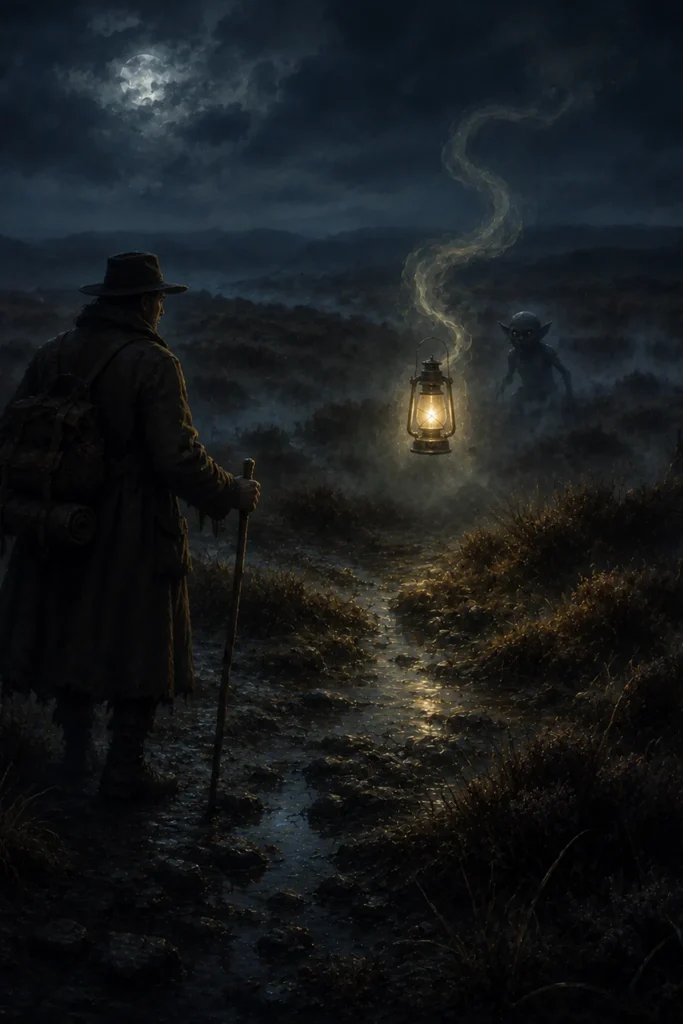
Pinket, the blue light of Powick
By Ralf Ittermann · last reviewed on
Pinket is a spirit of English folk tradition.
The blue moor light that Jabez Allies witnessed himself.
Pinket is the traditional name of the will-o’-the-wisp in Worcestershire, documented by the Worcester antiquarian Jabez Allies between 1839 and 1852. It appears as a bluish moor light, ranging from calm to flickering, and shows the usual will-o’-the-wisp behaviour of leading travellers astray across the moor.
An important note on the naming: the forms Pyne or Pinney found in some lists are not attested as the Worcestershire will-o’-the-wisp; the attested form is Pinket. The particular value of the tradition lies in Allies’ own dated sighting at Powick.
Type: Regional moor light with standard misleading behaviour
Origin: English folk belief in Worcestershire
Texts: Jabez Allies on the folklore of Worcestershire
Period: documented 1839 to 1852
Appearance: bluish moor light, calm to flickering

Textual history
Period of the Texts
Pinket was documented between 1839 and 1852; almost all records go back to the Worcester antiquarian Jabez Allies.
Area of Diffusion
Worcestershire in the English West Midlands; the site of the attested sighting is Powick near Worcester.
Sources
Sparse: the evidence rests almost entirely on Jabez Allies; independent narratives about Pinket are scarcely handed down.
Name and variants
English: Pinket; the etymology is uncertain. A connection to pink in the sense of a small, blinking light is possible, but this remains speculation. The forms Pyne and Pinney could not be verified in the folklore literature as names for the will-o’-the-wisp.
Description
Appearance
Pinket appears as a bluish moor light, calm to flickering. Allies recorded his own observation at Powick: a clear, strong, motionless light, distinctly bluer than a candle.
Effect
Pinket shows the standard behaviour of the will-o’-the-wisp, leading travellers astray across the moor. Beyond the name and the sighting, hardly any independent narrative tradition has survived.
Profile: Pinket
The key aspects of the Worcestershire light at a glance.
Purely a regional designation of the English will-o’-the-wisp motif, handed down in the name list of the antiquarian Jabez Allies.
Night-time travellers on the Worcestershire moor, whom the bluish light can lead astray.
Bluish moor light, calm to flickering; described at Powick as a clear, motionless light, bluer than a candle.
Standard misleading across the moor; the true value of the tradition lies in the dated eyewitness account.
No specific banishing practice has been handed down; the general rule remains: do not follow the light, and stay on the path.
The English will-o’-the-wisps such as Hobby Lantern and Hinkypunk; the motif is identical to the will-o’-the-wisp.
Jabez Allies and the sighting at Powick
The central source is Jabez Allies, who in his treatise on the folklore of Worcestershire gives a name list of the local will-o’-the-wisps, including Pinket. The etymology is uncertain; a connection to pink in the sense of a small, blinking light is possible, but this remains speculation.
The valuable core of the tradition is Allies’ own observation: at Powick near Worcester he saw will-o’-the-wisps in December 1839 and January 1840, a clear, strong, motionless light, distinctly bluer than a candle. Such a dated eyewitness account is rare in will-o’-the-wisp folklore and makes this small name significant.
Research value and classification
Pinket is almost only accessible lexicographically and is mostly cited through the name list of Jabez Allies; there is no broader reception.
From a religious-studies perspective, Pinket is a good example of the fact that its value lies less in the name than in Allies’ rare, dated eyewitness account. As is usually the case, the moor light is to be explained naturally as ignited marsh gas. And the circulating name forms Pyne or Pinney should be corrected: the attested form is Pinket.
Dealing with the moor light
No particular defence tied specifically to Pinket has been handed down; a dedicated Pinket banishing practice is simply absent. What remains is the general rule against will-o’-the-wisps: do not follow the light, and stay on the path. The fact that Allies describes the light at Powick as motionless changes nothing, since even a stationary light can lure the traveller from the safe path.
Pinket among the English will-o'-the-wisps
Pinket is purely a regional designation; the motif is identical to the general will-o’-the-wisp and stands alongside other English will-o’-the-wisps such as Hobby Lantern, which Jabez Allies treated in the same family of names, and the one-legged Hinkypunk. The dangerous variant of the same motif is represented by the East Anglian Lantern Man.
Frequently Asked Questions about Pinket
Is the being called Pyne or Pinket?
The attested form is Pinket; the forms Pyne or Pinney cannot be verified as the Worcestershire will-o’-the-wisp.
Who documented Pinket?
The Worcester antiquarian Jabez Allies, who also recorded his own sighting at Powick.
What was notable about the sighting?
A clear, motionless light, distinctly bluer than a candle, observed in December 1839 and January 1840.
Further links
Further reading:
- Hobby Lantern – the goblin light from Allies’ family of names
- Hinkypunk – the one-legged light of the West Country
- Lantern Man – the dangerous East Anglian variant
- Salt, Amulet, Protective Candle – traditional protective means
- Protection Compass – protective means at a glance
Literature (selection)
Further standard works in the bibliography.
As the Worcestershire will-o’-the-wisp, Pinket owes its survival to a single witness: Jabez Allies, whose dated sighting near Powick gives England’s ignis fatuus one of its rare eyewitness accounts.