Hobby Lantern, the lantern of the goblin Hob
By Ralf Ittermann · last reviewed on
Hobby Lantern is a spirit of the English tradition.
Hob’s lantern lures travellers from the safe path into the swamp.
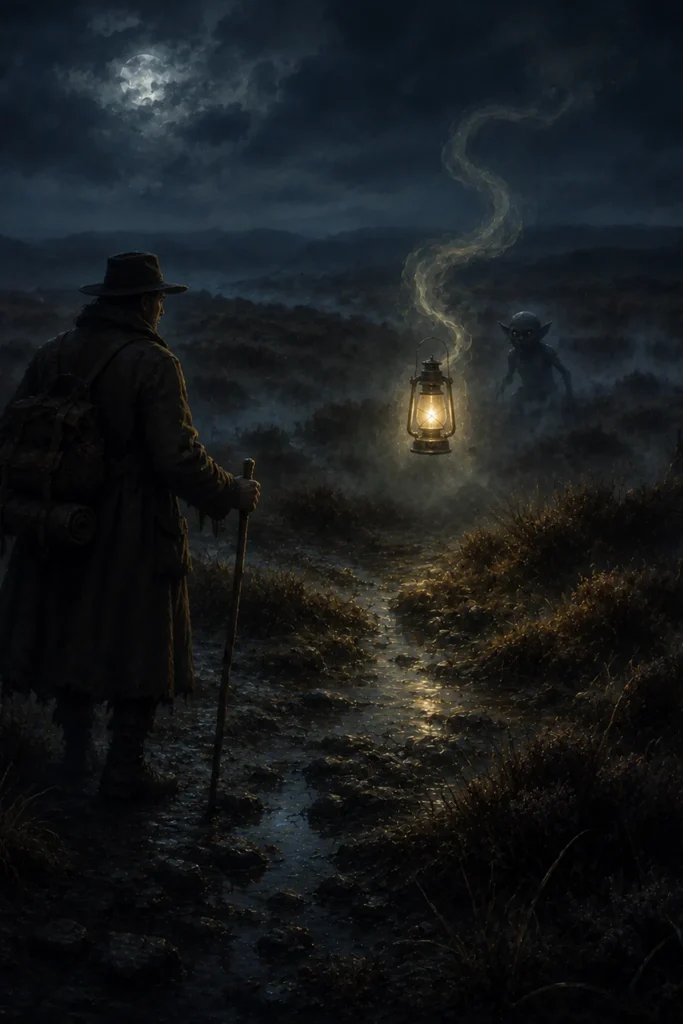
Hobby Lantern, also called Hob and his Lantern or Hobbedy’s Lantern, is an English will-o’-the-wisp that appears as the portable lantern of the goblin Hob. It lures night-time wanderers away from the safe path, across bog and swamp.
The name is attested above all in Hertfordshire and East Anglia, the variant Hobbedy’s Lantern in Warwickshire and Gloucestershire. The figure is lexicographically traceable since the 19th century, above all in the folklore dictionaries.
Type: Misleading bog light, personified as the lantern of the goblin Hob
Origin: English folk belief
Texts: folklore dictionaries, Jabez Allies on Worcestershire folklore
Period: lexicographically traceable since the 19th century
Appearance: flickering lantern light over bog and swamp
Source Context
Period of the Texts
Hobby Lantern is lexicographically traceable since the 19th century; the evidence comes from English folk belief and its dictionaries.
Area of Diffusion
Hertfordshire and East Anglia, in part the West Midlands; the variant Hobbedy’s Lantern belongs to Warwickshire and Gloucestershire.
Sources
Moderate: the figure lives above all in the folklore dictionaries, together with the name analysis by the folklorist Jabez Allies.
Name and variants
English: Hob is an old name for a goblin or house spirit, related to the hobgoblin. The folklorist Jabez Allies showed that forms such as Hobany’s derive from Hob and his; further variants include Hob-o’-Lantern and Hobbady-lantern. The name has nothing to do with the modern word hobby.
Appearance and behaviour
Appearance
Hobby Lantern appears as a flickering lantern light over moor and marsh, personified as Hob with his lantern. His sign is the deceptive, seemingly portable light in the darkness.
Effect
The classic behaviour is leading astray: the light acts like a carried lantern and draws the wanderer off the safe path and out into moor and marsh.
Profile: Hobby Lantern
The key aspects of the lantern light at a glance.
Regional name variant of the English will-o’-the-wisp motif, tied to the goblin figure Hob and the will-o’-the-wisp belief.
Night-time wanderers: the apparent lantern light tempts them to leave the safe path.
Flickering lantern light over moor and marsh, imagined as the goblin Hob carrying his lantern.
Leads travellers from the safe path into moor and marsh; a distinct narrative tradition beyond the name is largely absent.
No dedicated form of protection is attested; the general precautions apply: do not follow the light and stay on the path.
From Hob to lantern: a family of names
The key to this figure lies in the name: Hob is an old English name for a goblin or house spirit, related to the Hobgoblin; the page on Hob describes this figure in detail. The folklorist Jabez Allies demonstrated that forms such as Hobany’s derive from Hob and his; alongside these stand the variants Hob-o’-Lantern and Hobbady-lantern.
Geographically, the name family is spread across several counties: Hobby Lantern is chiefly attested in Hertfordshire and East Anglia, the form Hobbedy’s Lantern in Warwickshire and Gloucestershire. The will-o’-the-wisp of the goblin Hob is thus less a single legendary figure than a wandering name for one and the same night-time light.
Survival in the dictionaries
Hobby Lantern survives chiefly in fairy and folklore dictionaries; beyond the name, there is little independent narrative tradition.
From a religious-studies perspective, Hobby Lantern is a regional name variant of the general will-o’-the-wisp motif, tied to the goblin figure Hob. Scientifically, such lights are interpreted as ignited marsh gas. It remains important to clarify: Hobby has nothing to do with leisure, but with Hob, the goblin.
Precautions against the lantern light
A specific defence tied to Hobby Lantern is not reliably attested; further protective means would be speculation. What tradition does know are the general precautions against will-o’-the-wisps: those travelling at night do not follow the lantern glow and stay on the path, for leaving the path is precisely this light’s only weapon.
Name-relatives and kin
Hobby Lantern is a name-relative of Jack o’ the Lantern and Hob-Lantern; it shares its basic motif with all British will-o’-the-wisps, from the Scottish Spunkie to the Welsh Ellylldan, and belongs to the widespread will-o’-the-wisp belief. In East England, the Lantern Man represents the more dangerous form of the same motif, while in Cornwall Joan the Wad represents the benevolent one.
Frequently asked questions about Hobby Lantern
What does Hobby mean in Hobby Lantern?
It derives from Hob, an old name for a goblin or house spirit, not from the modern word hobby.
What does Hobby Lantern do?
It appears as a lantern light over moor and marsh and lures night-time wanderers from the safe path.
Where is it found?
Chiefly in Hertfordshire and East Anglia; the variant Hobbedy’s Lantern belongs to Warwickshire and Gloucestershire.
Further links
Further reading:
- Hob and Hobgoblin – the goblin figures behind the name
- Joan the Wad – the benevolent counterpart from Cornwall
- Lantern Man and Spunkie – the more dangerous relatives
- Salt, Amulet, Protective candle – traditional protective means
Literature (selection)
Further standard works in the bibliography.
As an English will-o’-the-wisp, Hobby Lantern carries its origin in its name: Hob with the lantern, the goblin whose deceptive light has wandered through the dictionaries of English folklore since the 19th century.