iWell Guard

Gabriel Hounds and the howling of the invisible pack

Gabriel Hounds are a spirit of English tradition.

An invisible pack whose call in the sky announces death.

SpiritEngland

Table of Contents

Gabriel Hounds, spirit of English tradition
Gabriel Hounds

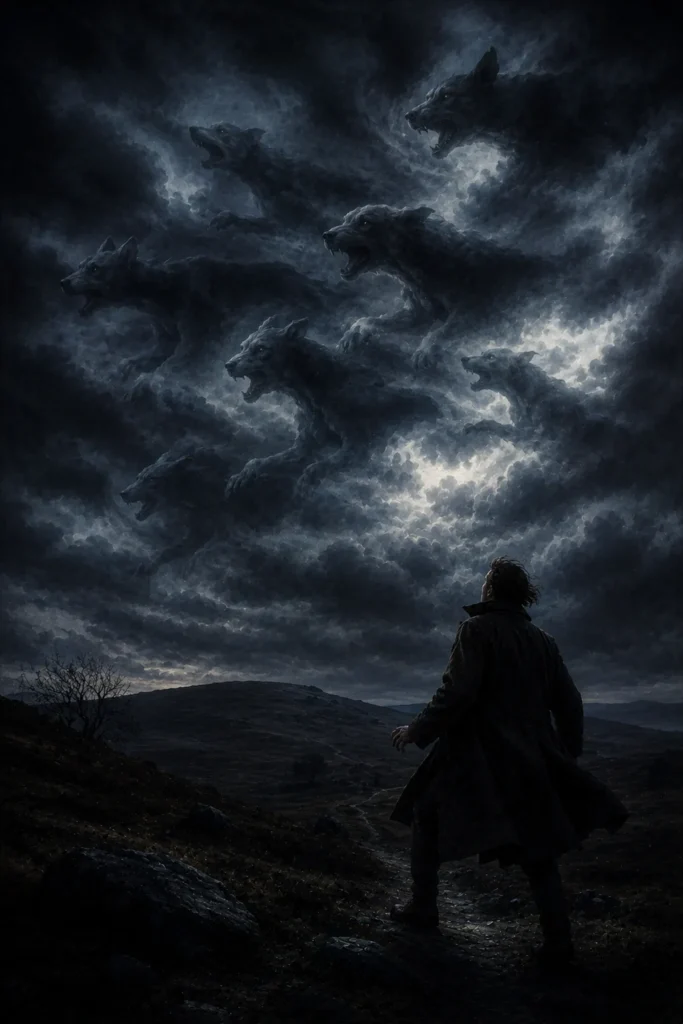
Gabriel Hounds are the ghostly hunting pack in the night sky of Northern England. You do not see them, you hear them: a yelping, barking sound high in the air, often popularly mistaken for the calls of migrating wild geese. Whoever hears it is thereby warned of death or misfortune.

The name derives from the Gabriel Ratchets and interprets the call, in reference to Archangel Gabriel, as a heavenly, soul-fetching sign; in the 19th century William Henderson described monstrous, human-headed dogs passing through the air.

At a glance: Gabriel Hounds

Type: Spectral aerial pack, purely acoustic omen of death
Origin: Regional folk tradition of Northern England
Texts: Notes on the Folk-Lore of the Northern Counties (Henderson, 1866) and later folklore collections
Period: recorded in the 19th century, still passed down today
Appearance: mostly invisible, audible as yelping, barking calls high in the air

Collection and tradition

Period of the Texts

The tradition is regionally rooted in Northern England and was collected by William Henderson in the 19th century; it is still considered a living folk motif today.

Area of Diffusion

Northern England, with focal points around Leeds, Cleveland and the Calder Valley.

Sources

Good: Henderson’s 19th-century collection forms the core source, supplemented by later overviews by Briggs, Harte, and Westwood and Simpson.

Name and variants

English: ‘ratchet’ denotes a hunting dog, ‘gabble’ the chattering sound: from both roots came the names Gabriel Ratchets and Gabble Ratchets. The reference to Archangel Gabriel additionally interprets the call as a heavenly, soul-fetching sign.

Appearance and interpretation

Appearance

The Gabriel Hounds are above all an acoustic omen: the invisible pack in the night sky, whose calls pass high through the air. William Henderson described them as monstrous, human-headed dogs passing through the air, rarely seen but often heard.

Effect

Hearing the Gabriel Hounds announces death or misfortune. As ghost hounds, they are also considered hunters of the souls of the recently deceased. They are active at night, especially in autumn and winter, and pass across the sky as an invisible pack.

Profile: Gabriel Hounds

The key aspects of the aerial pack at a glance.

Tradition

Regional folk tradition of Northern England, collected by William Henderson in the 19th century.

Relates To

Who hears the calls: the hearing itself is already considered the actual event, regardless of place or person.

Depiction

Mostly invisible; described by Henderson as monstrous, human-headed dogs passing through the air.

Sphere of Influence

An announcement of death or misfortune; in interpretation, also hunters that gather in the souls of the recently deceased.

Approach

Avoid the calls and do not imitate them; no proper ritual of defence against the Gabriel Hounds has been passed down.

Distinctions

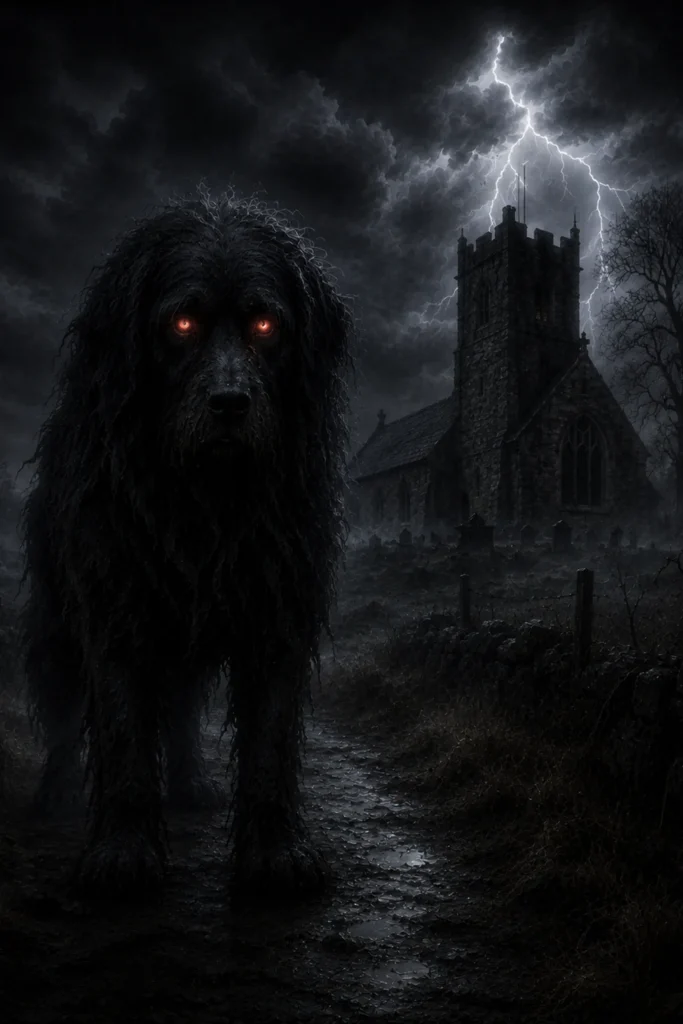
The Welsh Cwn Annwn as the closest relative, along with the English Black Shuck and Barghest, which, unlike the purely aerial pack, appear bodily on the ground.

Between the hunting-dog word and the archangel's name

The names Gabriel Ratchets and Gabble Ratchets combine ratchet, an old word for a hunting hound, with gabble, the chattering sound of the calls themselves. In the 19th century, William Henderson described monstrous, human-headed hounds passing through the air, rarely seen but often heard.

The interpretation varies regionally: near Leeds, the calls were held to be the souls of unbaptised children fluttering restlessly around their parents’ house. In Cleveland, tales told of a hunting-obsessed lord who was buried in the same grave as his pack and now hunts on as a spirit. Both versions share the same image: a pack that never leaves the sky.

Echoes in folklore and fantasy

The Gabriel Hounds are a fixed part of the reception of the Wild Hunt in folklore collections and modern fantasy; they have inspired the motif of a ghostly pack in the sky in literature and games.

From a religious-studies perspective, the Gabriel Hounds combine the motif of the Wild Hunt with the death omen. The soul-hunting airborne pack is regarded as a Christianised variant of pre-Christian hunts of the dead; the association with Gabriel Christianises the omen and ties it to the heavenly judgement.

Avoid the calls, do not imitate them

The source material on protective customs is thin: what has come down chiefly is the interpretation as an omen, not an actual banishing ritual. Generally, one was advised to avoid the calls and not to imitate them. Where protection was sought, people turned to consecrated holy water as a Christian sign against the hunt, understood as a hellish pack, to the sound of consecrated bells during the feared nights, and to the light of a protective candle kept as a watch. At its core, however, the Gabriel Hounds remain an omen, not a threat that can be warded off.

Cwn Annwn, Black Shuck, Barghest: related packs

The Gabriel Hounds correspond to the Welsh Cwn Annwn, also called Cwn Wybir, the hounds of the sky, and are closely related to regional packs such as the Wisk Hounds in Devon and the Devil and his Dandy-dogs in Cornwall. More broadly, they belong to the Germanic Wild Hunt in the retinue of Woden.

Among the ghost hounds of northern England, they occupy a special position through their purely acoustic presence: unlike the corporeal Black Shuck, the monstrous Barghest and the padding Padfoot, all of which appear as single hounds on the ground, the Gabriel Hounds remain invisible and pass over the sky as a pack.

Frequently asked questions about the Gabriel Hounds

Can the Gabriel Hounds be seen?

Usually not. They are heard, rarely seen; their hallmark is the call in the night sky.

What causes the calls naturally?

Presumably the nocturnal calls of migrating wild geese, which folk tradition interpreted as a ghostly pack.

What does their call mean?

To whoever hears it, the Gabriel Hounds announce death or misfortune.

Further links

Recommended internal links:

Literature (selection)

A selection of key sources and studies:
  • Henderson, William: Notes on the Folk-Lore of the Northern Counties of England and the Borders. London 1866.
  • Briggs, Katharine: A Dictionary of Fairies. London 1976.
  • Harte, Jeremy: Explore Fairy Traditions. Loughborough 2004.
  • Westwood, Jennifer / Simpson, Jacqueline: The Lore of the Land. London 2005.

Further standard works in the bibliography.

Known as Gabriel Ratchets, the Gabriel Hounds remain a special case among English death omens. The ghost hounds of northern England otherwise appear bodily, but here only the call of an invisible pack in the night sky remains.

Classification & Protection

IIILEVEL
The Protection Compass assigns this being to influence level III, Burdensome influence.

Against its influence, cross-cultural tradition names these protective means:

Compare in the Protection Compass →

Recommended protective means

iWell Guard

The simplest protective means in this collection: 41 layers of fine gold 999, platinum, silver and silicon, manufactured in Ruhla, Thuringia. It requires no activation, is bound to no person, and is effective within a radius of around 50 meters, even without being worn.

All protective means at a glance →