Barghest, the shapeshifting harbinger of death of Yorkshire
By Ralf Ittermann · last reviewed on
Barghest is a spirit of English tradition.
A shapeshifting spirit hound with eyes the size of plates, glowing.
Barghest is the monstrous black spirit hound of Yorkshire, a dog-like goblin with enormous teeth, sharp claws and glowing eyes the size of plates. Encountering it is regarded as an omen of death for the witness themselves or a close relative.
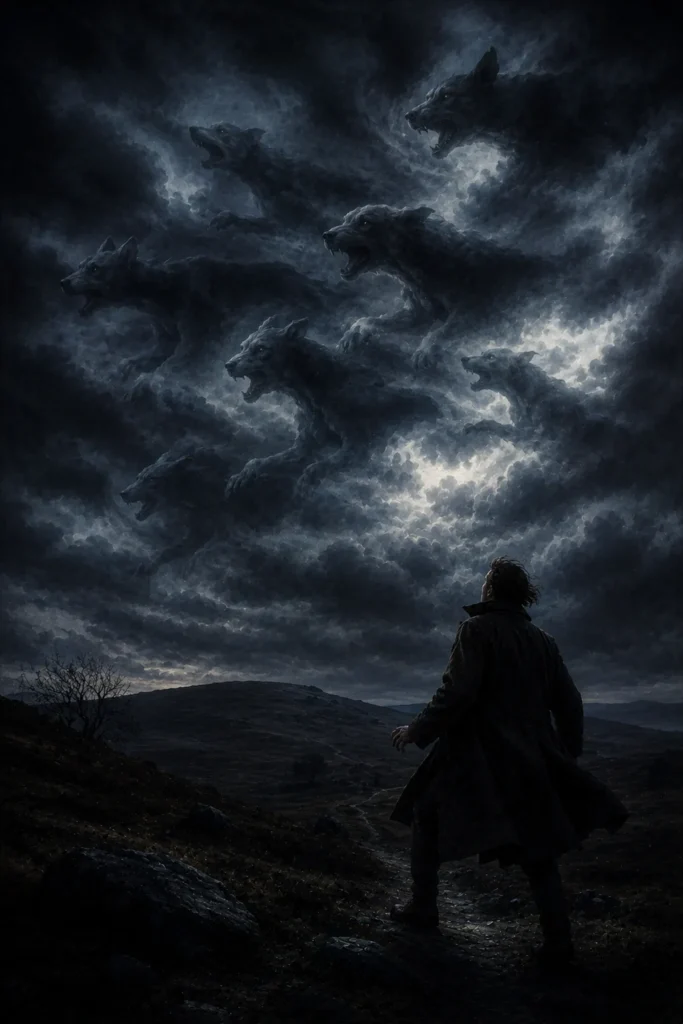
If a person of standing dies in the county, the Barghest is said to appear, followed by all the dogs of the area in a howling funeral procession. Unlike the more ambivalent Black Shuck, he is considered markedly more aggressive: according to tradition, whoever provokes him falls into his power.
Type: Black spirit hound, shapeshifting harbinger of death of Northern England
Origin: Northern English tradition of Yorkshire, derivation of the name not conclusively established
Texts: collected by William Henderson in 1866 and by Katharine Briggs
Period: Northern English tradition, systematically collected in the 19th century
Appearance: large black, dog-like goblin with horns, claws and glowing eyes

Historical Classification
Period of the Texts
Northern English tradition, systematically collected in the 19th century, chiefly by William Henderson.
Area of Diffusion
Yorkshire and its surroundings, as well as Northumberland and Durham.
Sources
Good: well documented, chiefly through the collections of William Henderson and Katharine Briggs.
Name and variants
English: In Northern England, ghost was pronounced like guest, to which the name is sometimes traced back. Also proposed have been burh-ghest, town spirit, the German Berggeist or Bärgeist, as well as Bahr-Geist, the spirit of the funeral bier; no derivation is considered conclusively established.
Form and effect
Appearance
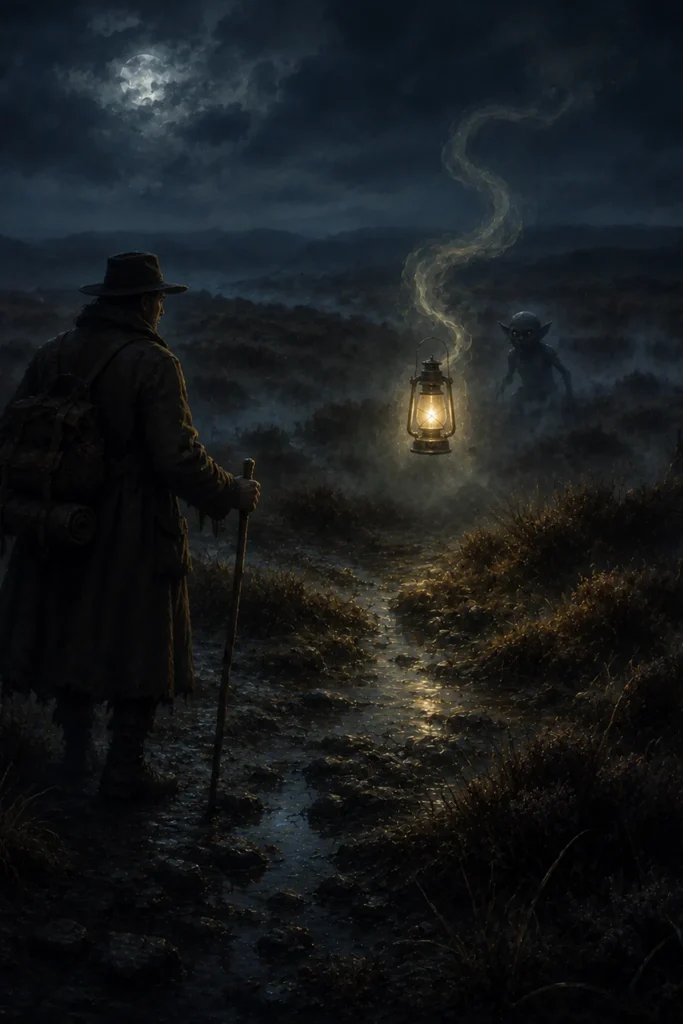
Barghest appears as a large black dog with enormous teeth, sharp claws and glowing eyes the size of plates, ranging in size from a mastiff to that of a calf, shaggy and partly shapeshifting. It can vanish suddenly, sometimes leaving behind a smell of sulphur or bursting into flame.
Effect
Barghest is a harbinger of death, illness or misfortune; encountering it announces the death of the witness or a close relative. It is nocturnal and haunts liminal places, moors, lonely roads, gates and boundaries, and according to tradition, whoever provokes it falls into its power.
Profile: Barghest
The most important aspects of the spirit hound at a glance.
Northern English spirit-hound tradition of Yorkshire, collected in the 19th century by William Henderson.
Individual nocturnal wanderers at liminal places, whose death or that of a close relative the encounter foretells.
Large, dog-like goblin with horns, enormous teeth, claws and glowing eyes the size of plates, partly shapeshifting.
Harbinger of death, illness and misfortune; if a person of standing dies, a howling funeral procession of all the dogs of the area follows the Barghest.
Restraint as the most important protection: leave the being alone, do not speak to it and do not attack it, for whoever provokes it falls into its power.
The more ambivalent Black Shuck of East Anglia and the Welsh Cŵn Annwn as a further relative of the same spirit-hound family.
From the town-spirit name to the funeral procession of the dogs
The name Barghest has not been conclusively explained. In northern England, ghost was pronounced like guest, to which the name is partly traced back; also proposed are burh-ghest, town spirit, the German Berggeist or Bärgeist, and Bahr-Geist, the spirit of the bier. The figure is documented above all in the collections of William Henderson and Katharine Briggs.
The Yorkshire tradition holds that when a significant person dies, the Barghest appears, followed by all the dogs of the surrounding area in a kind of howling funeral procession. This motif of the collective death messenger sets it clearly apart from other English spectral hounds.
From folk belief to fantasy creature
Barghest is listed in reference works as a classic Yorkshire spectral hound and has provided both the name and the motif for monsters in fantasy literature and role-playing games. It sits alongside the reception of the Hound of the Baskervilles and the black spectral hounds of England generally.
In terms of religious studies, Barghest is a prototype of the monstrous death omen with a link to thresholds and boundaries. The funeral procession points to the hound as a psychopomp for an entire community, while its demonic traits, sulphur smell and flame, show the Christian reinterpretation of the older spectral hound motif.
Restraint as the most important protection
The source material on protective customs is modest. What survives above all is the advice to leave the being alone, not to address it and not to attack it, since whoever provokes the Barghest falls into its power. No specific banishing ritual is widely documented, so restraint remains the most important recorded protection. In northern English folklore generally, iron, the horseshoe and scattered salt are considered protection against ghostly beings at thresholds and gates.
Spectral hounds of northern and western Britain
Alongside Black Shuck, Padfoot and Gytrash, the Barghest also belongs to the English family of black spectral hounds. Related across the border are the Welsh Cŵn Annwn and the Scottish Cù Sìth, and through etymology there is even a loose bridge to the German Berggeist.
Frequently asked questions about Barghest
Is the Barghest the same as Black Shuck?
No, but both belong to the English family of black spectral hounds. The Barghest is the Yorkshire variant, drawn in more monstrous terms and with its own motif of the funeral procession.
Can the Barghest become dangerous?
Yes, if provoked; however, it is regarded chiefly as a harbinger of death.
What does the funeral procession of dogs mean?
When a significant person dies, the Barghest is said to appear, followed by all the dogs of the surrounding area in a howling procession.
Further links
Further reading:
- Black Shuck – the related hellhound of East Anglia
- Cŵn Annwn – the Welsh hellhounds
- Iron, horseshoe, salt – traditional protective means
- Protection Compass – an overview of protective means
Literature (selection)
Further standard works in the bibliography.
As a Yorkshire spectral hound and black harbinger of death, the Barghest stands for a death that announces itself before plunging an entire region into mourning.