


Black Shuck, the hellhound of East Anglia's coasts and churches
By Ralf Ittermann · last reviewed on
Black Shuck is a spirit of English tradition.
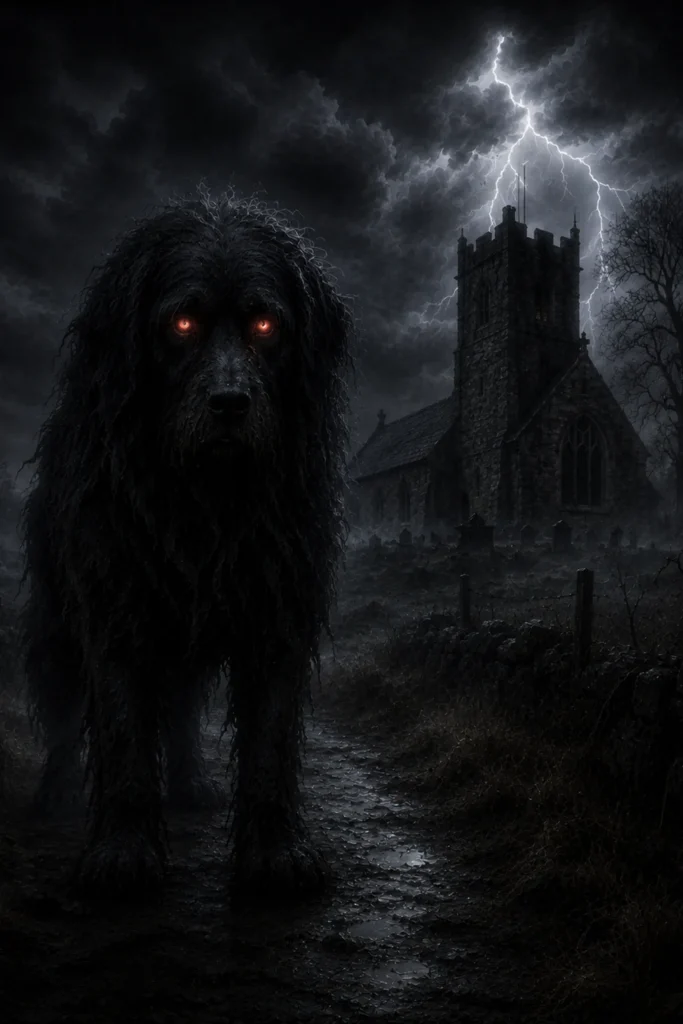
Black hellhound with glowing eyes at coast and church. Black Shuck belongs to the hellhound type, and East Anglia’s coasts and churches supply the settings in which the figure is remembered.
Black Shuck is the ghostly black hellhound of the English counties of East Anglia, a large, shaggy dog with one or two glowing eyes. In Norfolk and Suffolk, meeting him is considered a death omen, while in other regions he instead appears as a harmless or even protective companion to lone travellers.
Black Shuck became famous through the legend of 4 August 1577: on that day, during a severe thunderstorm, he is said to have burst into the church at Blythburgh, killed a man and a boy in the nave, and damaged the tower. On the same day, something similar is said to have occurred in nearby Bungay.
Type: Black ghost dog, death omen of the East Anglian coast
Origin: East Anglian folk belief, name from Old English scucca, demon
Texts: Peterborough version of the Anglo-Saxon Chronicle around 1127, Abraham Fleming’s pamphlet of 1577, later folklore collections
Period: early record around 1127, famous account 1577, a legend still alive today
Appearance: large black dog with one or two glowing eyes
Textual history
Period of the Texts
Early record to the present: a black ghost dog already appears around 1127 in the Peterborough version of the Anglo-Saxon Chronicle; the famous individual account dates from 1577, but the tradition was only systematically collected from the 19th century onward.
Area of Diffusion
East Anglia, particularly the counties of Norfolk and Suffolk, along with the Fens, Essex and Lincolnshire.
Sources
Good: Abraham Fleming’s pamphlet of 1577 provides a contemporary primary source, supplemented by the Anglo-Saxon Chronicle and later folklore collections.
Name and variants
Old English: The name Shuck is probably derived from scucca, demon or fiend; a dialectal derivation instead interprets it as shucky, shaggy. Both interpretations fit the traditional figure.
Appearance
Appearance
Black Shuck appears as a large black dog with a shaggy coat and one or two glowing eyes, at times said to be as large as a calf. He embodies the boundary between this world and the next, and the sudden, inescapable arrival of death in lonely places.
Effect
Anyone who meets him in Norfolk, Suffolk, Lincolnshire or Essex is said, according to tradition, to face their own death or that of someone close to them. In rarer tales, however, he accompanies travellers protectively on their way home. He appears at night on coasts, on field paths, at boundaries and at churches.
Profile: Black Shuck
The key aspects of the hellhound at a glance.
Part of the English family of black ghost dogs, rooted in East Anglian folk belief concerning death and omens.
Individual night travellers and churchgoers, for whom the encounter is taken as an omen of their own death or that of a relative.
Large, shaggy black dog, at times as large as a calf, with one or two glowing eyes.
A death omen on coasts, field paths, boundaries and at churches; more rarely also a protective companion to nocturnal travellers.
Do not speak to the dog, do not look at it and do not attack it, but walk on calmly, as no reliable protective rituals are attested for it.
From the name scucca to the attack on Bungay and Blythburgh
The name Shuck probably derives from the Old English scucca, demon or fiend; a dialectal derivation instead traces it to shucky, shaggy. An early record of a black spirit hound can already be found in the Peterborough version of the Anglo-Saxon Chronicle around the year 1127.
The figure became famous, however, only through the report of 4 August 1577: during a severe thunderstorm, Black Shuck is said to have burst into the church of Blythburgh, killed a man and a boy in the nave and damaged the tower. On the same day similar events occurred nearby in Bungay. The preacher Abraham Fleming described the events in the pamphlet A Straunge and Terrible Wunder.
From church terror to Dartmoor hound
Black Shuck is considered one of the sources for Arthur Conan Doyle’s novel The Hound of the Baskervilles from 1902, which combined East Anglian hellhound legends with Dartmoor colour. In music, a 2003 song by the band The Darkness bears its name. To this day it remains a fixed part of East Anglian folklore.
From a religious-studies perspective, Black Shuck is a classic example of the pan-European motif of the black dog as an omen of death: the dog as a guide of souls and harbinger, situated at liminal places. It points to pre-Christian ideas of the dog as a being of the otherworld, later reinterpreted as diabolical under Christianity.
Behaviour instead of banishing spell
The source material on protective customs against Black Shuck is sparse and inconsistent. What has been handed down is chiefly a rule of behaviour: do not speak to the dog, do not look at it and do not attack it, but walk on calmly. Reliable protective rituals are scarcely attested for Black Shuck; at its core it is regarded as an omen that one encounters but cannot escape through magic. In British folklore generally, iron and the horseshoe are widespread protective means against ghostly beings, supplemented at church thresholds by a consecrated protective candle.
Black spirit hounds of Britain
Frequently asked questions about Black Shuck
Was Black Shuck always a harbinger of death?
No. In Norfolk and Suffolk he is often regarded as malicious and death-foretelling, whereas elsewhere he is seen as a harmless or even protective companion.
Where do the scorch marks in Blythburgh church come from?
The church attributes singe marks on the north door to the legend of 1577; they are not historically confirmed.
Is Black Shuck related to the Hound of the Baskervilles?
In terms of motif, yes. The East Anglian hellhound legends surrounding Black Shuck are among the inspirations for Arthur Conan Doyle’s novel.
Further links
Further reading:
- Barghest – the related spirit hound of Yorkshire
- Cŵn Annwn – the Welsh hellhounds
- Iron, horseshoe, protective candle – traditional protective means
- Protection Compass – an overview of protective means
Literature (selection)
Further standard works in the bibliography.
As a black spirit hound, Black Shuck is the hellhound of East Anglia par excellence: an omen at coast and church, whose glowing eyes still line the roads of Norfolk and Suffolk today.


