Hinkypunk, a smoky figure on one leg
By Ralf Ittermann · last reviewed on
Hinkypunk is a spirit of English folk tradition.
One-legged, as if made of smoke, with a light over the moor. The description dwells on the smoky, one-legged shape that flickers over the moor at dusk.
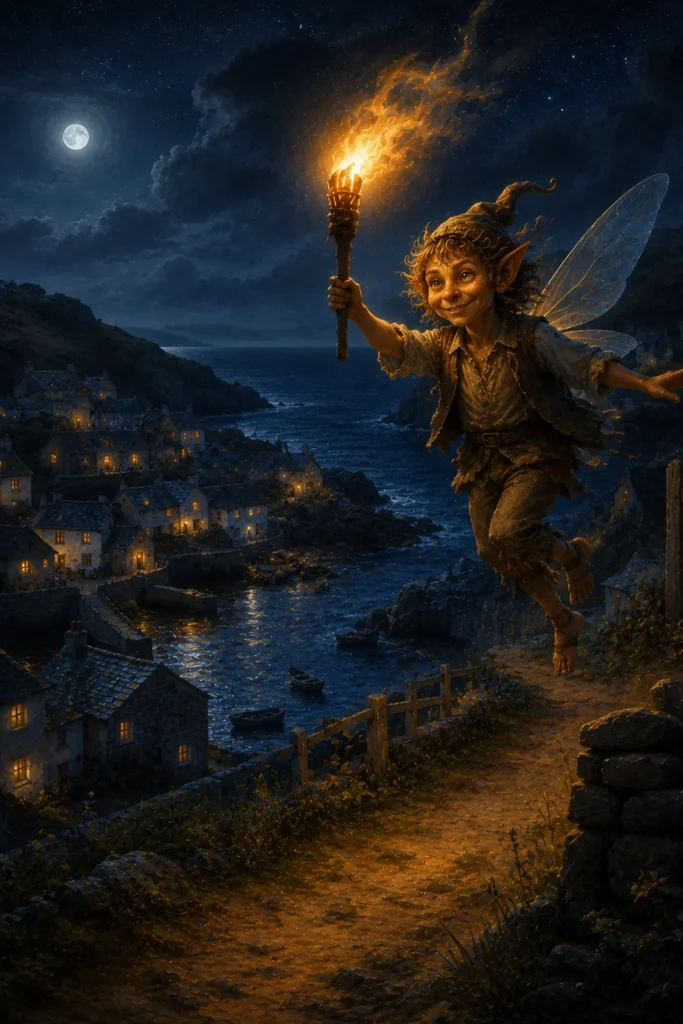
Hinkypunk is the will-o’-the-wisp of the English West Country, attested in the border area of Somerset and Devon and especially on Dartmoor. It is described as a small, one-legged being like smoke, carrying a light.
Its nature is ambivalent: good hinkypunks lead travellers out of the marshes, while evil ones lure them in and then laugh at the misfortune of the stranded. The source material is sparse; the figure was documented in the 20th century.
Type: Ambivalent one-legged bog light
Origin: English folk belief of the West Country
Texts: few regional sources, including a Dartmoor travel account from 1927
Period: documented in the 20th century
Appearance: small, one-legged being as if made of smoke, carrying a light

Traditional context
Period of the Texts
The tradition belongs to English folk belief and was documented in the 20th century; an important source is a Dartmoor travel account from 1927.
Area of Diffusion
The border region of Somerset and Devon, above all Dartmoor: there the tale of the one-legged light has its fixed place.
Sources
Sparse: there are only a few regional sources; noteworthy are the 1927 travel account and the folklore dictionaries.
Name and variants
English: The etymology is unresolved. Hinky is linked to limping or being one-legged, punk to tinder or rotten, glowing wood; both remain uncertain.
Form and Activity
Appearance
Hinkypunk is described as small, one-legged, at times also one-eyed and as if made of smoke; it carries a light. The one-leggedness is regarded as the West Country peculiarity of this will-o’-the-wisp.
Effect
With its light, Hinkypunk lures travellers into bogs and ponds. Yet it also has a good side: some Hinkypunks lead wanderers away from the marshes, while the malicious ones lead them into them, and afterwards laugh at those who have come to harm.
Profile: Hinkypunk
The most important aspects of the one-legged bog light at a glance.
Regional representative of English will-o’-the-wisp belief, native to the West Country between Somerset and Devon.
Night-time wanderers in the bog: to them the light appears, leading either out or in depending on the being’s disposition.
Small, one-legged, at times one-eyed being as if made of smoke, carrying a light.
Bogs and ponds of Dartmoor: sometimes rescue from the swamp, sometimes enticement into the depths.
No specific defence is attested; the general will-o’-the-wisp rule applies: do not follow the light and stay on safe ground.
The British bog lights from the Lantern Man to the Ellylldan; the one-leggedness remains Hinkypunk’s distinctive feature.
One leg, one light: the Dartmoor tradition
The etymology of the name is unresolved. Hinky is linked to limping or being one-legged, punk to tinder or rotten, glowing wood; both interpretations remain uncertain. Hinkypunk is attested in the border region of Somerset and Devon, above all on Dartmoor.
The source material is sparse: only a few regional sources record the figure, among them a Dartmoor travel account from 1927. Precisely against this scant background, the distinctive trait of the tradition stands out, the one-leggedness that sets this bog light apart from the other English ghost lights.
From Dartmoor into fantasy
Today Hinkypunk is known above all through the Harry Potter series, in which a Hinkypunk appears as a small, one-legged being of light; this image is fiction. The one-legged figure itself is attested in folklore, but its presence in the sources is sparse.
From a religious-studies perspective, Hinkypunk is a regional representative of will-o’-the-wisp belief with the distinctive trait of one-leggedness. As with all bog lights, the natural-science explanation lies in ignited swamp gas. And its present-day fame stems almost entirely from modern fantasy.
Behaviour in the bog: do not follow the light
A defence specific to Hinkypunk is not reliably attested. The general rule against will-o’-the-wisps applies: do not follow the light and stay on safe ground. Anything beyond this would be invented; the tradition knows no protective means of its own against the one-legged light, and its ambivalent nature leaves it open anyway whether the light helps or harms in any given case.
Hinkypunk among the British bog lights
The motif of the one-legged, smoke-like being of light is the West Country peculiarity; otherwise Hinkypunk is a standard will-o’-the-wisp in the series of British bog lights, from the East Anglian Lantern Man to the Welsh Ellylldan. The Scottish Spunkie also belongs to this family of ghost lights.
Frequently asked questions about Hinkypunk
What does a Hinkypunk look like?
As a small, one-legged, at times one-eyed being as if made of smoke, carrying a light. The one-leggedness is its distinguishing mark.
Is Hinkypunk dangerous?
It is ambivalent: good Hinkypunks help wanderers out of the bog, malicious ones lure them in and laugh at those who come to harm.
Where does the name come from today?
Above all from the Harry Potter series; however, this image is fictional, and the folkloric basis is narrow.
Further links
Further reading:
- Lantern Man – the aggressive ghost light of the East Anglian marshes
- Spunkie and Ellylldan – the Scottish and Welsh neighbours
- Tine Ghealain – another ghost light of the British Isles
- Salt, Amulet, Protective Candle – traditional protective means
- Protection Compass – protective means at a glance
Literature (selection)
Further standard works in the bibliography.
As a one-legged will-o’-the-wisp, Hinkypunk possesses the most distinctive feature of its kind: the West Country bog light from Somerset and Devon is a smoke figure on one leg, part helper, part misfortune.