Hobgoblin, Robin Goodfellow's good-natured kin
By Ralf Ittermann · last reviewed on
The Hobgoblin is a spirit of English folk tradition.
The friendly house spirit behind the ambivalent name. Robin Goodfellow’s good-natured kin, the Hobgoblin has been recast as something more sinister.
In English folklore, the Hobgoblin is originally a friendly, helpful house spirit, a close relative of the Brownie and of Puck. At night he threshes, grinds and tidies up, in exchange for a bowl of milk or cream and some food.
The meaning common today, a small, evil goblin, is a shift, reinforced above all by fantasy fiction. Since the 16th century, Robin Goodfellow and Puck have been its best-known representatives, made popular through Shakespeare’s A Midsummer Night’s Dream.
Type: Originally a friendly house spirit of the brownie type
Origin: English folklore
Texts: Reginald Scot (1584), Shakespeare’s A Midsummer Night’s Dream, Briggs
Period: Robin Goodfellow from the 16th century
Appearance: small, shaggy, rough, helpful

Textual history
Period of the Texts
Robin Goodfellow and Puck have been the best-known representatives since the 16th century; in 1584 Reginald Scot counted the hobgoblin among the frightening figures used to scare children.
Area of Diffusion
England; the Hobgoblin is bound to a hearth, house or place and belongs to rural custom.
Sources
Good: Reginald Scot’s The Discoverie of Witchcraft from 1584, along with the folkloric reference works of Katharine Briggs and Elizabeth Mary Wright.
Name and variants
English: hobgoblin, from Hob, a pet form of Robert and Robin, and goblin. The friendly first name and the frightening word combine into a name that already contains both poles of the being.
Appearance
Appearance
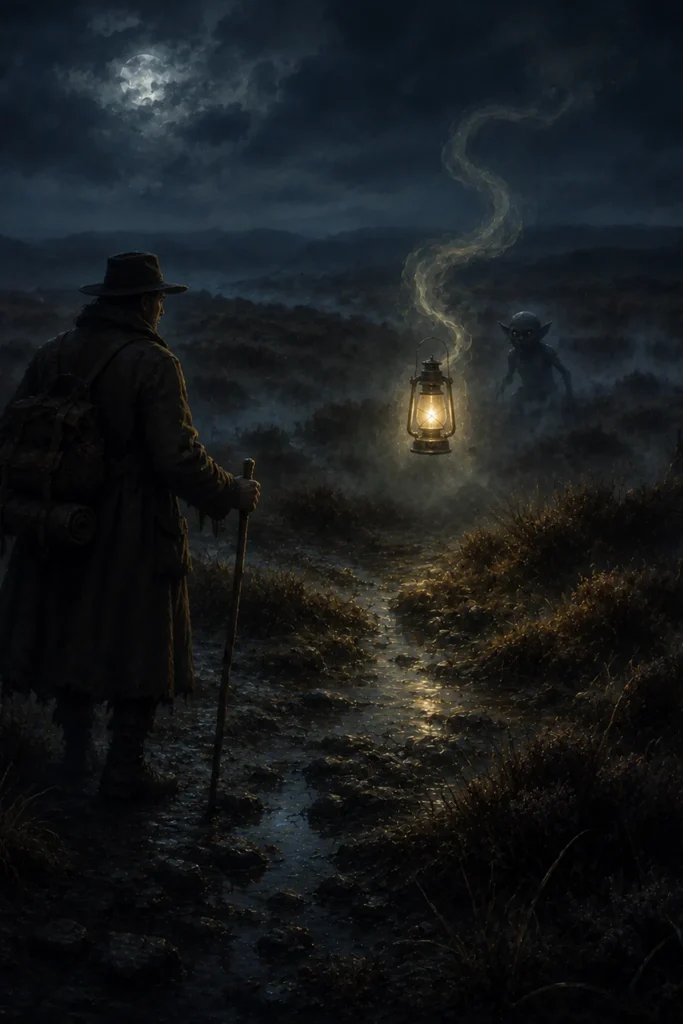
The Hobgoblin is small, shaggy and rough, often naked or in rags; a gift of clothing drives him away, just like the Brownie. He is bound to a hearth, a house or a place.
Effect
At night the Hobgoblin threshes, grinds and tidies up, in exchange for a bowl of milk or cream and food. If he is insulted, if his work is mocked, or if he is offered payment such as clothing, he turns into a noisy poltergeist or disappears. Typologically he is the friendly pole of the sprite spectrum; the name itself, however, was perceived as ambivalent from the very beginning.
Profile: Hobgoblin
The key aspects of the friendly house spirit at a glance.
English folklore since the 16th century; Robin Goodfellow and Puck are its best-known representatives, made popular through Shakespeare.
House and farmyard: the Hobgoblin is bound to a hearth, house or place and works there at night for the occupants.
Small, shaggy and rough, often naked or in rags; his manner is helpful as long as he is not insulted.
Nocturnal threshing, grinding and tidying in exchange for milk, cream and food; if insulted, noise and disappearance follow.
Set out milk or cream and food at the hearth, neither comment on nor reward the work; a piece of clothing ends the service.
Brownie, Hob and Lob Lie-by-the-Fire as well as Puck; in a broader sense the Kobold, Nisse and Tomte.
Robin Goodfellow and the two faces of the name
The name combines Hob, a pet form of Robert and Robin, with goblin. Robin Goodfellow and Puck have been the best known representatives of the type since the 16th century, made popular by Shakespeare’s A Midsummer Night’s Dream, where the mischievous but good natured spirit found its firm literary place.
That the hobgoblin was perceived ambivalently from the start is confirmed by Reginald Scot: in 1584 he lists the hobgoblin among the frightening figures used to scare children. The friendly helper of the farmyard and the nursery bogey-word thus stood side by side early on, long before fantasy fiction strengthened the malevolent pole.
From Shakespeare to fantasy
In modern fantasy, especially in Tolkien and in role-playing games, the hobgoblin is a larger, warlike and malevolent kind of goblin; this meaning has moved far from the friendly folklore being. In Shakespeare and in older literature he remains the mischievous but good natured Robin Goodfellow.
From a religious studies perspective, the hobgoblin was originally a friendly house spirit who turns malicious only when offended. Key clarifications: the malevolent fantasy meaning is recent. Historically he stands close to the Brownie and to Puck. And Scot’s use of him as a bogey shows that both poles existed side by side early on.
Milk, food and the clothing taboo
Part of a good relationship with the hobgoblin is leaving out a bowl of milk or cream and some food by the hearth at night and not commenting on or rewarding his work. To get rid of him, one gives him a piece of clothing, at which he vanishes offended. These practices are folkloric collected material, mainly from England.
Puck, Brownie and the wider family
The hobgoblin corresponds to the Scottish and English Brownie, the Hob, the Lob Lie-by-the-Fire and Puck, as well as the Manx Fenodyree; in a broader sense the German Kobold and the Scandinavian Nisse and Tomte stand alongside him. His offended mirror image is the Boggart. At its core, the hobgoblin is the place-bound house spirit of the brownie type who refuses clothing as payment.
Frequently asked questions about the Hobgoblin
What is a hobgoblin?
Originally a friendly, helpful house spirit of English folklore, close to the Brownie and Puck.
Why is it now seen as evil?
This is a shift in meaning, reinforced especially by fantasy fiction; in Tolkien and in role-playing games it became a warlike kind of goblin.
How does one get rid of it?
By giving it a piece of clothing, at which it vanishes offended, the same taboo as with the Brownie.
Further links
Literature (selection)
Further standard works in the bibliography.
As an English house spirit and friendly kobold, the hobgoblin stands for a being whose name tells its own story: from the helpful Robin of the farmyard to the bogey-word of fantasy fiction.