Asrai, the Water Nymph that Melts in Sunlight
By Ralf Ittermann · last reviewed on
Asrai is a spirit of English tradition.
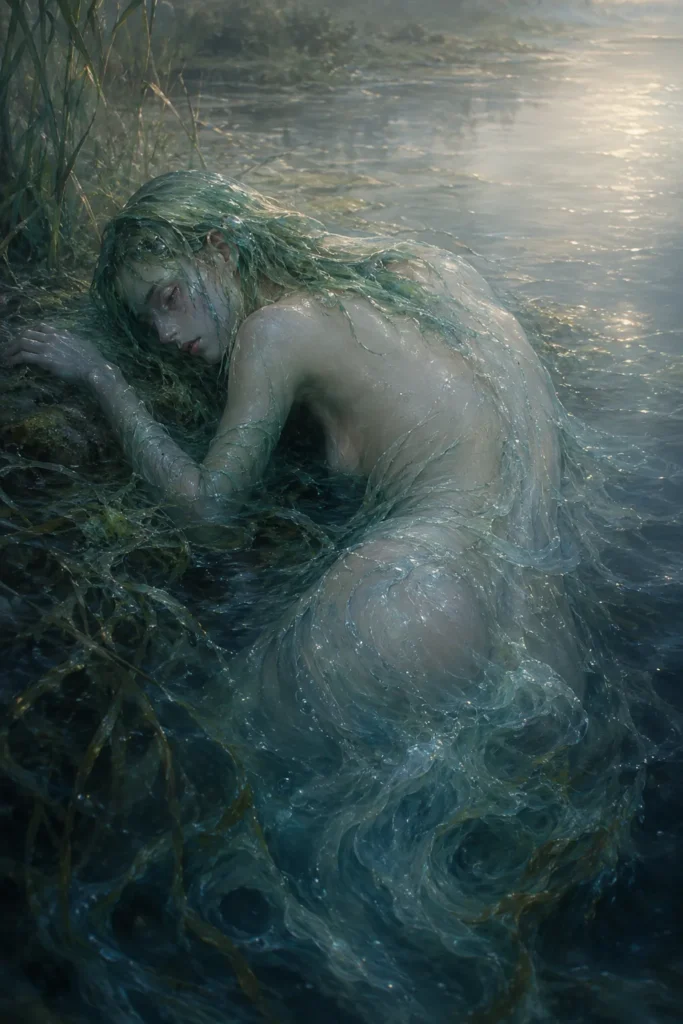
A delicate nymph who melts into water in sunlight. The melting form illustrates Asrai’s fragility in the face of daylight. In English legends, Asrai is regarded as a delicate water nymph, and the text explains how this figure can be recognized.
The Asrai is a delicate, shy water nymph of English tradition, a being of cold, dark, deep water. It is considered one of the most fragile beings in British legend: small, translucent, with green hair, barely tangible and almost never dangerous.
If the Asrai falls into the hands of curious fishermen, it melts in sunlight or at mere touch into a puddle of water, and is thus lost beyond recovery. The earliest clear version of the figure is literary: poems by the Scottish author Robert Williams Buchanan from 1872 and 1875, supplemented by Ruth Tongue’s folkloric collection in the 20th century.
Its origin as a genuine oral folk legend is disputed among scholars, a fact that any serious account of the Asrai should state openly.
Type: delicate, shy water nymph of deep water
Origin: Cheshire, Shropshire and the Welsh borderland
Texts: literary from 1872 in Buchanan, folkloric via Ruth Tongue in the 20th century, source material thin and disputed
Period: from 1872 to the present
Appearance: delicate, very beautiful, translucent skin, green hair, sometimes webbed hands
Source context
Period of the Texts
The earliest clear version is literary and dates from 1872 and 1875; an older oral folk tradition is not scholarly confirmed.
Area of Diffusion
Cheshire, Shropshire and the Welsh borderland, an area which in some versions is also counted as part of the English-Scottish tradition.
Sources
Thin and scholarly disputed: the main source is Ruth Tongue’s collection from the 20th century, whose reliability is questioned, along with Buchanan’s early poems.
Name and variants
English: A confirmed older vernacular root of the name Asrai is lacking. The earliest clear version of the figure is literary, in poems by the Scottish author Robert Williams Buchanan from 1872 and 1875.
Appearance
Appearance
The Asrai is a delicate, very beautiful, shy female being, small and fragile, with translucent skin, green hair and sometimes webbed hands, a creature of cold, dark, deep water.
Effect
For humans, the Asrai is largely harmless; its effect is tragic and melancholic. If caught, it loses its form in sunlight, and its captor bears a lasting, burning-cold scar, both punishment and warning against greed. It pursues no one but is itself the victim of curious fishermen.
Profile: Asrai
The key aspects of the water nymph at a glance.
A literarily shaped figure of English water-fairy tradition, associated above all with Cheshire and Shropshire.
Curious fishermen who try to catch the shy being, thereby unwittingly causing its dissolution.
A delicate, translucent figure with green hair, shown in paintings and illustrations at the edge of dark, deep waters.
No active action against humans; its only reaction is to melt upon light and touch.
The only tradition handed down is the teaching not to catch the being, and to let it return to the deep, dark water before sunrise.
The Germanic Nixe and other delicate water fairies, for whom daylight becomes dangerous.
A nymph between poem and folk legend
The earliest clear version of the Asrai is literary: poems by the Scottish author Robert Williams Buchanan from 1872 and 1875. Folklorically it is documented above all through Ruth Tongue in the 20th century, whose reliability is disputed by scholars, which is why many researchers regard the Asrai as a modern, literarily created myth rather than a genuine oral tradition.
Tongue tells of the fisherman who catches an Asrai: the being pleads for freedom in an unknown language, the touch of its cold, wet hands burns the fisherman’s skin like fire and leaves a permanent scar, and by the time it reaches the shore, covered in wet seaweed, it has already melted into water. Katharine Briggs included the motif in her dictionary of fairies. A confirmed older vernacular root of the name is lacking.
Between fantasy motif and myth research
The Asrai is a popular motif in modern fantasy, art and poetry, that of the melancholic, fragile water fairy. It is also the subject of academic research into modern myth-making, in which it serves as a case study of how new legendary figures emerged in the 19th and 20th centuries.
The Asrai is a textbook example of literarily produced folklore, of a modern mythologem later presented as an old tradition. Scholarly interest lies less in it as a pre-Christian relic than as a case study of modern myth-making. Any account should honestly state this ambivalence: there is no confirmed source before 1872, and the folkloric authenticity of the Asrai is scholarly disputed.
The danger comes from humans
Protection from the Asrai is, strictly speaking, not relevant, since it barely threatens humans; the source material here is also very thin. What has been handed down is rather the teaching not to catch the being. The protection lies with the being itself, in its return to the deep, dark water before sunrise, not with the human. This makes the Asrai one of the few water figures where the danger comes from humans. Anyone who nevertheless spends time near deep, dark waters can rely on general, traditional protective signs.
Related water nymphs of Europe
The Asrai is closely related to the mermaid and the Germanic Nixe, and as a female water figure it is akin to the Slavic Rusalka; as a delicate water fairy it belongs to the type of undines and nymphs, which the sirens of Greek legend also touch upon. It shares the motif of melting in daylight with other fairy beings that cannot bear sunlight. Unlike the aggressive English river bogeys Jenny Greenteeth and Peg Powler, who deliberately reach for humans, the Asrai threatens no one: it is itself the endangered one.
Frequently asked questions about the Asrai
Is the Asrai a genuine old legendary figure?
Very probably not in the strict sense. The earliest clear evidence is literary, in Buchanan in 1872; the attribution as an oral folk legend goes back above all to the disputed Ruth Tongue.
Why does the Asrai melt?
As a being of cold, dark deep water, its translucent skin cannot withstand warmth and daylight; it dissolves into water as soon as it is caught and exposed to light.
Is the Asrai dangerous?
Hardly. It is shy and passive; what is dangerous is rather the attempt to catch it, since its cold touch burns and leaves a lasting scar.
Further links
Further reading:
- Nixe – the Germanic water fairy as its closest relative
- Jenny Greenteeth, Peg Powler – the dangerous English river bogeys as a contrast
- Amulet, Salt, Holy Water – traditional protective means
- Protection Compass – overview of protective means
Literature (selection)
Further standard works in the bibliography.
As an English water fairy and Asrai water nymph, it remains one of the most delicate beings of English river tradition: shy, transient and not hostile to humans, unless one tries to catch it.