Am Fear Liath Mòr, the grey presence of Ben Macdui
By Ralf Ittermann · last reviewed on
Am Fear Liath Mòr is a spirit of Scottish tradition.
The grey presence that triggers panic on Ben Macdui.
Am Fear Liath Mòr, the Great Grey Man, in English the Big Grey Man and often written without diacritics as Am Fear Liath Mor, is an uncanny presence on Ben Macdui, the highest peak of the Cairngorms in Scotland.
He is usually not seen but experienced as footsteps and a feeling of panic, known as mountain panic. The evidence is modern, not medieval-folkloric: the phenomenon only became public in 1925, when the chemist and mountaineer J. Norman Collie recounted an experience from 1891. The being is not physically attested.
Type: Uncanny presence, modern mountain apparition
Origin: Ben Macdui, Cairngorms, Scotland
Texts: modern accounts, public from 1925
Period: late 19th and 20th century
Appearance: usually only heard or felt, sometimes a giant grey figure
Source context
Period of the Texts
The tradition is modern and begins in the late 19th and 20th century; the phenomenon became public in 1925 through Collie’s account.
Area of Diffusion
Ben Macdui in the Cairngorms, Scotland: the highest peak of the range and its misty plateau.
Sources
The source material is moderate: modern accounts, above all Collie’s 1925 lecture and Affleck Gray’s book, which made the case widely known.
Name and variants
Scottish Gaelic: Am Fear Liath Mòr means the great grey man, in English the Big Grey Man. The name does not denote an old legendary figure but a modern mountain apparition; the evidence is not medieval-folkloric.
Description
Appearance
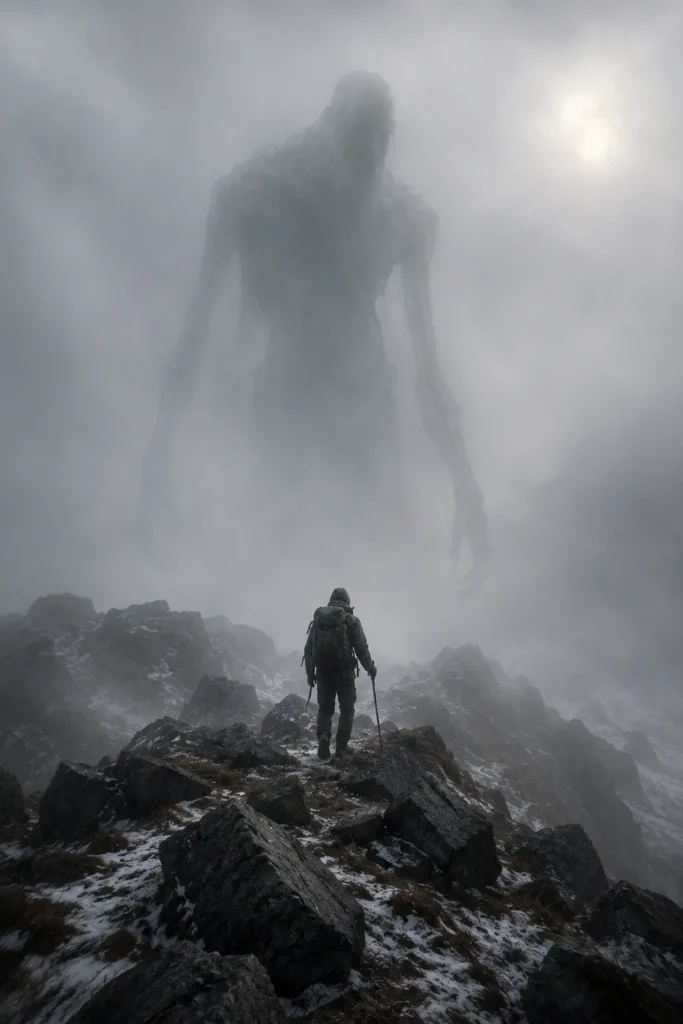
The Great Grey Man is usually not seen but heard and felt: as the crunching of gravel and as a presence. Later accounts describe a very tall, gaunt grey figure of over three metres, but the core phenomenon is the feeling of panic.
Effect
Am Fear Liath Mòr triggers unexplained fear and panic in lone walkers in fog, accompanied by the sound of footsteps. He is not physically attested, but the panic he triggers can be genuinely life-threatening in exposed high mountain terrain, through falls while fleeing.
Profile: Am Fear Liath Mòr
The key aspects of the Great Grey Man at a glance.
Modern Scottish mountain narrative: public since 1925, today a fixed part of the stories surrounding the Cairngorms and of cryptozoology.
Lone walkers in the fog of Ben Macdui: they report footsteps behind them and a sudden, unexplained panic.
Usually not visible at all, only the crunching of gravel and a presence; later accounts mention a gaunt grey figure of over three metres.
Trigger of mountain panic: unexplained fear with an urge to flee, which can become dangerous in exposed high mountain terrain through falls.
No traditional rites have been handed down: the being is a modern mountain apparition, not an object of an old protective custom.
Panic in the literal sense attributed to Pan, the Brocken spectre as an optical analogue, and the presence-felt phenomenon of altitude psychology.
An experience from 1891 and its late public exposure
In Scottish Gaelic, Am Fear Liath Mòr means the great grey man, in English the Big Grey Man. The evidence is modern, not medieval-folkloric: the chemist and mountaineer J. Norman Collie publicly recounted in 1925 an experience from 1891, in which he heard footsteps behind him in the fog three to four times the length of his own, was seized by panic and fled miles downhill.
It was only this account that turned a private terror into a narrated figure. Affleck Gray’s book then made the case widely known; today Am Fear Liath Mòr is a fixed part of Scottish mountain narratives and of cryptozoology, where it is sometimes exaggerated into the Scottish Bigfoot.
Renown and classification
Affleck Gray’s book made the case widely known; today Am Fear Liath Mòr is a fixed part of Scottish mountain narratives and of cryptozoology, where it is sometimes exaggerated into the Scottish Bigfoot.
From a religious-studies perspective: Am Fear Liath Mòr is not physically attested, but the panic he triggers can be genuinely life-threatening in exposed high mountain terrain, through falls while fleeing. Important clarifications: he is not an ancient Celtic being, the tradition only begins in the late 19th and 20th century. And rational explanatory proposals such as infrasound, fog acoustics, or altitude and exhaustion psychology are hypotheses, not established causes.
No old rites against the Grey Man
There are no traditional rites handed down against Am Fear Liath Mòr; the being is a modern mountain apparition, not an object of an old protective custom. Folk protective means in the proper sense do not exist here, and this should be honestly stated. The accounts know only one reaction: flight, and it is precisely this that makes the phenomenon dangerous in high mountain terrain.
Pan, the Brocken spectre, and the psychology of altitude
The name of the phenomenon alludes to panic in the literal sense attributed to Pan; as an optical analogue stands the Brocken spectre alongside it, and more generally the presence-felt phenomenon of altitude psychology. As narrated mountain beings, the Yeti, the Almas and the mountain troll are the closest neighbours, though unlike them the Great Grey Man is hardly ever seen, but felt.
Frequently asked questions about Am Fear Liath Mòr
What is Am Fear Liath Mòr?
The Great Grey Man, an uncanny presence on Ben Macdui, experienced above all as panic, accompanied by the sound of footsteps.
Is it an ancient Celtic being?
No. The tradition only begins in the late 19th and 20th century; it became public in 1925 through J. Norman Collie.
What is mountain panic?
A feeling of unexplained fear and panic experienced by lone walkers in fog, accompanied by the sound of footsteps. It can become dangerous in high mountain terrain through falls while fleeing.
Further links
Further reading:
- Celtic – all beings of the Celtic traditions
- Yeti – the snowman of the Himalayas
- Almas, mountain troll – further beings of the mountain wilderness
- Amulet, sage, protective candle – traditional protective means
- Protection Compass – protective means at a glance
Literature (selection)
Further standard works in the bibliography.
As the Big Grey Man, Am Fear Liath Mòr has become known far beyond Scotland, yet the mountain spirit of Ben Macdui remains at its core a modern mystery: a presence not seen, but experienced as panic.