iWell Guard

The Ankh: the Egyptian Sign of Life and Protective Amulet

The Ankh is an Egyptian sign of life that was worn in temple art and as a grave good, and at the same time as a protective amulet against misfortune. The Ankh is the Egyptian sign for life.

As a hieroglyph, as an implement held in the hand of the gods, and as a worn amulet, it accompanied the people of the Nile for more than three millennia and ranks among the best-known protective signs of the ancient world.

Protective symbolEgyptApotropaion
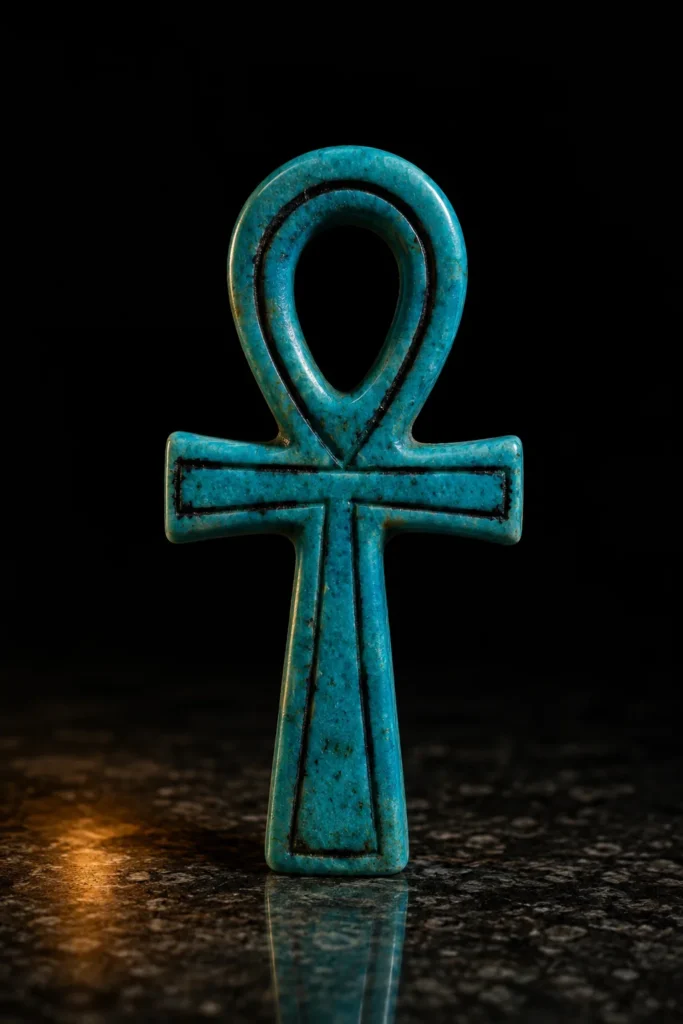
Ankh: protective symbol, museum-style illustration

Classification

The Ankh is one of the best-known signs of ancient Egypt. It shows a form that recalls a cross with a loop in the place of the upper bar.

In Egyptian writing it is the character for the word life. Beyond its purely written use, it became a symbol of great significance. It appears in art, in the temple, in the tomb, and as a worn amulet.

The meaning of the Ankh is closely tied to the concept of life, and in a comprehensive sense. What was meant was not only biological life, but also well-being, vital force, and continued existence beyond death.

The Ankh thus stood for something that every person desired. This positive basic meaning made it an obvious protective sign. Whoever secured life at the same time warded off misfortune.

In religious studies, the Ankh is understood as a sign that unites writing, image, and protective function in itself. It is a word and an image at once, neither alone.

This combination is characteristic of Egyptian culture. The Ankh shows vividly how closely the Egyptians linked language, depiction, and religious idea.

As an amulet, the Ankh belongs to the apotropaia, the objects of misfortune-averting and protection. It was worn by the living and placed with the dead.

Over many centuries its form remained remarkably stable. This constancy makes it possible to trace the Ankh throughout the whole of Egyptian history. To this day it has remained an easily recognizable sign.

The Sign for Life

At the core of the Ankh stands the concept of life. In the Egyptian language the corresponding word denoted being alive in a broad sense. It encompassed physical vital force as well as flourishing and salvation.

When a text wished life upon a person, it wished them this whole bundle of good things. The Ankh captured this wish in a single sign.

The Ankh was especially closely connected with the king and with the gods. In inscriptions, the name of the ruler is often followed by the formula that life be given to him.

The Ankh then appears as a written character directly beside the royal name. In this way the ruler was permanently associated with life. The sign was thus a firm part of royal self-representation.

In Egypt, life was regarded as a gift of the gods. It did not lie in human hands alone, but was granted and could likewise be withdrawn.

This idea explains the high significance of the Ankh. It was the visible sign of a gift that was felt to be the highest good. Whoever wore it kept this gift before their eyes.

From this basic meaning arose the protective character of the sign. For the Egyptian view, life and protection belonged together, for preserved life was protected life. The Ankh did not ward off a single named danger.

Rather, it stood for the comprehensive securing of life itself. In this it resembles the Wedjat, the eye of Horus, which likewise meant integrity as a whole.

Form and Origin of the Shape

The form of the Ankh is clearly outlined and unmistakable. Above a vertical stroke and a horizontal crossbar sits an oval or teardrop-shaped loop. This combination of loop and cross form makes the sign immediately recognizable. Egyptian art held to this basic shape over millennia. Variations usually concerned only the ornamentation, not the structure.

Regarding the original origin of the form, scholarship offers various proposals. A widespread interpretation sees in the sign the loop of a sandal strap, since the Egyptian word for sandal strap sounded similar to the word for life.

Other proposals suggest a knot or an implement. A definite decision is not possible. The sources leave the question open.

This uncertainty about the origin does not, however, diminish the significance of the sign. What was decisive for the Egyptians was not where the form came from, but what it denoted.

Already in the earliest testimonies the Ankh stands firmly for life. The connection of form and meaning was thus present from the beginning. It remained unchanged throughout the whole of Egyptian history.

The clear shape of the Ankh had a practical advantage. It could be chiseled in stone, cast in metal, and molded in faience.

The sign functioned as a small hieroglyph just as well as a large temple relief. This versatility contributed to its wide distribution. The Ankh could appear anywhere the idea of life was to be expressed.

The Ankh in the Hand of the Gods

In Egyptian art the gods very often hold the Ankh in the hand. They hold it by the loop, so that the cross form points downward. This depiction is widespread across all periods.

It shows the Ankh not as an ornament, but as an implement at the disposal of the gods. Life thus appears as something that lies in their hand.

A particularly striking scene shows a deity holding the Ankh to the king’s nose. In this way the breath of life is conveyed to him. This gesture means that the deity grants life to the ruler.

It is found on the walls of many temples. In a single image it makes visible the whole idea that life is a divine gift.

This gesture is famous from the time of Akhenaten. In the depictions of that period, the rays of the sun disk end in small hands, and these hands offer the Ankh to the royal couple.

Life thus flows directly from the sun to the people. Here too the Ankh is the visible sign of this gift. It connects the heavenly source with those who receive.

From these depictions it becomes clear that the Ankh was at first no ordinary ornament of the people. It belonged to the sphere of the gods and of the king.

Only from this high standing was its use as an amulet derived. Whoever wore an Ankh thereby brought themselves into connection, as it were, with the divine gift of life. The amulet brought a sign of the gods into everyday human life.

Material and Use as an Amulet

As an amulet, the Ankh was made from various materials. Faience in bright turquoise or blue-green was very common, for these colors were regarded as life-promoting.

In addition there were Ankh amulets of gold, of carnelian, and of further stones. The choice of material depended on the means of the wearer. Simple faience pieces stood alongside costly works in precious metal.

Ankh amulets were produced in great numbers in molds. This mass production made the sign affordable and thus broadly available. It was not a privilege of the upper class, but a protection for many.

The numerous surviving pieces attest to this wide distribution. The Ankh belongs to the most frequent amulet forms that have come down to us from Egypt.

The Ankh was worn as a pendant on a cord or chain. It could also be incorporated into larger pieces of jewelry, such as broad collars and pectorals.

The Ankh frequently appears together with other protective signs. The combination of several signs was intended to concentrate their effect. A single piece of jewelry could thus carry several protective ideas at once.

Beyond jewelry, the Ankh form also appears on everyday objects. Mirror cases shaped as an Ankh are well known. The mirror and the sign of life were thereby joined into a single object. Such objects show how naturally the Ankh was integrated into daily life. It was a sign that could be present everywhere.

The Ankh in the Cult of the Dead

The Ankh had a firm place in the Egyptian conception of death. Since it stood for life, it was a self-evident sign for the hope of a continued life after death.

The deceased was not to remain in death, but to attain new life. The Ankh embodied precisely this wish. It accompanied the dead as a sign of this hope.

In the tombs, Ankh amulets are found among the grave goods. They were placed in the wrappings of the mummies and distributed in the coffins.

The sign also appears on the walls of the tombs and on the funerary papyri. Everywhere it was meant to secure life for the deceased. The burial chamber thus became a place permeated by the sign of life.

Egyptian religion did not understand the afterlife as a mere end. It hoped for a continuation in which the deceased lived on. The Ankh was the sign of this continuation. It expressed that death could be overcome. With this it belonged to the core of the Egyptian conception of the afterlife.

In this use a peculiarity of many Egyptian protective signs becomes apparent. They served the living and the dead at the same time. The Ankh secured life in this world and was meant to open it anew in the next.

This dual orientation connected the two great realms of Egyptian religion. It made the Ankh a sign that spanned the whole course of life.

The Ankh and Related Signs

In Egyptian art the Ankh often appears together with other signs. It appears especially frequently beside the Was scepter and the Djed pillar.

The Was scepter stood for power and dominion, the Djed pillar for stability and permanence. Together with the Ankh they formed a meaningful series. They combined life, power, and constancy into a comprehensive blessing formula.

This group of signs occurs especially in solemn contexts. It adorns temple walls, thrones, and furnishings. With these signs the gods wish the king a long, powerful, and secured life. The Ankh contributes the idea of life to this. It is the first and most fundamental link in this series.

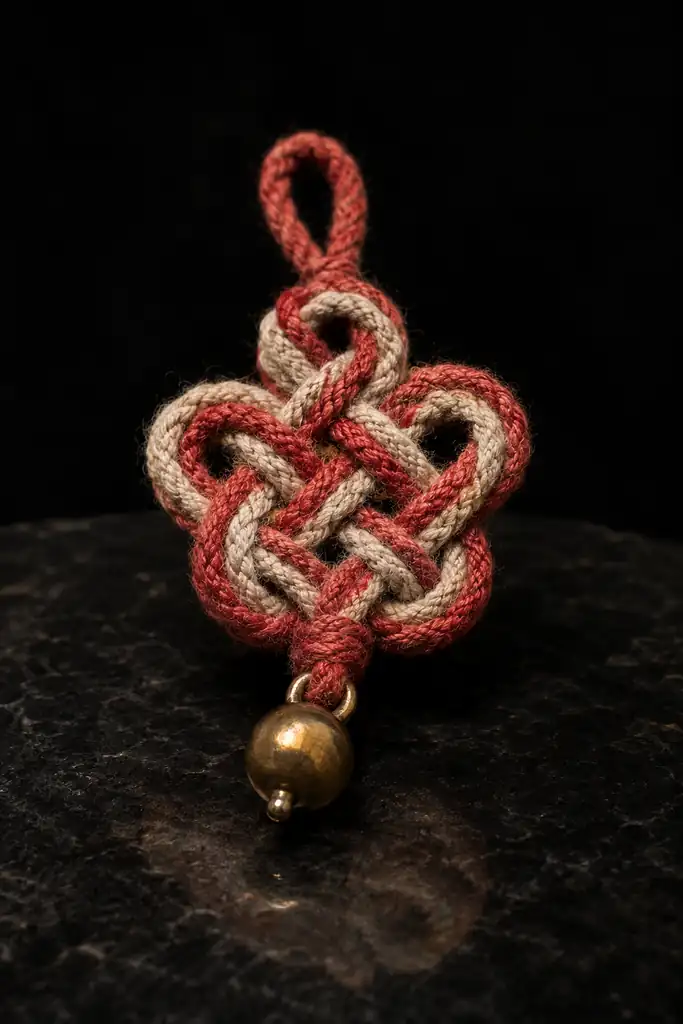
The Ankh is also related to the Tit, the so-called knot of Isis. Both signs bear a loop, and both belong to the realm of life and protection.

The Egyptian pictorial language had several such signs that complemented one another. They could be used singly or in combination. The Ankh was the most widespread and best known among them.

This embedding within a whole group of signs is revealing. It shows that the Egyptian protective signs did not form a loose juxtaposition, but a coherent system.

Each sign had its place and its meaning. Within this system the Ankh stood for the most fundamental thing of all, for life itself. This explains its high rank.

From Hieroglyphic Sign to Coptic Cross

The history of the Ankh did not end with the ancient Egyptian religion. When Christianity took hold in Egypt, the sign lived on in altered form.

The Egyptian Christians, the Copts, adopted the Ankh form and reinterpreted it. From the sign of life there arose a Christian cross. In this shape it is called the looped cross.

This adoption was no coincidence. The Ankh stood for life, and Christianity proclaimed a life beyond death. The old meaning and the new message could be combined. The looped cross thus became a sign that united Egyptian tradition and Christian faith. It shows how a symbol can persist across a religious change.

The looped cross appears in Coptic art on stelae, in manuscripts, and on buildings. It is a visible testimony to the long history of the Ankh’s influence. A sign of the pharaonic age found its place in Christian culture. This bridge across the centuries is remarkable. It makes the Ankh a particularly long-lived symbol.

This example reveals a general pattern. Signs of protection and salvation are often more enduring than the religions in which they arose. They are adopted, reinterpreted, and carried on in new contexts.

The Ankh is a clear example of this process. It outlasted the demise of the ancient Egyptian religion and lived on in the Coptic cross.

Reception Today

Today the Ankh ranks among the best-known signs of Egyptian culture. Alongside the pyramids and the hieroglyphs, it is a sign that is immediately associated with ancient Egypt. It owes this familiarity to its clear form and its long history. It appears in countless depictions that refer to Egypt.

As a piece of jewelry the Ankh is widespread. It is worn as a pendant, often without precise knowledge of its original meaning.

For many wearers it stands in a general way for life, for a connection to Egypt, or for a spiritual attitude. With this the meaning has shifted compared to its ancient Egyptian use.

In certain movements the Ankh is deliberately taken up. Modern movements that invoke the ancient Egyptian religion use it as a sign of their tradition. The Ankh has also found a firm place in particular youth and subcultures. In these contexts it carries its own new meaning in each case.

Original Ankh amulets can be seen in almost every larger Egyptian collection. Museums in Cairo, London, Berlin, and Paris preserve numerous pieces. They attest to a sign that stood for life over more than three millennia.

From the temple relief to the small faience amulet its meaning remained the same. The Ankh is thus one of the most enduring signs of protection and salvation in history.

Literature (Selection)

  • Carol Andrews: Amulets of Ancient Egypt (1994)
  • Erik Hornung: Der Eine und die Vielen. Ägyptische Gottesvorstellungen (1971)
  • Richard H. Wilkinson: Reading Egyptian Art (1992)
  • Geraldine Pinch: Magic in Ancient Egypt (1994)
  • Wolfhart Westendorf: Das alte Ägypten (Studien)

Related key terms: Ankh, looped cross, sign of life, hieroglyph, apotropaion, faience, Was scepter, ancient Egypt, Coptic.

iWell Guard and Protective Traditions

iWell Guard stands in the cultural-historical line of portable protective objects, to which the Ankh also belongs. A modern companion for people who live with protective symbols: made in Germany, 41 layers of solid gold, platinum, and silver, with a 30-day right of return.

Personal experiences may vary. Not a medical device. No healing promise.