iWell Guard

The Bes Amulet: the Egyptian Protective God of Home and Childbirth

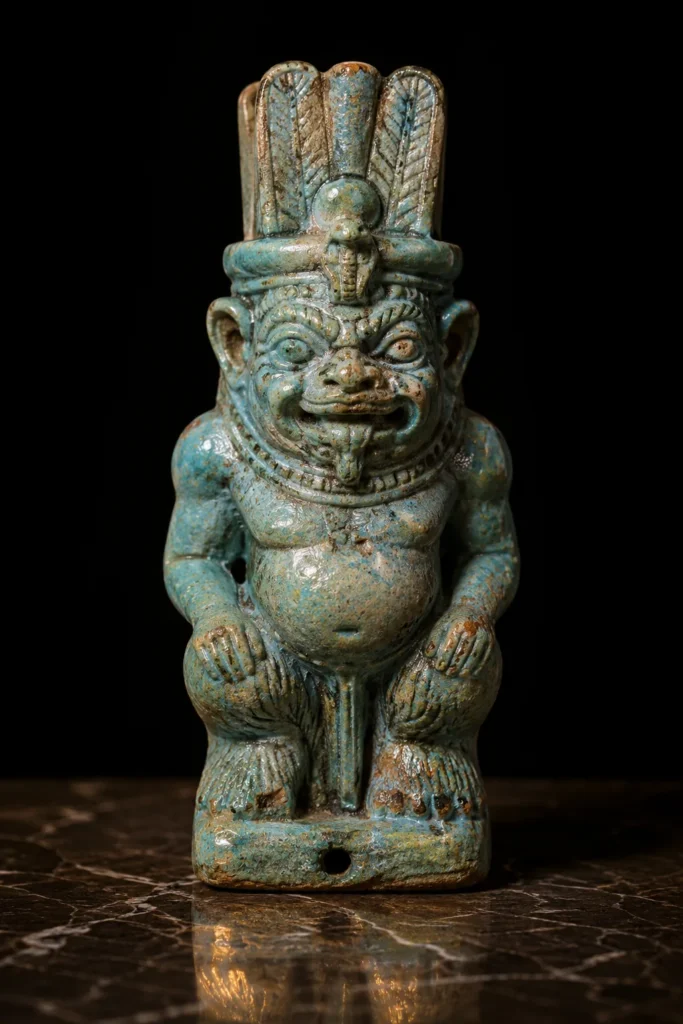
The Bes amulet depicts the Egyptian protective god Bes, a friendly yet fearsome dwarf. He was not a god of the great temples, but a guardian of the home, of childbirth, and of sleep.

The Bes amulet served in ancient Egypt as Egyptian household protection, especially for mother and child.

Protective SymbolEgyptApotropaion
Bes Amulet - Protective Symbol, museum illustration

Classification

The Bes amulet is a protective object from ancient Egypt. It depicts the god Bes, a protective deity of distinctive, unmistakable form. The amulet was worn on the body and used in the home.

Bes was not a god of the great state temples. He was a god of the home and of everyday life. His domain lay with people and their daily concerns, not with the great affairs of kingship.

The function of the Bes amulet was protection. It was meant to safeguard the home, childbirth, sleep, and especially those who were vulnerable. Bes watched over mothers, over children, and over those who slept.

In religious studies, Bes is a good example of a popular household deity. Such gods were close to ordinary people and were more present in their daily lives than many of the great deities.

The Bes amulet survives in extraordinarily large numbers. This abundance of finds demonstrates how widespread the veneration of Bes was. He belonged to the established repertoire of Egyptian everyday piety.

The amulet combines two traits that appear contradictory at first glance. Bes is friendly and approachable, and at the same time fearsome. Both aspects belong to his protective function.

Bes, the God

Bes is an unusual figure among the Egyptian gods. Most Egyptian gods are depicted with dignity and in composed postures. Bes, by contrast, is small, stocky, and wild in expression.

The name Bes possibly designates an entire group of related protective figures that merged into a single form over time. Bes is therefore less a single god than a type of protective being.

Unlike the great gods, Bes had no significant temples of his own and no elaborated mythology. He lives primarily in the amulets and in the depictions of the domestic sphere.

Bes had a friendly nature. He was regarded as well-disposed toward people, even cheerful. He is associated with music and dance, and in some depictions he plays an instrument.

At the same time, Bes was combative. He confronted harmful forces and drove them away. This combination of cheerfulness and readiness to fight is characteristic of Bes.

Bes spread beyond Egypt. In the Levant, across the Mediterranean, and in other regions he became known. The friendly, protective household deity was intelligible across cultural boundaries.

Form: the protective dwarf

The form of Bes is immediately recognizable. He is depicted as a dwarf, small and stocky, with a large head and short, often bowed legs. This sets him fundamentally apart from the slender depiction of the other gods.

The face of Bes is broad and leonine. It shows a mane, wide-open eyes, and frequently a protruding tongue. This expression is deliberately wild and fearsome in character.

On his head, Bes often wears a crown of tall feathers. This feathered crown is a widespread feature of his depiction. It elevates the small figure and lends it dignity.

Unlike most Egyptian gods, Bes is frequently shown from the front, facing the viewer. This frontal depiction is unusual. It allows Bes to look the viewer directly in the eye.

In his hands, Bes often holds objects such as knives or instruments. The knives point to his combative nature; the instruments point to his association with music and dance.

This form has remained consistent over a long period. The leonine dwarf with the feathered crown is a fixed image type. By this type, Bes is recognizable throughout Egyptian history.

Protection of Home and Sleep

Bes was above all a god of the home. His protection was directed at the living space and those who dwelled in it. The Bes amulet and the image of Bes had their place in the domestic sphere.

Bes appears on objects of daily life. He decorates furniture, vessels, mirror handles, and jewelry. He is found with particular frequency on headrests, the Egyptian neck supports used during sleep.

This association with the headrest is telling. Sleep was regarded as a state of vulnerability. During sleep, a person was exposed to harmful forces and to troubling dreams.

Bes watched over the sleeper. On the headrest, immediately at the head of the sleeper, his image kept nocturnal dangers at bay. Bes was thus a guardian of the night and of sleep.

Bes also appears on the walls of living rooms. His image placed the entire room under his protection. Where Bes was present, harmful spirits were to find no entry.

Bes thus secured the domestic sphere comprehensively. He protected the space, the everyday objects, and especially the person in their most vulnerable state, during sleep.

Protection in Childbirth and Childhood

The most important task of Bes was the protection of childbirth and childhood. In this domain, he was one of the most significant protective deities of everyday Egyptian life.

Childbirth in the ancient world was a dangerous hour, for both mother and child. Egypt had no reliable medicine in the modern sense. The protection of the gods was therefore of the greatest importance.

Bes stood by the woman in labor. In the rooms where children were born, his image was present. He was meant to secure the birth and to keep away the harmful forces that threatened mother and child.

After the birth, Bes remained with the child. Small children were considered especially at risk, and they were placed under the protection of Bes. Bes amulets were used specifically for children.

In this domain, Bes worked alongside other protective powers. The Mesopotamian Pazuzu amulet was also directed at the protection of childbirth and childhood. Birth and earliest childhood were a central concern of protection everywhere.

Bes is therefore a clear example of a recurring pattern. In very many cultures, the most important protective powers are directed at the most vulnerable phase of life: birth and the young child.

Warding Off Harm Through the Terror Image

The protective power of Bes rests in part on his fearsome appearance. His wild, leonine face with its protruding tongue is deliberately designed to be frightening.

Here the principle of warding off harm through a terror image is at work. What looks fearsome keeps harmful forces away. Bes frightens away evil spirits before they can harm the home or the child.

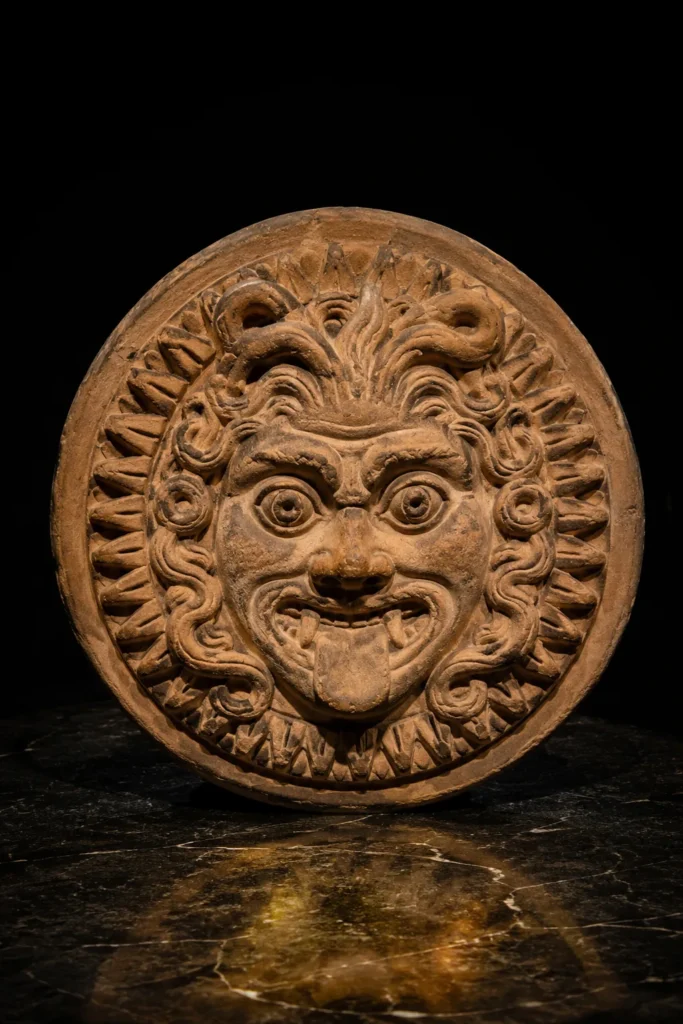
In this, Bes shares a principle found in many cultures. The Greek Gorgoneion wards off harm through the terrible head of Medusa. The Pazuzu amulet wards off harm through the demon head. Bes belongs in this lineage.

What is distinctive about Bes is the combination of terror and friendliness. His face is wild, yet he is well-disposed toward people. The terror points outward, against the enemies; the benevolence is directed toward those under his protection.

This dual nature makes Bes a compelling figure. He is not a mere terror image, but a friendly god who employs a fearsome face as a weapon against harm.

For the people who venerated him, Bes was therefore not a threatening being, but a reliable helper. His terrible countenance was not directed at them, but at the forces he kept away from them.

Material and Distribution

Bes amulets were made from various materials. Faience was very widespread, the glazed quartz ceramic in turquoise and blue-green. Alongside this there were pieces in stone, metal, and other materials.

The amulets were produced in large numbers using molds. This mass production made the Bes amulet affordable. It was not a privilege of the wealthy, but a means of protection accessible to broad sections of the population.

Bes appears not only as a standalone amulet, but also on countless other objects. He decorates jewelry, household items, furniture, and tools. His image could be placed wherever protection was desired.

This ubiquity makes Bes a valuable source for Egyptian everyday religion. Wherever Bes appears, the desire for protection in daily life is evident.

Beyond Egypt, Bes spread through trade. In Cyprus, the Levant, and across the Mediterranean, depictions of Bes have been found. The Egyptian household deity became a protective figure known far beyond his region of origin.

Bes remained vital across the centuries. From early times through the Greco-Roman period in Egypt, he was present. He thus belongs among the most enduring protective figures of the Egyptian religion.

Bes Alongside the Great Gods

Egyptian religion knew the great gods of the state temples and the gods of domestic everyday life. Bes belongs clearly to the second group. He is a god of the people, not of the state.

The great gods such as Amun, Re, or Osiris had powerful temples, their own priesthood, and a fixed place in the state cult. Bes had none of these. His place was the home.

Yet precisely therein lay his strength. Bes was close to people. He was present in their living spaces, on their furniture, on their headrests, among their children. He accompanied their daily lives.

Egyptian piety knew both levels. The great gods were venerated in the temples; the household gods secured daily life. Bes was the best known among these household gods.

For an accurate account of Egyptian religion, the household gods are just as important as the great deities. They show how religion was lived in everyday life, far from the great temples.

Bes is thus a key to understanding Egyptian everyday piety. He shows that the protection of home and family was a central religious concern, served by a god of his own who was widely venerated.

Contemporary Reception

Bes is less well known today than the great Egyptian gods. While names such as Isis, Osiris, or Anubis are widely familiar, Bes is known mainly to those versed in Egyptian culture.

Yet through his distinctive form, Bes is a memorable being. The leonine dwarf with the feathered crown differs strikingly from all other Egyptian gods and stays in the mind.

In the Egyptian collections of museums, Bes is richly represented. Numerous Bes amulets and Bes depictions have survived. They attest to how widespread his veneration was in everyday life.

For the study of Egyptian religion, Bes is of great value. He shows the side of religion that took place not in the temples but in the homes.

Bes is thus a compelling example of an everyday protective object. He was not a distant god, but a close guardian who watched over the home, over sleep, and especially over childbirth and children.

In him, friendliness and combativeness, cheerfulness and terror are combined. This combination made Bes one of the most beloved and reliable protective gods that ancient Egypt knew.

Selected Bibliography

  • Carol Andrews: Amulets of Ancient Egypt (1994)
  • Geraldine Pinch: Magic in Ancient Egypt (1994)
  • Veronica Wilson: The Iconography of Bes (Studies)
  • Richard H. Wilkinson: The Complete Gods and Goddesses of Ancient Egypt (2003)
  • Erik Hornung: Der Eine und die Vielen (1971)

Related key terms: Bes amulet Bes protective god household deity childbirth headrest apotropaion faience ancient Egypt.

iWell Guard and Protective Traditions

iWell Guard stands in the cultural-historical lineage of wearable protective objects, to which the Bes amulet also belongs. A modern companion for people who live with protective symbols: crafted in Germany, 41 layers of genuine gold, platinum, and silver, with a 30-day return policy.

Individual experiences may vary. Not a medical device. No health claims.