iWell Guard

The Cippus of Horus: the Egyptian Protective and Healing Stele

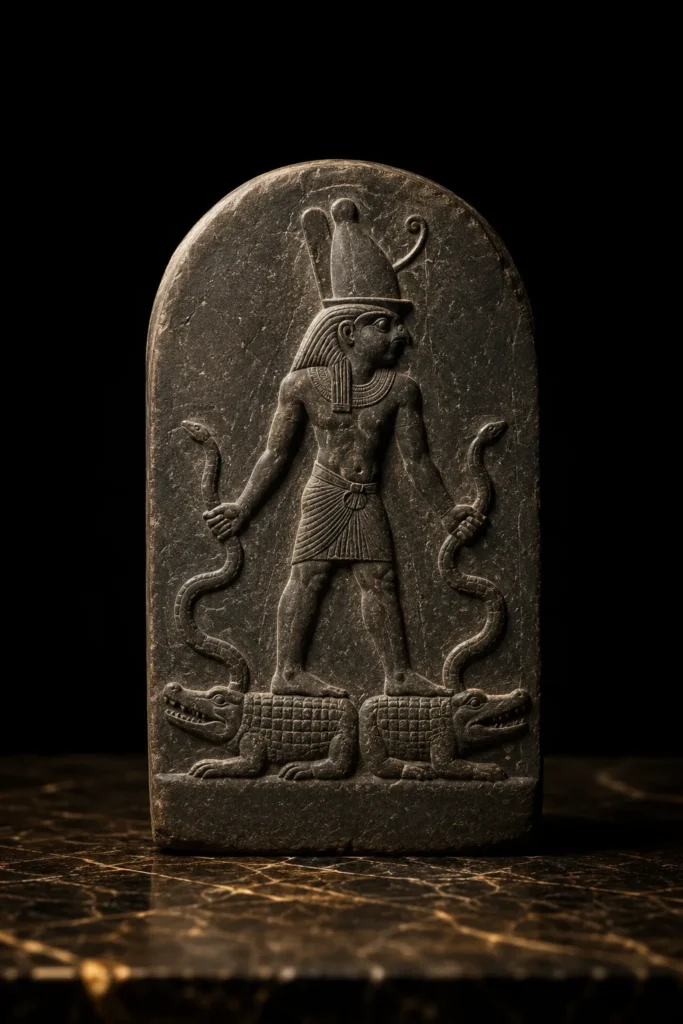
The Cippus of Horus is an Egyptian protective and healing stele. It depicts the divine child Horus subduing dangerous animals and is covered with magical texts against snakebite and scorpion sting.

The Cippus of Horus ranks among the healing stelae of ancient Egypt.

Protective SymbolEgyptApotropaicon
Cippus Horus - protective symbol, museum-style illustration

Classification

The Cippus of Horus is a protective object from ancient Egypt. It is a stele, that is, a tablet or panel covered with images and texts. At its center stands the young god Horus.

Unlike a worn amulet, the Cippus is an object placed upright or held in the hand. Small pieces existed for domestic use, and larger stelae stood in sanctuaries and public spaces.

The Cippus of Horus addresses a very specific danger. It was meant to protect against the venom of harmful animals and to help against snakebite and scorpion sting.

In this way the Cippus is at once a protective and a healing object. It was intended to ward off poison and, where it was already active, to neutralize its effect. Protection and healing are closely bound together in it.

In religious studies, the Cippus is a prime example of an object that combines image, word, and action into a single protective practice. Its efficacy rests on the interplay of these three elements.

The Cippus also shows that Egyptian religion responded to concrete everyday dangers. Snakes and scorpions were a real, ever-present threat, and the Cippus was the religious answer to them.

Horus, the Child

At the center of the Cippus stands a particular manifestation of the god Horus, namely Horus as a child. This childlike form of Horus is often referred to in scholarship by the Greek name Harpocrates.

Horus as a child is the son of Isis and Osiris. Egyptian tradition recounts how Isis hid her son in the marshes of the Nile Delta and protected him from his enemies.

During this time the young Horus was exposed to numerous dangers. Accounts relate that the child was stung by a scorpion or bitten by a snake and fell into great peril.

This peril was overcome. Through the power of the gods and through effective magical spells, the young Horus was healed. The story of the divine child’s healing is the core on which the Cippus is built.

Those who used the Cippus invoked this narrative. Just as the young Horus was healed from poison and danger, so too was the person who turned to the Cippus to be healed.

The Cippus thus depicts not a powerful, adult god, but a vulnerable and rescued child. It is precisely in this rescue of the child that the model lies which was meant to make the Cippus effective.

Form of the Stele

The Cippus shows the naked divine child Horus at its center. He stands upright and faces the viewer directly. This frontal depiction is, as with Bes, unusual in Egyptian art.

The young Horus stands on two crocodiles. With his hands he grasps and subdues dangerous animals, among them snakes, scorpions, and other creatures regarded as threatening. He holds them fast and renders them powerless.

Above the head of Horus the face of the god Bes frequently appears. The protective household deity thus looks down upon the scene from above. Bes and Horus, two protective figures, work together on the Cippus.

The pictorial scene thus depicts a victory. The divine child has overcome the dangerous animals and holds them in his power. This mastery over danger is the central message of the image.

Around the main scene and on the reverse, the Cippus is covered with texts. These texts are magical spells, and they are as important for the efficacy of the Cippus as the image itself.

Image and text form a unity on the Cippus. The image shows the victory over danger; the text speaks the spells that bring about this victory. Only together do they constitute the effective protective object.

The Texts Against Poison

The Cippus is covered all over with texts. These texts are incantations and magical spells directed against poison and against venomous animals.

The spells take up the narrative of the healing of the Horus child. They recount how Horus was threatened by poison and how he was saved. The act of narrating this rescue was intended to bring about the rescue of the human being.

In the texts, the gods who had already helped the young Horus are invoked. Above all Isis, the mother, and Thoth, the god of wisdom and efficacious words, appear in these spells.

The magical spells followed the belief that the correctly spoken word is effective. A spell that made the divine healing present was intended to repeat that healing in the present moment.

The texts address the poison directly. They command it to withdraw from the body, just as it once withdrew from the body of Horus. The word thus becomes a weapon against the poison.

This close connection between text and effect is characteristic of the Cippus. It is not merely an image but a bearer of words, and in those words lies an essential part of its protective power.

The Consecrated Water

The Cippus of Horus was used in a particular way. This use connected the object directly with the healing of the affected person.

Water was poured over the Cippus. The water ran over the images and over the inscribed texts. In doing so, it absorbed, according to Egyptian belief, the power of the images and the spells.

The water that had thus flowed over the Cippus was collected. It was now considered consecrated and permeated by the protective power of the stele. Ordinary water had become an effective remedy.

This consecrated water was then used to help the person who had been stung or bitten. It was drunk or applied in another manner. Through the water, the protective power of the Cippus was intended to enter the person’s body.

In this way the power of the stele became mobile. It was no longer bound to the stone but could be brought to the person who needed it by means of the water.

This custom reflects a striking concept. The image and word of the stele are, so to speak, dissolved by the water and transferred into the person. The Cippus is thus an object whose power can be passed on.

Protection Against Snake and Scorpion

The Cippus addresses a very concrete danger: venomous animals. Snakes and scorpions were ubiquitous in Egypt and posed a constant, real threat.

A snakebite or scorpion sting could be fatal. Egypt had no reliable treatment in the modern sense. In this situation, protection through the gods was of the utmost importance.

The Cippus was the religious response to this danger. It was meant to protect before misfortune occurred and to heal when the poison was already at work. Prevention and healing belonged together.

The small cippi for domestic use could be kept in the home. In an emergency, the object was at hand, and water could be poured over it.

In this respect the Cippus belongs to those protective objects aimed at a specific, named danger. Unlike a general protective sign, it is directed precisely against animal venom.

This precise orientation reveals the closeness of Egyptian protective practice to daily life. The Cippus responded not to an abstract threat but to a danger people faced every day.

From the Household Stele to the Great Cippus

The Cippus of Horus exists in very different sizes. This range extends from small, handheld pieces to large, elaborately worked stelae.

The small cippi were intended for domestic use. They could be kept in the home and used whenever needed. They provided protection for the individual family.

Alongside these, large cippi stood at sanctuaries and in public spaces. They were accessible to the general public. Anyone who needed help could obtain the consecrated water from them.

The most famous example of such a large stele is the so-called Metternich Stele. It is covered all over with images and texts and ranks among the most significant surviving cippi.

These large stelae show that protection from poison was a concern of the whole community. Not only the individual family but also the sanctuary and the public sphere kept this protection available.

The range from the small household piece to the large public stele makes clear how widespread the Cippus was. It covered both the private and the public domain equally.

The Operative Principle: Word, Image, and Water

The Cippus of Horus combines several operative principles into a single protective practice. This combination makes it a particularly illuminating protective object.

The first element is the image. The depiction of the victorious Horus child subduing dangerous animals shows the triumph over danger. The image makes this triumph present.

The second element is the word. The magical spells on the stele invoke the gods and command the poison to withdraw. The correctly spoken and written word was regarded as effective.

The third element is the water. It absorbs the power of image and word and transfers it to the person. The water makes the protective power mobile and applicable.

Only in the interplay of these three elements does the Cippus unfold its full significance. Image, word, and water form a complete protective practice in which each element has its role.

This combination of image, word, and action is characteristic of Egyptian protective practice. The Cippus exhibits it in a particularly clear and complete form and therefore ranks among the most instructive protective objects of ancient Egypt.

Modern Reception

The Cippus of Horus is today known primarily to those familiar with Egyptian culture. It is not among the widely recognized symbols, yet in Egyptology it is an important and well-researched subject.

Cippi are preserved in the major Egyptian collections of museums, ranging from small household pieces to large stelae. The Metternich Stele is among the best-known pieces and is held in a major collection.

For the study of Egyptian religion, the Cippus is of great value. Its texts provide insight into Egyptian healing arts, into incantation, and into the connection between religion and healing.

The Cippus shows that Egyptian religion provided a precise answer to concrete dangers of life. Protection against animal venom was an urgent concern to which a dedicated object was devoted.

In this way the Cippus is a compelling example of a protective object that combines protection and healing. It was intended to ward off harm and, where harm had already occurred, to neutralize its effect.

The Cippus of Horus thus ranks among the most carefully considered protective objects of the ancient world. It unites the myth of the rescued divine child, the power of the word, and a custom that passes this power on to the person by means of water.

Selected Bibliography

  • Heike Sternberg-el Hotabi: Untersuchungen zur Überlieferungsgeschichte der Horusstelen (1999)
  • Geraldine Pinch: Magic in Ancient Egypt (1994)
  • Carol Andrews: Amulets of Ancient Egypt (1994)
  • J. F. Borghouts: Ancient Egyptian Magical Texts (1978)
  • Hartwig Altenmüller: Studien zur ägyptischen Heilkunde

Related key terms: Cippus Horus healing stele Harpocrates snakebite scorpion Metternich Stele apotropaicon ancient Egypt.

iWell Guard and Protective Traditions

iWell Guard stands in the cultural-historical lineage of wearable protective objects, to which the Cippus of Horus also belongs. A modern companion for people who live with protective symbols: crafted in Germany, 41 layers of genuine gold, platinum, and silver, with a 30-day right of return.

Individual experiences may vary. Not a medical product. No healing claims made.