Aita: Etruscan Hades and Ruler of the Underworld
By Ralf Ittermann · last reviewed on
Aita (also Eita) is, in Etruscan religion, the god of the underworld, the counterpart to the Greek Hades and the Roman Pluto.
He rules over the realm of the dead and is the consort of the goddess Persipnei (the Etruscan counterpart to the Greek Persephone). This account describes his position within religious studies in the Etruscan system of eschatology.
Profile: Aita
Aita: the most important aspects at a glance. The following fields summarise origin, function, appearance, veneration, symbols and parallels.
Aita (also Eita) is the god of the underworld in Etruscan religion and ranks among the highest gods. His name is related to the Greek Hades and is considered a borrowing from Greek. Aita Tuchulcha is attested as an epithet.
Aita rules the realm of the dead, a complexly structured space, and presides over the underworld demons Charun, Vanth and Tuchulcha. He is the consort of Persipnei, the Etruscan counterpart of Persephone. Unlike in the realm of the Greek Hades, the existence of the dead with him carries no negative connotation.
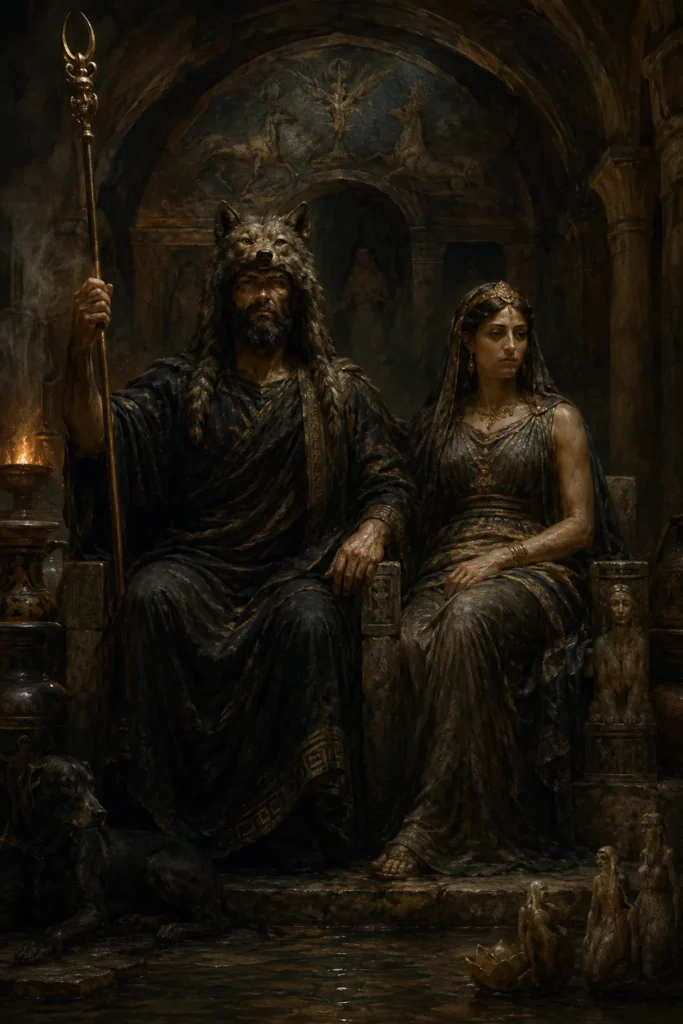
Aita is depicted as a bearded, majestic man, often with a wolf-skin cap (Hades cap) or a sceptre. The wolf-skin cap is regarded as an Etruscan peculiarity. In the Tomba dell’Orco in Tarquinia he appears with his consort Persipnei.
Like all gods of the underworld, Aita was not worshipped in public temples; his cult was current in the sphere of the tomb. At funerals, formulas addressed to Aita were spoken, and images of Aita adorned burial chambers and sarcophagi. Offerings were made at wells, which were regarded as entrances to the underworld.
The wolf-skin cap (Hades cap), an Etruscan peculiarity, and the sceptre belong to Aita. Wells were regarded as entrances to his realm, and objects in tombs were intended as gifts to him.
Aita corresponds functionally to the Greek Hades, the Roman Pluto and Dis Pater, and the Mesopotamian Nergal. The idea of a male ruler of the underworld with an abducted consort is widespread in the ancient Mediterranean. The positive emphasis on the afterlife is rare in the Greek tradition.
Place within the Etruscan Pantheon
Aita belongs to the highest gods of Etruscan religion. He is not part of the Capitoline triad (Tinia, Uni, Menrva), but the ruler of the underworld realm, which in Etruscan religion is an independent domain. In this function he is superior to Charun, Vanth, and Tuchulcha.
Larissa Bonfante, Jean-Rene Jannot, and Nancy Thomson de Grummond have treated Aita systematically in their works on Etruscan religion. He is attested less frequently in Etruscan visual art than the Olympians, but he is central to understanding Etruscan eschatology.
Aita as ruler of the Etruscan afterlife can only be placed in context if one views Etruscan religion as an independent system between Greek-Mediterranean and Italic-Roman tradition.
This view goes back to the research contributions of Massimo Pallottino, Jacques Heurgon, Sybille Haynes, Mauro Cristofani, and Giovanni Colonna, who decisively sharpened the profile of this tradition.
Aita stands at the head of the Etruscan underworld domain and thereby shows how strongly the Etruscan pantheon was ordered hierarchically and structured by function. Unlike what some older studies suggest, this pantheon was not ‘mysterious’ or ‘alien’, but an independent variety of Mediterranean religion.
Aita, whose name points back to the Greek Hades, embodies the mediating role of the Etruscans between Greek influence and the emerging Roman religion. It is precisely this intermediary position in Italic religious history that makes the Etruscan material valuable for religious studies.
The fact that Aita is related to the Greek Hades has led older scholarship to treat the Etruscan afterlife as a mere copy.
The religious-ethnological research of recent decades, by contrast, sees Etruscan religion as a self-contained, religious-phenomenologically independent system and has replaced the reading of it as a mere offshoot with a more differentiated view.
Name and Etymology
The name Aita is related to the Greek Hades. Linguistically it is assumed that the Etruscan form was borrowed from Greek. The variant Eita is likewise attested. Helmut Rix’ Editio Minor documents the epigraphic evidence.
Aita sometimes also appears under the epithet Aita Tuchulcha, which suggests a connection with the demon Tuchulcha. This connection is interesting for religious studies: it shows that the Etruscan underworld theology knows a dense network of relationships.
Aita’s name, together with the variant Eita, stands in a language that is classified linguistically as isolated or can be assigned to a hypothetical ‘Tyrsenian’ family, to which Lemnian and Raetic possibly also belong. The decipherment of these texts has been an open research topic since the 19th century.
The epigraphic evidence for Aita and the variant Eita is found in Helmut Rix’ Editio Minor, the fundamental collection of the Etruscan language corpus. This collection is now being expanded by the Thesaurus Linguae Etruscae and the online database ETP (Etruscan Texts Project).
Aita’s position in the Etruscan afterlife also touches on the unresolved question of the origin of the Etruscans. Herodotus traced them back to Lydia, Dionysius of Halicarnassus saw in them natives of Italy. This question matters for religious history because it concerns possible connections of Etruscan religion to Anatolian cults.
Linguistic and epigraphic research are today dependent on each other, and the digital edition of Etruscan texts in the ETP (Etruscan Texts Project) makes it easier to compare attestations, including of the name forms Aita and Eita. Marie-Laurence Haack and Vincent Jolivet are among the leading researchers in this field.
Description and Iconography
Aita is depicted in Etruscan art as a bearded, majestic man, often with a wolf cap (the cap of Hades) or with a scepter. The wolf cap is an Etruscan particularity that is not attested in the same way in the Greek Hades type.
On Etruscan tomb paintings (Tomba dell’Orco in Tarquinia) Aita appears in impressive scenes with his consort Persipnei. These images are among the most striking testimonies of Etruscan eschatology.
Aita is attested less frequently in Etruscan art than the Olympians, yet it is precisely here that the richness of Etruscan visual art shows itself, whose mirrors, vases, tomb painting, and bronzes carry the greatest part of our knowledge. Larissa Bonfante has honored this visual language as an independent tradition, not merely a derived one.
Aita is among the most striking figures of Etruscan tomb painting, which in Tarquinia, Cerveteri, and Vulci represents a first-rate source of Etruscan religion and eschatology. Its banquet, dance, and music scenes, as well as mythological episodes, portray the afterlife as a continuation of life.
Aita is often depicted in connection with Persipnei and further underworld figures, which reflects the preference of Etruscan iconography for multi-figure scenes, narrative references, and symbolic condensations. This visual language is the subject of Etruscan religious iconography.
Aita appears in scenes with Persipnei and demons such as Tuchulcha, and even this makes clear the narrative condensation of Etruscan visual art, in which a mirror or a vase can contain several mythological references at once. Research must therefore read these images carefully in context.
Aita in Etruscan Eschatology
Aita rules over the underworld realm, which in the Etruscan conception is a complexly structured space. After their death the dead enter the realm of Aita, where they lead a shadow existence that, however, is not negatively connoted like the Greek realm of Hades.
Etruscan tomb paintings show the dead at the banquet, at the dance, in conversation: images of a thoroughly pleasant afterlife.
This positive eschatology is remarkable from a religious-phenomenological standpoint and distinguishes the Etruscan tradition from the Greek. Jannot worked out this difference in Religion in Ancient Etruria.
A coherent narrative about Aita is not handed down, for Etruscan mythology knows no elaborated narrative texts like the Greek or Roman. It is reconstructed from pictorial sources, inscriptions, and the Greek-Roman secondary tradition, which demands methodological caution.
Aita is related to the Greek Hades and thereby stands for the complex relationship of both mythologies. The Etruscans adopted many Greek subjects concerning Achilles, Odysseus, or Oedipus, but provided them with their own interpretations. This adaptation is the subject of intensive research.
Aita presides over the underworld demons Charun, Vanth, and Tuchulcha, but acts within the framework of a theological model that holds elsewhere as well: the council of the gods (consensus deorum). Even Tinia does not act alone, but consults with other gods. This concept is a particularity from a religious-phenomenological standpoint.
Aita’s position in the afterlife can only be inferred because the mythological tradition of the Etruscans is not handed down in self-contained narratives, but must be reconstructed from pictorial scenes, inscriptions, and secondary sources. In doing so, an important method connects the Etruscan caption, the Greek pictorial model, and the contextual reading.
Mythological Narratives
The Etruscan Aita narratives often follow Greek models, with their own accents. The story of the abduction of Persephone is attested on Etruscan mirrors, with Persipnei appearing as the Etruscan Persephone and Aita as Hades. This adaptation shows both Greek influence and an Etruscan stamp of its own.
One example of this is the Tomba dell’Orco painting, in which Aita and Persipnei are depicted in a rich community of gods in the afterlife. This scene combines Greek-influenced pictorial motifs with Etruscan elements.
The Disciplina Etrusca was the divination system of the Etruscans and consisted of the inspection of entrails (haruspicina), the interpretation of lightning (fulguratio), and the observation of birds (auspicia). The Etruscans handed it over to the Romans, among whom it was practiced into the 4th century AD; Cicero and Seneca described it in detail.
The Disciplina Etrusca was transmitted in dedicated priestly schools, whose foundational texts formed the Libri Rituales, the Libri Haruspicini, and the Libri Fulgurales. These writings are lost, but can in part be reconstructed thanks to quotations in Roman sources such as Cicero, Festus, and Macrobius.
The Etruscan cult was strongly organized around the city. Each large city maintained its own principal cults and religious particularities, such as Tarquinia, Caere, Vulci, Veii, Clusium, Volsinii, Cortona, Perugia, Arezzo, Volterra, Populonia, and Roselle, in whose tombs the realm of Aita is pictorially present.
As a self-contained religious-divinatory system, the Disciplina Etrusca belongs to the highly developed divination practices of the ancient world. The Romans adopted it systematically, and it was practiced into late antiquity, a continuity remarkable in religious history.
Cult and Rituals
Aita, like all underworld gods, was not venerated in open public temples. His cult was primarily current in the sepulchral sphere: at burials, Aita formulas were spoken, and images of Aita adorned tomb chambers and sarcophagi.
Specifically Etruscan practices included offerings at wells, which were regarded as entrances to the underworld, as well as the placing of specific objects in tombs that were intended as gifts to Aita.
The Etruscan temples are architecturally distinctive: the Tuscanus style forms its own order of columns, which Vitruvius describes in De Architectura. Their ground plans accentuate the cella and a broad frontal hall, which clearly sets them apart from Greek models.
Etruscan temples were often monumental structures. The Iuppiter temple on the Capitolium in Rome, erected by Etruscan architects and artists and in particular by Vulca of Veii, testifies to Etruscan religiosity in early Rome.
The Etruscan league comprised twelve cities, which met annually at the Fanum Voltumnae near Volsinii for the religious and political assembly. Voltumna was the federal god of the Etruscan confederation and held a superordinate religious position.
The Etruscan temples were in many cases erected on tuff stone foundations, with timber-jointed superstructures and terracotta ornamentation. The famous Apollo statue of Veii from the hand of Vulca is a principal architectural and religious testimony of this tradition.
Protective Traditions
Aita was invoked in protective contexts primarily in the context of mourning and burial. Unlike the Olympians he was not a patron of protection in the positive, active sense, but a respected power whose domain one should not enter prematurely.
Apotropaic practices aimed to prevent premature ‘going to Hades’: health rituals, protective formulas, and the wearing of certain amulets.
Etruscan protective practice knew many apotropaic symbols, among them phallus amulets, gorgoneion images, eye symbols, bullae, and certain formulas.
In Etruscan culture, apotropaic symbols such as the eye of Tinia, phallus amulets, and gorgoneia were widespread. They adorned temples, tombs, household shrines, and personal objects, and in Roman and Mediterranean popular belief this practice lived on.
Protective practice and the Disciplina Etrusca were closely connected in the Etruscan context. Before every significant step, such as the founding of a city, a military campaign, or the building of a house, one consulted the omens.
Protective tradition and the Disciplina Etrusca were closely connected in Etruscan religion. Whoever carried out a protective ritual often consulted at the same time a haruspex or augur. This institutional linkage is regarded in religious studies as characteristic.
Parallels in Other Cultures
Aita corresponds functionally to the Greek Hades, the Roman Pluto and Dis Pater, as well as the Mesopotamian Nergal. The idea of a male ruler of the underworld with an abducted consort is widespread in the ancient Mediterranean.
Of comparative-religious interest is the Etruscan ‘positive’ accentuation of the afterlife, which is rare in the Greek tradition. It possibly contributed to the later Christian conception of ‘paradise’, though by a mediated path.
With the interpretatio Romana, Etruscan gods received Roman names: Tinia became Iupiter, Uni became Iuno, Menrva became Minerva. The equation was usually selective and incomplete, and the research of the last fifty years works out what was preserved of the Etruscan character.
Etruscan religion shows numerous connections to Anatolian, Phoenician, and Near Eastern traditions. The Pyrgi tablets testify to the Phoenician mediation, and this trans-Mediterranean networking is among the important research fields of recent decades.
From a comparative-religious standpoint, the Etruscan cult fits into the Mediterranean family of religions, with references to Greece, Phoenicia, Egypt, Anatolia, and Latium. This networking is among the important research fields.
Current Research
Aita research has made progress in recent decades through the opening up of new tomb paintings and sarcophagi. Stephan Steingraber, Larissa Bonfante, and Cornelia Weber-Lehmann have made important contributions.
Research investigates the relationship between the Greek Hades tradition and Etruscan Aita independence. The iconographic and narrative differences are here the most important indication of an Etruscan stamp of its own.
Etruscan religion is today an international research topic. Important centers are the universities of Florence, Rome Sapienza, Pisa, Tubingen, and Princeton, and several international congresses per year are devoted to individual aspects.
International research projects on Etruscan religion today use digital methods: 3D scans of temples and tombs, databases on inscriptions and pictorial sources, as well as GIS analyses of the Etruscan settlement structure. These methods open up new insights.
Today’s Etruscan research reaches the public through exhibitions, among others at the Vatican Museums, the Museo Nazionale Etrusco di Villa Giulia, and the Boston Museum of Fine Arts, as well as through numerous publications.
Sources and State of Research
The most important sources for Aita research are the Tomba dell’Orco in Tarquinia, further tomb paintings, Etruscan mirrors with captions, and inscriptions. Stephan Steingraber’s Etruscan Painting is the standard work on tomb painting.
A deeper placement within the Etruscan religious history as a whole shows how Aita is to be understood within the web of relationships with the other underworld beings. This networking is essential for religious studies.
The source situation for Etruscan religion is heterogeneous and relies on epigraphic testimonies such as Helmut Rix’ Editio Minor, archaeological finds, pictorial sources, and secondary literature. This diversity demands interdisciplinary methods; recent research systematically links philology, archaeology, religious studies, and anthropology.
Source-critical work on Etruscan religion presupposes that one knows the Etruscan primary sources and the Greek-Roman secondary tradition equally. This double perspective is demanding, but indispensable for an appropriate religious-historical reconstruction.
A deeper placement within Etruscan religious history requires knowledge of the epigraphic, archaeological, and literary sources as well as of modern religious studies. This multilayered engagement is regarded as the standard of research.
Aita in the Tomb Paintings of Tarquinia
The most vivid testimonies for Aita, the Etruscan ruler of the underworld, come from the painted chamber tombs of Tarquinia, above all from the Tomba dell’Orco.
This tomb complex, painted in several phases in the 4th century before our era, shows in the second room an underworld scene in which Aita is enthroned together with his consort Phersipnei.
Aita wears a striking head covering made from the fur of a wolf, whose skull is drawn like a cap over his head; this attribute is his clearest iconographic mark of recognition.
The captions in Etruscan script secure the identification of the figures. Besides the divine couple, further underworld figures appear, among them the demon Charun with a hammer and the winged Vanth.
The Tomba dell’Orco thereby combines pictorial motifs of Greek character, the name Phersipnei corresponds to the Greek Persephone, with an independent Etruscan world of demons that has no direct counterpart in the Greek conception of the underworld.
The tomb paintings are doubly valuable as a source. They show not only how the Etruscans imagined the ruler of the realm of the dead, but also in what context this image had its place: in the tomb itself, before the eyes of the buried and the bereaved.
Research on Etruscan sepulchral art, such as the works of Stephan Steingraber on tomb painting, emphasizes that these images are less illustrative mythic scenes than statements about the expected fate of the dead. Aita appears here as the guarantor of an ordered underworld into which the deceased is received.
From the Etruscan Calu to the Greek-Influenced Aita
Research assumes that the figure of Aita is the result of a development in which an older native conception of the underworld was enriched with Greek pictorial motifs.
Before the appearance of the name Aita, which corresponds to the Greek Hades, a being named Calu is attested in Etruscan sources, which is connected with the realm of the dead and at times appears associated with the wolf. Some researchers see in Calu a forerunner or another aspect of the same conception.
The strong Hellenization of the Aita iconography falls in the 4th century before our era, a phase in which the Etruscan upper class intensively received Greek visual culture.
The name Phersipnei for his consort, the adoption of enthroned divine couples, and scenes such as the encounter with Greek heroes in the underworld show this influence clearly.
At the same time, the Etruscan portion of its own was preserved, above all in the accompanying demons and in the characteristic wolf-fur hat, which has no model in the Greek depiction of Hades.
This layering makes Aita an instructive case for Etruscan religious history. The Etruscans did not adopt Greek pictorial material passively, but inserted it into their own conceptions and in doing so retained specific elements.
The source situation does not, however, allow the older layer to be reconstructed in detail; Calu remains a figure difficult to grasp. What can be said is that Aita is not a mere Etruscan Hades, but an independent formation in which older and adopted elements merged.
Literature (Selection)
- Larissa Bonfante and Judith Swaddling: Etruscan Myths (2006)
- Stephan Steingraber: Etruscan Painting (1986)
- Jean-Rene Jannot: Religion in Ancient Etruria (2005)
- Nancy Thomson de Grummond: Etruscan Myth, Sacred History, and Legend (2006)
- Cornelia Weber-Lehmann: Contributions to Etruscan sepulchral art
Further standard works in the literature index.
In Etruscan myth, Aita appears as a stern ruler of the underworld, whose pictorial world shows heads covered in wolf fur and scepters and who initiates later connections to the Roman Dis Pater.
Related key terms: Aita Etruscans god of the underworld Persipnei Tomba dell’Orco wolf cap Hades Pluto.
iWell Guard and Protective Traditions
iWell Guard ties in with the cultural-historical tradition of portable protective objects, in the tradition of Etruscan and many other cultures worldwide. 41 layers, solid gold, platinum, silver, made in Germany. 30-day right of return.
Personal experiences may vary. Not a medical device. No healing promise.