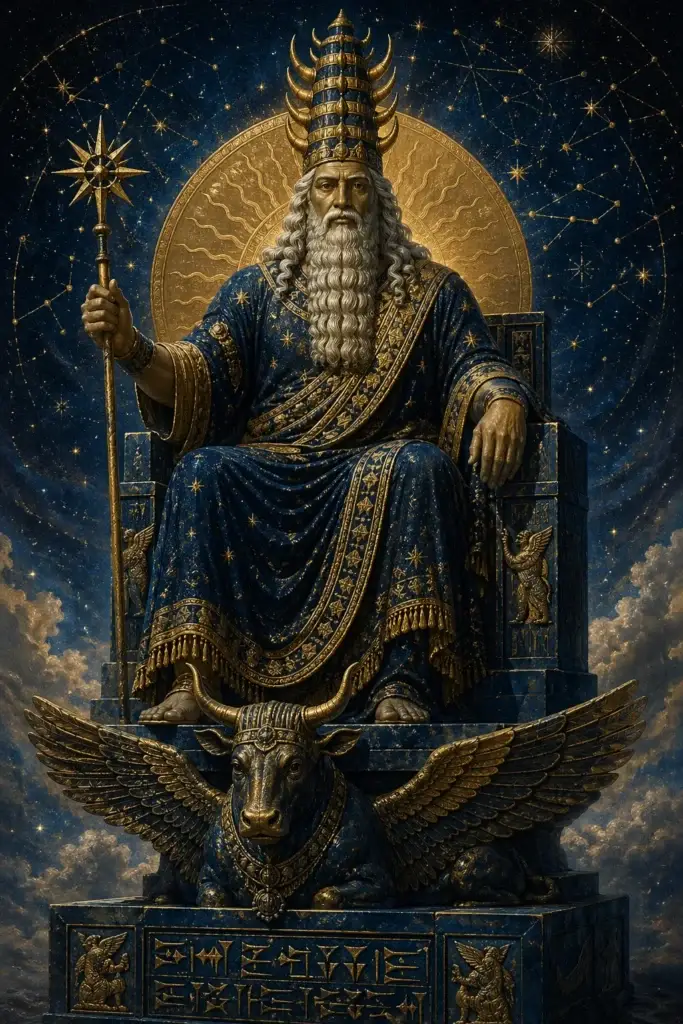
Nusku, king of the night with the lamp
By Ralf Ittermann · last reviewed on
Nusku is a god of the Mesopotamian tradition.
The god of the lamp, whose light drives away the demons of the night.
Nusku is the god of fire and light of Mesopotamia, the vizier and messenger of Enlil and the god of the lamp and the sacrificial fire. As king of the night, he illuminates the darkness and drives back the demons of night.
He is attested from early Sumerian times into the 1st millennium, in the incantation series Maqlû, on boundary stones and in god lists; he was venerated among other places in Nippur, Babylon, Uruk and Harran. As messenger, he carries the offerings and prayers of humans to the gods.
Type: god of fire and light, vizier and messenger of Enlil
Origin: early Sumerian traditions, where he is a son of Enlil
Texts: Maqlû, boundary stones, god lists
Period: early Sumerian times into the 1st millennium
Appearance: symbols of the lamp, staff and rooster

Context of the tradition
Period of the Texts
Attested from early Sumerian times into the 1st millennium: in the series Maqlû, on boundary stones and in god lists.
Area of Diffusion
Nippur, Babylon, Uruk, Harran and other places: Nusku’s veneration was spread across the great centres of Mesopotamia.
Sources
Well documented: the Maqlû editions, the handbooks of Assyriology and the ORACC article on Nuska.
Name and variants
Name: Nusku, also Nuska. He is best attested as Sukkal, divine vizier and messenger, of Enlil; in some traditions he is also associated with the moon god Sin. In early Sumerian tradition: son of Enlil, whose voice he is in the hymns.
Description
Appearance
Nusku’s symbols are the lamp, his identifying attribute on boundary stones, along with the staff and rooster. He embodies the sacrificial fire and the lamplight that illuminates the night.
Effect
Nusku is the god of the lamp and the sacrificial fire; as messenger, he carries offerings and prayers to the gods. In Maqlû he is invoked as a protective night light, to safeguard the offering and to ward off witches. He is regarded as a protective god against demons such as Lamashtu and against nightmares.
Profile: Nusku
The key aspects of the god of light at a glance.
Sumerian-Akkadian fire and light god, Sukkal of Enlil, in some traditions associated with the moon god Sin.
Those seeking protection at night, incantation priests and petitioners at the sacrificial fire: through the flame their prayer reaches the gods.
Recognisable by his symbols: the lamp, the identifying attribute on boundary stones, along with the staff and rooster.
Illuminates the night, drives away demons and, as messenger, delivers the messages and offerings of humans to the gods.
Nocturnal incantations and purification rites, invocation at the sacrificial and lamp fire and protective prayers against the powers of the night.
Vizier, messenger and king of the night
Nusku, also Nuska, is best attested as the sukkal of Enlil, his divine vizier and messenger; in some traditions he is also associated with the moon god Sin. In the earliest Sumerian traditions he is the son of Enlil, whose voice he is in the hymns. As a god of fire and light, he is regarded as king of the night.
His attestations span from early Sumerian times to the 1st millennium: in the incantation series Maqlû he is invoked as a protective night light, on boundary stones the lamp identifies him, and the god lists place him among the circle of the great gods. He was worshipped at Nippur, Babylon, Uruk, Harran and other sites.
Classification and afterlife
Nusku is received in Assyriology; no living cult exists.
In the study of religion, Nusku embodies fire and light as a power of protection and purity in the night. As a messenger, he is also the link between humans and deity through the sacrificial fire: whatever is offered and prayed at the fire, he carries to the gods. As a distinction from Girra: both are fire gods, but Nusku is more strongly the god of light, lamps and messages, the vizier of Enlil, while Girra is more strongly the pure power of fire and the forge.
Night light and sacrificial fire: the forms of the cult
Well attested by sources are nocturnal incantations and purification rites, invocation at the sacrificial and lamp fire, and protective prayers against the evil powers of the night. In Maqlû, Nusku protects the offering as a night light and wards off the witches; he is furthermore regarded as a protective god against demons such as Lamashtu and against nightmares. The burning lamp at night was thus more than illumination: it was the presence of the god himself.
Three fire gods, three offices
Nusku corresponds to the Vedic Agni, the god of fire and sacrifice and mediator between humans and gods. Within Mesopotamia, Girra and Ishum stand closest to him, with whom he is in part functionally identical. Yet the offices can be distinguished: Girra is the pure power of fire and the forge of the incantation series, Ishum the torch-bearing night watchman of the streets, and Nusku the god of the lamp and the sacrificial fire who, as vizier and messenger of Enlil, mediates between humans and gods.
Frequently asked questions about Nusku
What distinguishes Nusku from Girra?
Both are fire gods. Nusku is more strongly the god of light, lamps and messages, the vizier of Enlil; Girra is more strongly the pure power of fire and the forge.
Why the lamp as a symbol?
It stands for his nature as light in the darkness and for the sacrificial fire; on boundary stones the lamp is his identifying attribute.
What does Nusku protect against?
Against the demons of the night, against Lamashtu and against nightmares; in Maqlû he is invoked as a protective night light.
Further links
Further reading:
- Mesopotamia – all beings of the land between the rivers
- Girra and Ishum – the related fire gods of Mesopotamia
- Lamashtu – the demoness against whom Nusku protects
- Agni – the Vedic fire god as a parallel
- Protective candle, incense burning, amulet – traditional protective means
Literature (selection)
Further standard works in the bibliography.
As god of light and vizier of Enlil, Nusku unites two roles in one figure: he is the night light that drives back the demons, and the messenger who carries the prayers of humans over the sacrificial fire to the gods.