Tiamat, Goddess of the Mesopotamian Tradition
By Ralf Ittermann · last reviewed on
Primeval saltwater dragon, mother of all gods, embodiment of chaos. Tiamat is the oldest force in the Mesopotamian cosmos, not evil but primary, the chaotic saltwater mass from which all life flowed and to which it returns.
The *Enuma Elish* tells of her defeat by Marduk, yet this battle is not a simple victory of good over evil but the birth of order out of chaos, Tiamat is broken apart, and her body becomes the universe.
Tiamat appears in the Enuma Elish as the primeval dragon of saltwater chaos.
Tiamat is a goddess of the Mesopotamian tradition, embodying the saltwater chaos before creation.
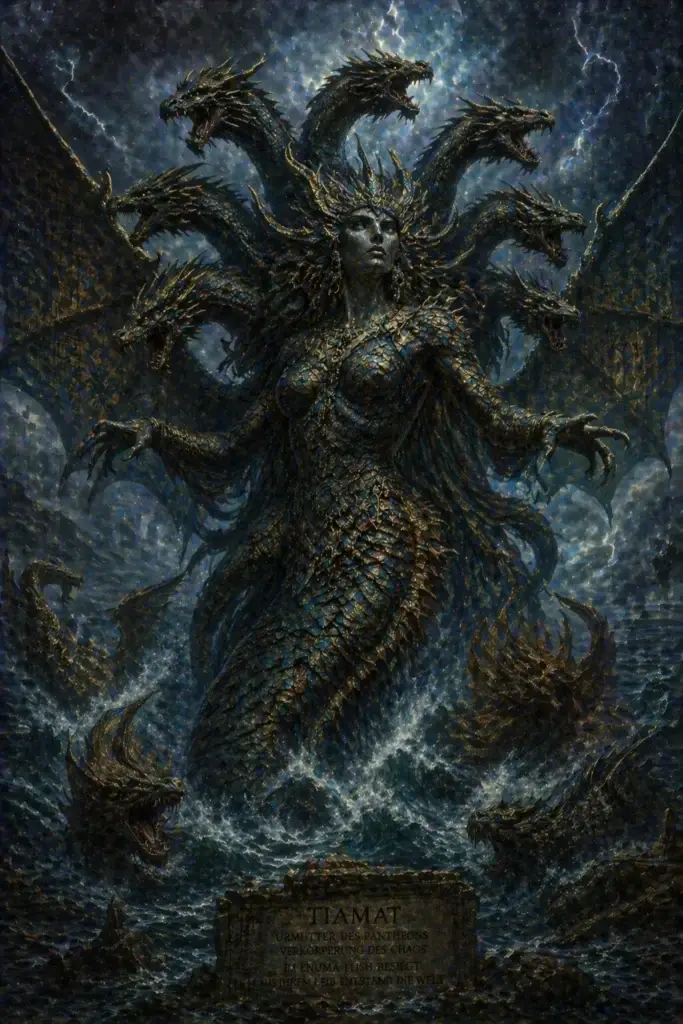
Tiamat
At a Glance: Tiamat
Type: Mesopotamian primeval deity, dragon goddess of primal chaos, opponent of Marduk
Pantheon: Babylon (central as antagonist in the Enuma Elish)
Function: saltwater primeval sea, mother of all gods, counter-power to cosmic order
Main attributes: dragon form, divided body shape (heaven and earth made from her body), eleven hybrid being helpers
Main cult sites: none of her own, antagonist in the Babylonian creation myth
Opponent: Marduk (defeats her in the Enuma Elish)
Classification
Period of the Texts
Tiamat is the central antagonist of the Babylonian creation epic Enuma Elish (12th century BCE, the main manuscript is Neo-Assyrian). She has a precursor in the Sumerian tradition as Nammu (primeval sea).
The main flourishing of Tiamat mythology is the Neo-Babylonian period, when the Enuma Elish was recited at every New Year festival (Akitu) in the Esagila temple, and each spring the cosmic victory of Marduk over Tiamat was ritually renewed.
In later traditions she was very rarely directly venerated; in the 19th and 20th centuries she was intensively received by religious studies and esotericism.
Area of Distribution
Tiamat has no cult sites of her own; she is a mythological figure, not an object of cult. Her presence was nonetheless given at every Babylonian Akitu festival, where the Enuma Elish was recited and her defeat by Marduk was ritually renewed.
Since Gunkel (1895) she has been compared with the „dragon antagonist“ of the apocalyptic tradition (Revelation 12, 1st century CE). In modern reception (especially after Robert Graves and feminist religious history) she appears as a symbol of the suppressed feminine primal power.
Source Situation
Central sources: Enuma Elish (creation epic, 7 tablets, the main source), precursors in Sumerian creation myths.
Secondary literature: Lambert, Babylonian Creation Myths (standard edition); Heidel, The Babylonian Genesis; Bottéro, La plus vieille religion. En Mésopotamie; Black/Green, Gods, Demons and Symbols. Comparative (dragon-slaying motif): Watkins, How to Kill a Dragon (Indo-European dragon-slaying pattern).
Name and Variants
Tiamat is depicted as a gigantic, serpentine and draconic figure, with scales and a terrifying dragon mask. Her skin is dark blue or greenish, the color of the salt sea.
She wears no crown, since crowns derive from humans and gods; rather, she herself is primordial substance. In later depictions she is shown with several heads or a hydra-like form. Her breath is poison, her roar shakes the worlds.
Characteristics
Tiamat was not venerated as a goddess in the classical sense; there was no temple and no priesthood. Yet in cosmic and philosophical contexts she was presented as that from which order must come.
Each year at the New Year festival (Akitu) the Enuma Elish was recited, and Marduk was invoked anew as victor over Tiamat. This recitation was a magical ritual for the renewal of the world and for defense against a relapse into chaos. Tiamat represents the cosmic threat that must be defeated eternally.
Appearance and Symbolism
Tiamat is today usually depicted as a huge dragon or sea monster with shining scales that shimmer in the colors of water, blue, green, white. She has mighty claws and teeth, the size of a mountain.
Her body is a sea itself. She breathes poison. Tiamat is beautiful in her wildness, but repellent in her strangeness. Water and the sea are her symbols. Her eyes glow with primal intelligence, not moral but instinctive and cosmic.
Profile: Tiamat
The most important aspects of Tiamat at a glance. The following fields summarize origin, function, appearance, veneration, symbols and cultural parallels.
In the Enuma Elish Tiamat is the primeval mother, the salty primeval sea, the source of all gods together with the fresh-water god Apsu (her consort). When the young gods (Anu, Enki, later Marduk) disturb the peace, Apsu wants to kill them, but Enki kills him first.
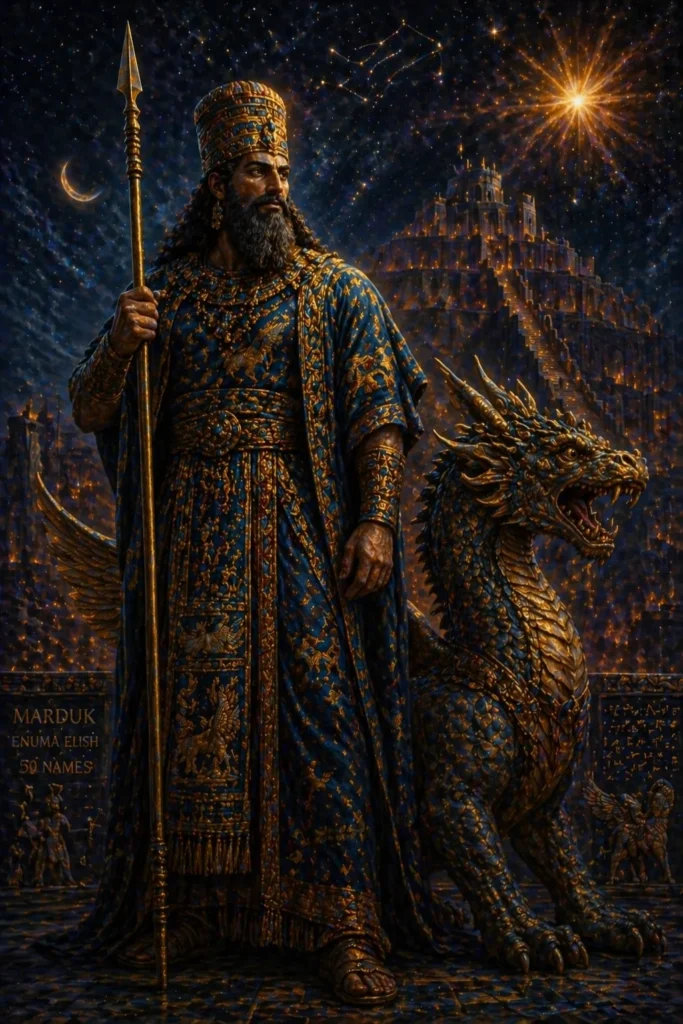
Tiamat swears revenge, forges an army of eleven hybrid being demons (among them Mušhuššu dragons, lion-men, scorpion-men) and chooses Kingu as general. Marduk offers himself as the hero, is given command over all the gods, kills Tiamat in single combat and makes heaven and earth from her body, the cosmic order arises from Tiamat’s body.
Tiamat is the mythological embodiment of the chaos that precedes cosmic order. Mother of all gods (theogonic function), but at the same time a threat to order, she must be defeated so that the world can come into being.
Symbol of the unordered primal power, of the saltwater primeval sea (in contrast to the fresh water of Apsu, which is fertile). In the theological consolidation of the Babylonian pantheon, her death justifies Marduk’s kingship, a politically motivated creation narrative.
In the Enuma Elish Tiamat is not described unambiguously; some passages point to an anthropomorphic female figure, others to a huge dragon or serpent body. Scholarship tends toward a hybrid dragon-human figure.
In pictorial depictions of the modern era she is almost always portrayed as a dragon with feminine symbolism (large serpent body, several heads, claws, wings). Direct images of Tiamat are absent from the Babylonian glyptic tradition; the Mušhuššu dragon images (e.g. on the Ishtar Gate) are her helpers, not herself.
Sphere of effect: Tiamat has no cult of her own, but her presence was given at every Babylonian New Year festival (Akitu); the Enuma Elish was recited there, the Marduk victory ritually renewed. In personal cult she was not invoked (only Marduk as victor).
In modern esoteric reception (from the 19th century) she is received as „mother goddess,“ „dragon mother,“ „primal woman“; in feminist religious history as a symbol of suppressed feminine primal power. In modern pop culture she is present as a dragon in games, novels and films.
Dragon form, serpent body, several heads, claws, wings (in modern depiction), divided body (mythologically, heaven and earth were made from her halves). Helpers: eleven hybrid being demons (Mušhuššu, Lahamu serpent, Bashmu, Uṣumgallu, etc.). Sacred element: saltwater. Sacred number: 11 (her hybrid beings).
Apsu (Mesopotamia, consort, fresh-water primeval god), Nammu (Sumer, Sumerian precursor goddess), Lotan/Leviathan (Phoenician-Hebrew, chaos dragon), Vritra (Hinduism, dragon, defeated by Indra, shared Indo-European dragon-slaying root), Typhon (Greece, chaos monster, defeated by Zeus), Jormungand (Germanic, world serpent, fought by Thor), Yamata-no-Orochi (Japan, eight-headed dragon, defeated by Susano-o), Apophis (Egypt, chaos serpent).
Watkins’ Indo-European dragon-slaying motif finds in Tiamat one of its most famous examples.
Practical Defense
Apotropaic Rituals
Tiamat as the primeval saltwater dragoness (Enuma Elish I, 1-150) was not directly venerated; she is the power of primal chaos to be subdued, whose corpse is split by Marduk into heaven and earth (Enuma Elish IV, 105-145).
At the New Year festival akītu the subduing of Tiamat was repeated cultically.
Incantation Texts
The reading of the Enuma Elish on tablets IV-V (Marduk’s victory) on the fourth day of the akītu was a central ban act. The invocation „Tiamtu lalkaltu“ (Tiamat, be broken!) is found in anti-storm incantations from Nineveh (Heeßel, Babylonisch-assyrische Diagnostik).
Amulets and Protective Symbols
Marduk symbols (spade, dragon head) as protection against Tiamat; the mušḫuššu dragon is depicted as a subdued counter-symbol on Babylonian city gates (Ishtar Gate, Berlin).
Apotropaic tablets bearing Marduk’s name were placed under door thresholds to protect against Tiamatic powers. The eight-spoked sun wheel (Shamash’s solar symbol) replaces Tiamat’s chaos waters with ordered creation.
Tiamat, Parallels in Other Cultures
Tiamat resembles the Leviathan of Hebrew mythology, a primeval saltwater serpent that battles God. With the Egyptian Apophis (chaos serpent) she shares the role of the eternal chaos antagonist.
The Indian Vritra and the Norse Jörmungandr are similar cosmic serpents. Tiamat is unique, however, in that her defeat is not her annihilation but her transformation into the universe itself; she is both, enemy and mother at once.
The Saltwater Sea: Tiamat's Role in the Primeval Age of the Enuma Elish
In the Babylonian creation epic Enuma Elish Tiamat stands at the beginning of all things. Before the world there exist only two primeval waters: Apsu, the sweet groundwater, and Tiamat, the salty sea. Their waters are mingled together, a state preceding any order. From this mingling the first gods emerge.
The name Tiamat is connected with the Semitic word for sea; linguistically there is a kinship to the Hebrew tehom, the „primeval flood“ or „deep“ mentioned in the first chapter of Genesis. This linguistic proximity has led to long discussions about the relationship between Mesopotamian and biblical conceptions of creation.
In the epic the conflict begins because the noise of the young gods disturbs Apsu and Tiamat. Apsu wants to destroy the gods but is forestalled and killed by the wisdom god Ea. Tiamat at first remains inactive, but is then urged to war by some of the gods. She rises as an avenger.
Scholarship debates whether Tiamat was originally conceived as a personal goddess or rather as an impersonal cosmic substance. The texts waver: at times she appears as an acting mother figure, at times more as the sea itself.
This duality is not a contradiction of the tradition, but points to the difficulty of capturing a cosmic primal power in language at all. Tiamat is at once person and element, mother of the gods and the chaos that must be overcome.
The Single Combat with Marduk and the Creation of the World
The climax of the Enuma Elish is the battle between Tiamat and Marduk. Tiamat has created an army of eleven monsters, among them serpents, dragons and hybrid beings, and has appointed her new consort Kingu as commander, to whom she gives the Tablets of Destiny, the insignia of supreme power.
Marduk advances armed with wind, storm and flood. When Tiamat opens her maw, he drives the winds inside, so that they swell her body, and pierces her with an arrow. After her death he splits her body into two halves.
From one he forms the vault of heaven and sets bolts in place so that the water does not stream out; from the other, the earth. From her eyes he lets the rivers Euphrates and Tigris spring forth, from other body parts mountains and springs.
The world here does not arise from nothing but from the divided body of a defeated primeval being. This type of creation narrative, in which the parts of the world are formed from a slain cosmic being, has parallels in other mythologies, for instance in the Norse account of the giant Ymir.
The theological statement of the process is important: order arises from the overcome chaos, and it remains made of it. The heaven is Tiamat’s body. The chaos has not vanished without trace but has passed into the structure of the world. This conception gives Babylonian cosmology its particular tension.
The Chaoskampf Myth: Tiamat in Comparative Research
The battle against Tiamat is the best-known Mesopotamian example of a widespread narrative pattern that scholarship calls Chaoskampf (combat against chaos): a deity of order defeats a chaotic primeval being, often associated with water or dragons, and from this victory the ordered world or rule emerges.
Related narratives are found in the West Semitic world, for instance the battle of the weather god Baal against the sea Yam in the texts of Ugarit, and in Greek mythology the battle of Zeus against Typhon.
Traces appear in the Hebrew Bible as well: in several places, above all in the Psalms and in Job, allusion is made to a battle of God against sea monsters such as Rahab or the Leviathan.
The term Chaoskampf goes back to the theologian Hermann Gunkel, who in 1895, in his work Schöpfung und Chaos in Urzeit und Endzeit, worked out the connections between Babylonian mythology and biblical texts. His theses set off a debate that continues to this day.
More recent scholarship has become more cautious. It emphasizes that a linguistic similarity such as that between Tiamat and tehom does not yet prove direct literary dependence.
The cultures of the Ancient Near East probably shared a common stock of narratives from which each developed its own version. In this picture Tiamat is not the source of all related myths, but a particularly extensively transmitted link in a broad tradition.
Tiamat in Modern Reception: from Cuneiform Text to Dragon Queen
The rediscovery of Tiamat began in the 19th century. The clay tablets of the Enuma Elish were found in the excavations at Nineveh, and the British Assyriologist George Smith made them known in the 1870s. With that, a myth forgotten for more than two millennia returned to awareness.
In scholarly literature Tiamat has since been treated as a key figure of Mesopotamian cosmology. In popular reception, however, she has had a career of her own, partly detached from the sources. Widespread is the depiction as a mighty dragoness.
The ancient texts themselves do not describe Tiamat unambiguously as a dragon; they speak of her rather as sea and mother. The dragon form is largely a modern elaboration, fed by the circumstance that Tiamat commands an army of dragons and serpents.
Particularly formative was the role-playing game Dungeons & Dragons, which from the 1970s introduced Tiamat as a five-headed dragon queen of evil. Through this and similar games, along with novels, comics and computer games, the name is known to a large public that is hardly familiar with the Babylonian original.
For the religious-studies view this layer is to be clearly distinguished from the ancient tradition. The modern dragoness Tiamat is a creation of fantasy culture; the ancient Tiamat is the personified salt flood, primeval mother and defeated chaos of a Babylonian didactic poem. Both bear the same name but belong to different worlds.
Further Links
Literature (Selection)
Further standard works in the literature index.
Frequently Asked Questions about Tiamat
Who was Tiamat in Babylonian mythology?
Tiamat is the primeval goddess of the saltwater ocean in the Babylonian creation myth Enuma Elish. She and her consort Apsu (freshwater ocean) are the first beings; their mingling creates the first generations of gods. Yet the younger gods are loud and disruptive; Apsu wants to kill them.
Tiamat hesitates, but after Apsu’s own death (at the hands of Ea) she unleashes an army of dragons and monsters to take revenge. Marduk, the youngest of the gods, finally defeats her in a single battle.
How did Marduk create the world from Tiamat’s body?
After Marduk’s victory over Tiamat he divides her body into two halves: from the upper half he creates the vault of heaven (with stars and the sun’s path), from the lower half the earth, the mountains, the rivers Euphrates and Tigris (from her eyes).
From the blood of her slain leader Qingu, Marduk mixes clay and creates the first humans, destined to serve the gods. The creation myth has structural parallels to the Genesis account (dividing the waters, separating heaven and earth).