iWell Guard
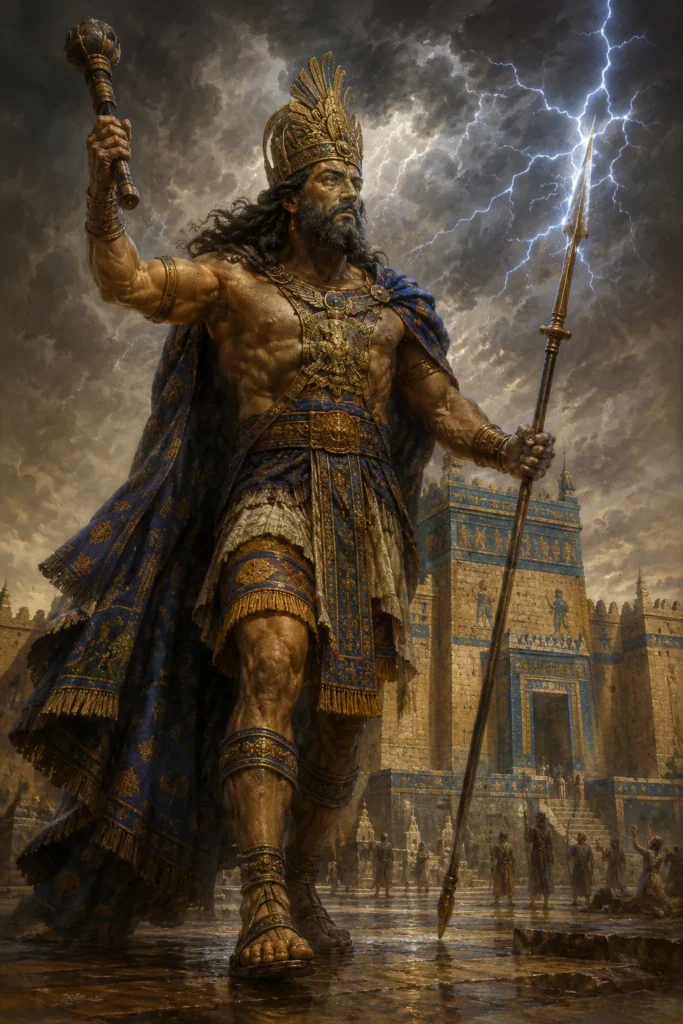
Sin - Gods from the Mesopotamian tradition, historical-illustrative

Sin: Mesopotamian moon god and lord of the night

GodMesopotamiaLunar deity
Sin (also the moon god Nanna in the Sumerian pantheon) embodied the moon and thus the order of time. As lord of the nocturnal sky, he regulated months and festivals, was regarded as the wise counter of days and as the father of important gods of the Babylonian pantheon. In Ur and Harran his temple cults endured well into the Islamic late antiquity.

Classification

Sin, called Nanna or Suen in Sumerian, is among the oldest and most enduring deities of Mesopotamia. As god of the moon, he held a prominent position within the pantheon, for the moon structured the calendar and thereby the whole of religious and economic life.

In theological systematics, Sin was regarded as the son of Enlil and Ninlil, which firmly anchored him within the highest family of gods.

Further significant deities issued from Sin. His child was the sun god Shamash, and likewise the goddess Ishtar in her appearance as the planet Venus.

Sin thus stood at the origin of those celestial deities that were central to Mesopotamian astral religion. The moon as father of sun and Venus reflects the high esteem that the nocturnal sky enjoyed in this culture.

From the standpoint of religious history, the longevity of the cult of Sin is remarkable. While other deities lost importance, Sin retained a faithful following over millennia. The sanctuary at Harran in northern Mesopotamia in particular remained a living center of moon worship into late antiquity.

Name and Etymology

The god bears two principal names, the relationship of which has long occupied scholarship. The Sumerian name Nanna is the older one; alongside it stands the form Suen, from which the name Sin arose through phonetic development in Akkadian.

In many texts the spelling appears as a combination of the signs that render Nanna and Suen.

The exact meaning of the name Nanna has not been fully clarified. Interpretations have been proposed that connect it with the luminous celestial body or with terms for radiance and loftiness.

For Suen the etymology is likewise uncertain. More important than the linguistic derivation is the observation that both names were used throughout the whole of Mesopotamian history, frequently side by side.

Sin bore numerous epithets that describe his functions. He was called the luminous bull, the lord of the crown, the wise lord, or the counter of days.

The reference to the bull arises from the crescent moon, whose shape recalled bull horns. These images run through hymns and prayers and shape the religious understanding of the god.

Description and Iconography

The unmistakable and, over the centuries, stable symbol of Sin is the recumbent crescent moon. It appears on cylinder seals, boundary stones, stelae, and in temple art.

Often the crescent is depicted so that it recalls a boat, which fits the notion that the moon god crosses the sky at night as if on a watercraft.

In anthropomorphic depictions Sin appears as a bearded, enthroned god with the horned crown. Some images show him with a half-moon above his head or in his hand.

On the Babylonian boundary stones, the so-called kudurrus, the crescent moon is among the most frequently depicted divine symbols and there usually stands beside the sun star of Shamash and the Venus star of Ishtar.

The literary description emphasizes the light of Sin. His radiance is portrayed as mild yet also as penetrating. He illuminates the night without dispelling it, and makes orientation in the dark possible.

The waxing and waning of the moon was interpreted mythically and connected with the regular appearance and disappearance of the god. This cyclical nature made Sin an image of reliable, self-renewing order.

Mythological Narratives

The birth of Sin is recounted in the narrative of Enlil and Ninlil. After Enlil has pressed himself upon the goddess Ninlil, he is banished to the underworld by the assembly of the gods. Ninlil, who has conceived the moon god by him, follows him.

So that the child, which is to belong to the bright sky, does not remain in the underworld, Enlil and Ninlil, through further encounters, provide substitute deities for the underworld. In this way Sin reaches the sky, while the subterranean deities inhabit the depths.

Sin also appears in myths in which he is beset by demons. An incantation narrative describes how evil powers darken the moon. In one transmitted account, seven evil demons join together to encircle Sin in the sky and extinguish his light.

A lunar eclipse was regarded as an ominous sign, as an attack by hostile beings upon the god. In such cases the incantation priests called upon other gods for help, so that Sin might regain his light. This narrative motif links myth and ritual directly to one another.

In hymns Sin is portrayed as a wise counselor who, together with his son Shamash, watches over justice and truth. While Shamash as sun god sees everything by day, Sin penetrates the night.

From this constellation arises the notion of a seamless divine gaze that leaves nothing hidden. The fate of the month, it is said, is determined by Sin, which is why his monthly appearance was observed with particular attention.

A distinct narrative motif concerns the dream in which Sin reveals himself to people. The last Babylonian king, Nabonidus, reports in his inscriptions that the moon god appeared to him in a dream and commissioned him to rebuild his ruined temple in Harran.

Such texts are not myths in the strict sense, yet they show how mythical notions of the speaking, instructing god carried over into royal self-presentation.

In hymns attributed to Enheduanna as well, and in the prayers of the high priestesses, Sin appears as a god who hears petitions and sends signs. The interpretation of these signs, above all the phases of the moon and the position of the crescent, was the object of an elaborate practice of observation and interpretation.

Cult and Veneration

The most important cult center of Sin in southern Mesopotamia was the city of Ur. There stood the temple Ekishnugal, and the famous ziggurat of Ur, a stepped temple platform, was consecrated to the moon god.

King Ur-Nammu and his son Shulgi erected the monumental ziggurat in the form that its ruins still allow to be recognized today. Under the Third Dynasty of Ur the cult experienced a particular flourishing.

An outstanding role was played by the office of the high priestess of the moon god, which was frequently filled by royal daughters. The best-known holder of this office was Enheduanna, a daughter of King Sargon of Akkad, to whom literary hymns are attributed.

The office endured for centuries, and even King Nabonidus installed his daughter as priestess in Ur, invoking a divine choice indicated by a lunar omen.

In northern Mesopotamia, Harran was the second great center of moon worship. The temple of Sin there, called Ehulhul, enjoyed prestige over an extraordinarily long period. As late as the first millennium before our era, Neo-Assyrian and Neo-Babylonian rulers showed great interest in this sanctuary.

The last Babylonian king, Nabonidus, devoted particular attention to the Sin of Harran, had the temple rebuilt, and spent several years far from Babylon, which met with resistance among the priesthood of other gods, above all that of Marduk.

Nabonidus’s mother too, whose long lifespan is recorded by a separate inscription, was closely bound up with the cult of Sin at Harran.

The cult comprised daily offerings, monthly festivals tied to the phases of the moon, and prayers. The new moon, the full moon, and the disappearance of the moon were ritually significant moments at which special rites were performed.

The day of the vanishing moon was regarded as delicate and was associated with rites of lamentation and atonement.

The temples possessed extensive landholdings and a graduated priesthood with singers, lamentation priests, and administrative personnel. Rich archaeological finds come from Ur, among them the sanctuary of the office of high priestess, the Gipar, which give insight into the material culture of the cult of Sin.

Protective Practice and the Apotropaic

Sin was closely connected with the sphere of protection and the warding off of misfortune, because his light illuminated the nocturnal darkness in which demonic powers were thought to be especially active.

Prayers to Sin asked for his light as aid and escort. Since the moon ordered the calendar, its reliability was at the same time a protection against the chaos of uncounted time.

Sin played a particular role in connection with lunar eclipses. An eclipse was regarded as an attack by hostile beings upon the god and as an ominous portent, above all for the king.

There were dedicated ritual texts with which one sought to avert the harmful consequences of an eclipse. A well-known procedure was the substitute king ritual, in which a stand-in symbolically took upon himself the misfortune threatened by the omen, while the actual king remained protected.

In incantations Sin was invoked together with other deities to heal the sick and drive out evil spirits. The moon god appears here not as an isolated protective power, but as part of a larger divine assistance.

Since Sin was regarded as a wise and just god, people trusted that he would support those wrongly beset. His mild yet steady light was a symbol of the hope that even the darkest night comes to an end.

Parallels in Other Cultures

Moon deities are attested in many cultures of the ancient Near East and beyond. In the West Semitic sphere there were distinct moon deities, and in South Arabia too the moon stood at the center of important cults.

The connection of moon, calendar, and the ordering of time is a recurring pattern, since the lunar cycle formed the most natural basis of timekeeping for premodern societies.

It is striking that within the Mesopotamian system the moon god Sin is regarded as the father of the sun god.

In many other mythological systems, for instance the Greek, the relationship is reversed or weighted differently, and the sun takes a primary position. The Mesopotamian higher valuation of the moon reflects the importance of nocturnal observation of the sky and of the lunar calendar.

The cult of Sin at Harran is a special case of religious continuity. While the old Mesopotamian religion had long since died out elsewhere, forms of astral veneration persisted at Harran into late antiquity.

Later sources report a community at Harran that maintained astral cults. The assessment of these reports is disputed in scholarship, yet they show how lastingly moon worship took effect at this place.

Present-Day Reception and Research

Research into the cult of Sin rests on a broad source base. The excavations at Ur, above all the work of Leonard Woolley in the first half of the twentieth century, uncovered temples, the ziggurat, the Gipar, and numerous finds.

To this are added cuneiform texts, among them hymns, prayers, ritual texts, and administrative documents, which document the cult in its various epochs. The inscriptions of Nabonidus form a distinct, much-studied body of sources on the late phase of moon worship.

An ongoing topic of discussion is the religious policy of Nabonidus. His favoring of Sin over Marduk was portrayed as a transgression in later texts hostile to him. Scholarship endeavors to separate these tendentious sources from the king’s own statements and to reconstruct the background of the dispute between the priesthoods.

An important research theme is the astral dimension of Mesopotamian religion. Sin stands at the center of the question of how observation of the sky, calendrical matters, and religious interpretation interacted.

Mesopotamian scholars developed an elaborate interpretation of omens in which lunar phenomena played a central role. These texts are of interest not only for the history of religion but also for the history of science, since they belong to the roots of later astronomy.

The figure of Enheduanna too has received much attention in recent decades. As high priestess of the moon god and presumed author of hymns, she is regarded as one of the earliest authors of literary history identifiable by name.

The attribution of the texts is discussed in a differentiated manner in scholarship. On the whole, Sin remains a figure through whom central themes of Mesopotamian religious history can be studied in an exemplary way.

Literature (Selection)

  • Jeremy Black, Anthony Green: Gods, Demons and Symbols of Ancient Mesopotamia (1992)
  • Jean Bottéro: Die älteste Religion. Mesopotamien (2001)
  • Thorkild Jacobsen: The Treasures of Darkness. A History of Mesopotamian Religion (1976)
  • Mark E. Cohen: The Cultic Calendars of the Ancient Near East (1993)
  • Wilfred G. Lambert: Babylonian Oracle Questions (2007)

Sin is regarded as the Mesopotamian moon god of Ur and Harran, whose horned crown and crescent-moon symbolism was handed down from the Old Sumerian Nanna into the Late Babylonian royal ideology.

Related key terms: Sin Nanna Suen Ur Harran moon god ziggurat Enheduanna Shamash.

iWell Guard and Protective Traditions

iWell Guard ties in with the cultural-historical tradition of portable protective objects, in the tradition of Mesopotamia and many other cultures worldwide. 41 layers, solid gold, platinum, silver, made in Germany. 30-day right of return.

Personal experiences may vary. Not a medical device. No healing promise.

Classification & Protection

IILEVEL
The Protection Compass assigns this being to influence level II, Noticeable influence.

Against its influence, cross-cultural tradition names these protective means:

Compare in the Protection Compass →

Recommended protective means

iWell Guard

The simplest protective means in this collection: 41 layers of fine gold 999, platinum, silver and silicon, manufactured in Ruhla, Thuringia. It requires no activation, is bound to no person, and is effective within a radius of around 50 meters, even without being worn.

All protective means at a glance →