iWell Guard

Sri Yantra: the geometric diagram of triangles and lotus rings

The Sri Yantra is a geometric diagram made of interlocking triangles and lotus rings. It belongs to the tradition of Hinduism and serves meditation and worship. As an image of perfect order, it is at the same time associated with protection and with blessing.

Protective symbolHinduismYantra
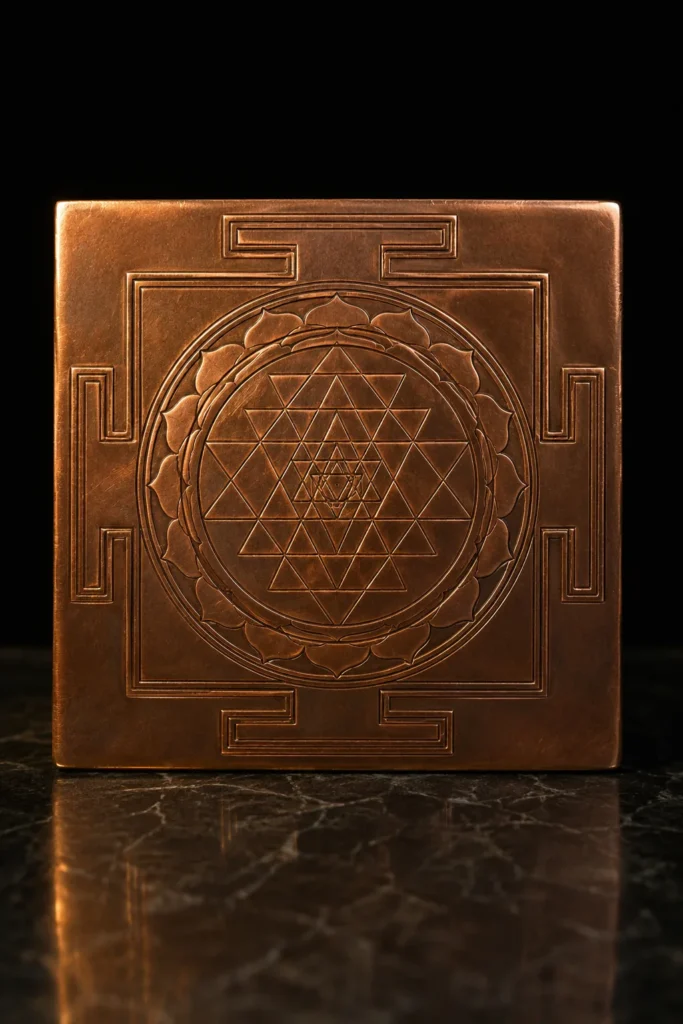
Sri Yantra - protective symbol, museum-style illustration

Classification

The Sri Yantra is a geometric diagram from the tradition of Hinduism. In Hinduism, the term Yantra denotes a geometric figure that serves worship and meditation. The Sri Yantra is regarded as the best known and most highly honoured among these diagrams.

The word Sri is a widespread honorific title meaning roughly holy or blessed. The Sri Yantra is thus, so to speak, the venerable Yantra, the pre-eminent diagram. Some texts also call it Sri Chakra, which means diagram or wheel.

The Sri Yantra is built up from several interlocking triangles, surrounded by rings of lotus petals and by a square frame. This form is precisely defined and follows a carefully considered order.

In religious practice, the Sri Yantra serves the worship of the goddess and acts as an aid to meditation. It is contemplated, worshipped and, in some traditions, also produced and set up at the place of dwelling.

Beyond worship, the Sri Yantra is ascribed an ordering and protecting significance. As an image of perfect order, it is regarded as a sign that keeps misfortune at bay and attracts blessing.

In religious studies, the Sri Yantra is a good example of a religious diagram. Unlike an image of a god, it does not represent anything figurative, but expresses a spiritual order through pure geometry.

Structure and form of the diagram

The structure of the Sri Yantra follows a fixed order. At the centre stands a point, which in Hinduism is called the bindu. This point is regarded as the origin from which the whole diagram unfolds, as it were.

Several triangles are arranged around the centre. Some of these triangles point upward with their apex, others point downward. The triangles interlock in such a way that a richly subdivided figure arises.

The upward-pointing and the downward-pointing triangles are associated in Hinduism with the male and the female principle. Their interlocking represents the interplay of these two principles.

Rings of lotus petals lie around the triangles. In the traditional form, one ring bears eight petals and a further ring sixteen petals. In Hinduism, the lotus is an important sign of purity and unfolding.

The whole is enclosed by a square frame. This square bears gate openings on its sides that point toward the four cardinal directions. It forms the outer boundary of the diagram.

The precise construction of the Sri Yantra is demanding. The interlocking triangles must be drawn so that their points of intersection meet exactly. A careful geometric execution is therefore regarded as essential.

The Yantra in Hinduism

To understand the Sri Yantra, it helps to look at the concept of the Yantra. In Hinduism, yantras are geometric diagrams that serve worship, meditation and concentration.

A Yantra differs from an image of a god. It does not show a figure in human shape, but consists of geometric forms such as points, lines, triangles, circles and squares. These forms carry a symbolic meaning.

Yantras are frequently assigned to a particular deity. The diagram is then regarded as a geometric form of this deity, as it were its image in the language of pure form.

Related to the Yantra is the mandala, which is known above all from Buddhism. The mandala too is an ordered diagram that serves meditation. The Yantra and the mandala belong to a common family of ordered religious figures.

In Hinduism, yantras have a firm place in religious practice. They are drawn, worshipped and contemplated. In some traditions, they are engraved on small metal plates and worn or set up at the place of dwelling.

The Sri Yantra stands out from the range of yantras. It is regarded as the most complete and the most significant of them. In it, the order of the Yantra is carried out in a particularly rich and many-layered way.

The Sri Yantra and the goddess

The Sri Yantra is connected with the worship of the goddess. In Hinduism, the divine is also worshipped in female form, and the Sri Yantra belongs to the context of this worship.

The diagram is assigned to the goddess in her blessing-giving, gracious form. In the traditions that hold the Sri Yantra in high regard, it is considered the geometric form of this goddess.

The interlocking triangles are here interpreted symbolically. They represent the interplay of the male and the female principle, from which, according to the Hindu conception, the world arises.

The centre of the diagram, the bindu, is understood as the seat of the goddess. From this point the whole diagram unfolds. Whoever meditates on the Sri Yantra directs their attention toward this centre.

This assignment belongs above all to a current within Hinduism that cultivates the Sri Yantra in particular. In this current, the worship of the goddess stands at the centre, and the Sri Yantra is its central diagram.

The Sri Yantra is therefore not a mere geometric pattern. It is a worship diagram that depicts the goddess in the language of geometry and that serves the turning toward her.

Meditation and worship with the Sri Yantra

In religious practice, the Sri Yantra serves above all two purposes, meditation and worship. The two are closely connected.

In meditation, the diagram is contemplated. The practitioner directs their gaze and their attention to the Sri Yantra, often moving step by step from the outer frame inward, as far as the centre.

This path from the outside inward is meant symbolically. It is regarded as a path of recollection that leads from the multiplicity of the outer world to the unity of the centre. The diagram gives meditation an order and a path.

In worship, the Sri Yantra is treated like an image of the goddess. It can be honoured with the customary offerings of Hindu worship, for example with flowers, with light and with spoken formulae.

In some traditions, the Sri Yantra is combined with the recitation of sacred syllables and formulae. The spoken word and the contemplated diagram then work together. Related here is the significance of the sacred syllable, which is presented in more detail on the page about the Om symbol.

The worship of the Sri Yantra is demanding and follows traditional rules. In its developed form, it is cultivated under guidance and within a particular tradition.

The Sri Yantra as a sign of order and protection

Beyond meditation and worship, the Sri Yantra is ascribed an ordering and protecting significance. This significance rests on the form of the diagram.

The Sri Yantra is an image of perfect order. Every line, every triangle and every ring has its precisely determined place. The whole is built up around a centre and follows a carefully considered geometry.

Such a perfect order was considered powerful. Where a seamless order prevails, misfortune, according to this conception, has no place at which it could take hold. The ordered diagram thus becomes a sign that keeps misfortune at bay.

In practice, the Sri Yantra is therefore also set up at the place of dwelling and at the place of work. There it is meant to unfold a favourable, ordered effect and to promote blessing as well as well-being.

In this, the Sri Yantra resembles other protective signs that rest on the idea of the protecting power of perfect order. Magic squares and ordered diagrams of various cultures follow the same basic thought.

It is, however, only honest to say that this protective and blessing-bringing use is more widespread in practice than in the learned texts. The old texts emphasise above all meditation and worship. The use as a general sign of protection and good fortune is a widespread, and in part also more recent, extension.

Production and everyday use

The Sri Yantra appears in several forms. These forms range from learned practice to widespread everyday use.

In the traditional practice, the Sri Yantra is drawn or engraved. It can be placed on paper, on cloth or on a metal plate. It is frequently engraved in copper, which in Hinduism is regarded as a suitable material.

Precise and careful execution is considered important. Since the Sri Yantra is an image of perfect order, its production too should correspond to this order. An inaccurate drawing is regarded as deficient.

In wider use, the Sri Yantra today appears on pendants, on pictures and on objects of household worship. In this form it has become a widespread sign.

Worn as a pendant, the Sri Yantra combines the worship of the goddess with the wish for protection and for well-being. It then belongs to the worn signs, similar to other Hindu signs.

With this widespread use, it should be borne in mind that in the learned tradition the Sri Yantra is a demanding worship diagram. The simple use as jewellery and a good-luck sign is to be distinguished from this, even though both forms exist side by side today.

Geometry as religious language

The Sri Yantra is a good example of how geometry can become a religious language. It depicts the divine not in human shape, but in pure form.

In many religions, the divine is conveyed through images of gods, of saints or through narratives. The Yantra takes a different path. It translates spiritual content into points, lines and surfaces.

The centre stands for the origin, the interlocking triangles for the interplay of two principles, the lotus rings for unfolding, the framing square for the ordered world. Each form carries a meaning.

This use of geometry as a language of meaning is not confined to Hinduism. Other traditions too know ordered diagrams that express spiritual content in geometric form.

What is special about the Sri Yantra is the density and the many-layered character of its geometry. In a single diagram, numerous levels of meaning are brought together, which open up to the observer only gradually.

The Sri Yantra thereby shows that a religious sign need not be pictorial. An ordered geometric figure too can be a profound image for worship and meditation.

Reception today

In Hinduism, the Sri Yantra remains a living sign to this day. In the traditions of goddess worship, it continues to be drawn, worshipped and meditated upon.

Beyond that, the Sri Yantra has become known far beyond the narrower religious sphere. As a pendant, as a wall picture and as an object of household decoration, it is widely diffused.

In this wider diffusion, the Sri Yantra is frequently understood in a general way as a sign of harmony, order and well-being. The precise religious meaning sometimes recedes into the background.

Outside Hinduism too, the Sri Yantra has attracted attention, for example in contexts concerned with meditation and with geometric patterns. Here a factual distinction is important between the traditional Hindu meaning and the more recent interpretations foreign to it.

An honest account names the Sri Yantra as what it is within its tradition, a geometric worship diagram of Hindu goddess worship. The use as a general sign of harmony and good fortune is a later extension.

The Sri Yantra thus remains a striking example of a religious diagram. In it are combined a carefully considered geometry, the worship of the goddess and the thought that a perfect order grants protection and blessing.

Literature (selection)

  • Heinrich Zimmer: Kunstform und Yoga im indischen Kultbild (1926)
  • Madhu Khanna: Yantra. The Tantric Symbol of Cosmic Unity (1979)
  • Axel Michaels: Der Hinduismus. Geschichte und Gegenwart (1998)
  • Gudrun Bühnemann: Mandalas and Yantras in the Hindu Traditions (2003)
  • Heinrich von Stietencron: Der Hinduismus (2001)

Related key terms: Sri Yantra Yantra bindu triangles lotus rings goddess meditation diagram geometry Hinduism.

iWell Guard and protective traditions

iWell Guard stands in the cultural-historical line of portable protective objects, to which the Sri Yantra also belongs. A modern companion for people who live with protective symbols: made in Germany, 41 layers of solid gold, platinum and silver, with a 30-day right of return.

Personal experiences may vary. Not a medical device. No healing promise.