iWell Guard

Ashtamangala: the eight auspicious symbols of Buddhism

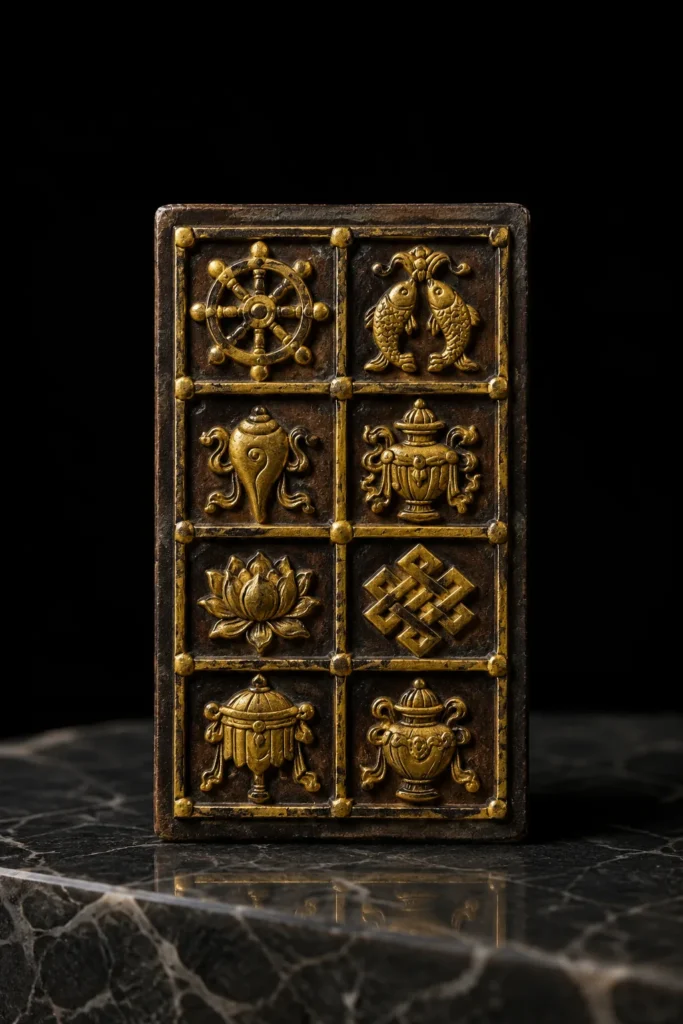
Ashtamangala is the name for a group of eight auspicious symbols of Buddhism. It includes the parasol, the golden fish, the treasure vase, the lotus, the conch shell, the endless knot, the victory banner and the wheel of the teaching. Together, the eight signs stand for blessing, well-being and the path to insight.

Protective symbolBuddhismSymbol of fortune
Ashtamangala, protective symbol, museum-style illustration

Classification

Ashtamangala is the name for a fixed group of eight symbols from the world of Buddhism. The word comes from Sanskrit and means roughly the eight auspicious signs.

The eight signs are the parasol, the pair of golden fish, the treasure vase, the lotus, the coiled conch shell, the endless knot, the victory banner and the wheel of the teaching. Together, these eight symbols form a closed group.

Each of the eight signs carries its own meaning, yet only together do they make up the Ashtamangala. They are frequently depicted as a sequence or as a group, for instance on wall paintings, on utensils and on gifts.

The eight symbols are regarded as bearers of blessing and of good success. They are used on festive occasions, adorn temples and living spaces, and accompany important life events.

In religious studies, the Ashtamangala is a good example of an ordered group of symbols of fortune. Here it is not a single sign but a specific number that forms the motif of protection and blessing.

This page presents the eight symbols as a group. The individual signs, such as the wheel of the teaching or the endless knot, are treated in more detail on their own pages.

Origin and history of the eight signs

The eight symbols of the Ashtamangala did not all originate within Buddhism. Several of them are older and come from the Indian tradition that predates Buddhism.

In the early Indian world, some of these signs were regarded as gifts or as insignia presented to a king or to a high-ranking person at their coronation. They were signs of dignity and of favorable destiny.

Buddhism adopted these signs and gave them a new interpretation. The worldly signs of fortune became symbols that were related to the Buddhist path and to the teaching of the Buddha.

The bringing together of precisely these eight signs into a fixed group developed over a longer period. In different regions and schools there were at first slightly differing enumerations.

Over time, the sequence of eight known today became established. Especially in Tibetan Buddhism, the Ashtamangala took on its fixed form and its great significance.

The history of the eight signs thus shows a widespread process. Older signs of fortune were taken up by Buddhism, reinterpreted and joined into an ordered group.

The parasol and the golden fish

The parasol is the first of the eight signs. In the Indian world the parasol was a sign of dignity, for it was carried over high-ranking persons to shield them from the sun.

In the Buddhist sense the parasol stands for protection from suffering and from harmful influences. It is an image of how the teaching shelters people like a parasol against the hot sun.

The second sign is a pair of golden fish. The two fish are usually depicted side by side, often with artfully curved bodies.

The golden fish stand for good fortune and for a life without fear. Just as a fish moves freely through the water, so a person is meant to move through existence without fear and unimpeded.

Both signs combine an older meaning with a Buddhist interpretation. The parasol was a worldly sign of dignity, the fish a sign of fertility and of good fortune.

Within the Ashtamangala they became images of the spiritual path. The parasol protects from suffering, the fish stand for the freedom that the path promises.

The treasure vase and the lotus

The treasure vase is the third of the eight signs. It is depicted as a rounded vessel, often adorned and fitted with a cloth or a plant.

The vase is regarded as a container that never becomes empty. It stands for abundance, for long life and for the inexhaustible gifts of the teaching. However much one takes from it, it remains full.

The lotus is the fourth sign. The lotus flower grows up out of the mud of the pond floor and unfolds its pure blossom above the water.

From this growth the meaning of the lotus arises. It stands for the purity that emerges from an impure ground, and thus for the path from entanglement to insight.

The lotus is among the most important images of Buddhism as a whole. It appears far beyond the Ashtamangala, as the seat of Buddha figures and as an image of spiritual unfolding.

Treasure vase and lotus complement one another. The vase stands for the abundance of gifts, the lotus for the inner purity that a person can attain along the path.

Conch shell, knot, banner and wheel

The coiled conch shell is the fifth sign. A conch shell coiled to the right was considered especially rare and precious and was used as a wind instrument.

The conch shell stands for the sound of the teaching, which spreads far and wide. Just as the tone of the conch resounds across the land, so the message of the Buddha spreads among people.

The endless knot is the sixth sign. It is a continuously interlaced band with no beginning and no end. It stands for the interconnection of all things and for endless wisdom. On the page about the endless knot, this sign is presented in detail.

The victory banner is the seventh sign. It was a field standard that marked a victory. In the Buddhist sense it stands for the victory of the teaching over suffering and over entanglement.

The eighth sign is the wheel of the teaching, the eight-spoked wheel. It is the most important of the eight symbols, for it stands directly for the teaching of the Buddha. On the page about the Dharmachakra it is treated in detail.

With these four signs the sequence of eight is complete. Conch shell, knot, banner and wheel stand for the spreading, the interconnection, the victory and the core of the teaching.

The eight signs as a group

The Ashtamangala is more than an enumeration of eight individual symbols. It is a closed group, and it is precisely as a group that it unfolds its meaning.

The eight signs are frequently depicted together, in a row, in a circle or as an ordered arrangement. In this joint depiction they are immediately recognizable as the Ashtamangala.

The number eight is not coincidental here. It points to the eightfold path that Buddhism teaches as the way to insight. The eight spokes of the wheel stand for the same eight links of the path.

As a group, the eight signs cover various aspects of blessing and of the path. They speak of protection, of freedom, of abundance, of purity, of the spreading of the teaching and of the victory of insight.

Together, the eight signs thus form a comprehensive image of the favorable life and of the spiritual path. No single sign could express this fullness on its own.

The Ashtamangala thus reveals a distinctive principle of design. A specific number of signs is joined into a fixed group, and the full meaning lies in this ordered multiplicity.

Use in religious and festive life

The Ashtamangala is deeply embedded in the religious and festive life of the Buddhist world. The eight signs appear in many places and on many occasions.

In the temples the eight signs adorn the walls, the ceilings, the utensils and the altars. They are part of the furnishing of sacred spaces and place them under the blessing for which they stand.

On festive occasions the eight signs are used with particular fondness. At weddings, at New Year festivals and at important life events they adorn houses, gifts and food.

In the household, too, the signs are widespread. They appear on cloths, on dishes, on furniture and on jewelry. Everywhere they are meant to carry blessing and good success into daily life.

When an honored guest or a teacher is received, the eight signs are sometimes depicted as a greeting, for instance strewn on the ground with flour or with colored powder.

This broad use shows that the Ashtamangala is not a closed body of scholarly knowledge. It belongs to the visible, lived everyday life of the Buddhist world and accompanies its festivals.

Fortune, blessing and protection

The Ashtamangala is understood as a bearer of good fortune and of blessing. It therefore belongs among the symbols of fortune, and its relationship to protection is to be understood from this meaning.

The eight signs do not ward off an evil in the narrower sense. They are not images of terror and not apotropaic amulets. Their effect is that of a favorable, blessing-bringing sign.

The protection that proceeds from the Ashtamangala is thus a protection through the good. By calling forth good fortune and blessing, the eight signs are meant to guide life in a favorable direction.

Several of the eight signs moreover carry a directly protective sense. The parasol stands for protection from suffering, the victory banner for victory over harmful powers.

Above all, however, the protection lies in turning toward the teaching. The eight signs point to the Buddhist path, and it is this path that, according to Buddhist understanding, preserves one from suffering.

The Ashtamangala is thus a sign of fortune and blessing with a protective character. It protects not through warding off, but by calling forth the good and recalling the path to insight.

Reception today

The Ashtamangala remains extraordinarily present in the Buddhist world to this day. In the lands of Tibetan Buddhism and beyond, the eight signs are a familiar sight.

In temples, in monasteries and in living spaces, the eight symbols still adorn walls, utensils and gifts today. At festivals and on important occasions they are used unchanged.

As jewelry and as pendants, individual signs among the eight are worn by many people. The endless knot and the lotus in particular are widely used as decorative motifs.

Beyond the Buddhist world, the eight signs have also become known in the West. With the interest in Tibetan Buddhism, they have found wide distribution as a decorative motif.

In this wider use the precise religious meaning can recede into the background. The signs are then often understood generally as motifs of fortune or as decorative motifs.

At its core, however, the Ashtamangala remains what it always was, an ordered group of eight signs that stands for blessing, for good success and for the path of Buddhism toward insight.

Literature (selection)

  • Robert Beer: Die Symbole des tibetischen Buddhismus (2003)
  • Robert Beer: The Handbook of Tibetan Buddhist Symbols (2003)
  • Dagyab Rinpoche: Buddhistische Glückssymbole und Opfergaben (1992)
  • Loden Sherap Dagyab: Buddhist Symbols in Tibetan Culture (1995)
  • Marylin M. Rhie and Robert A. F. Thurman: Weisheit und Liebe. 1000 Jahre Kunst des tibetischen Buddhismus (1996)

Related key terms: Ashtamangala eight auspicious symbols Buddhism parasol golden fish treasure vase lotus victory banner Dharmachakra.

iWell Guard and protective traditions

iWell Guard stands in the cultural-historical line of portable protective objects to which the Ashtamangala also belongs. A modern companion for people who live with protective symbols: made in Germany, 41 layers of solid gold, platinum and silver, with a 30-day right of return.

Personal experiences may vary. Not a medical device. No promise of healing.