iWell Guard

The Endless Knot: An Auspicious Symbol of Buddhism

The endless knot is a Buddhist symbol whose interlaced lines represent the infinity of wisdom and compassion. It is a self-contained interweaving without beginning and without end. As one of the eight auspicious signs of Buddhism, it stands for the interconnectedness of all things and for the immeasurable wisdom of the Buddhist teaching.

Protective symbolBuddhismSymbol of good fortune
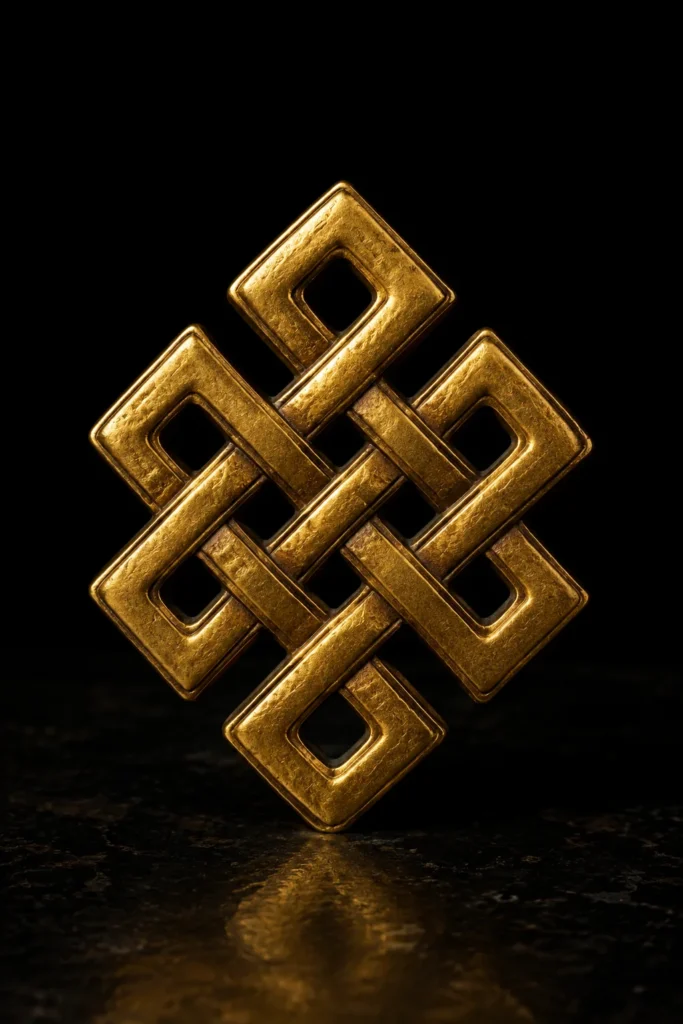
Endless knot: protective symbol, museum-style illustration

Classification

The endless knot is a sign from Buddhism. It shows a regular, self-interlacing weave of lines drawn at right angles. The pattern is fully closed. It has neither a recognizable beginning nor a recognizable end.

The endless knot belongs to a fixed group of signs, the eight auspicious symbols. This group is widespread in Buddhism and is of great significance especially in Tibetan Buddhism. The endless knot is one of the best-known signs in this series.

Unlike a frightening protective image, the endless knot is an auspicious and blessing sign. It does not ward off through terror but stands for something positive, namely for meanings connected with the Buddhist teaching and with good fortune.

In religious studies, the endless knot is a good example of a sign that gives a teaching a form. The closed, endless line is not merely a beautiful pattern. It vividly depicts central ideas of the Buddhist teaching. Form and meaning are closely bound together here.

The endless knot carries its own names in the source languages, in Sanskrit and in Tibetan. It belongs to a fixed stock of transmitted pictorial signs whose form and meaning were carefully passed on. This embedding in a binding pictorial canon distinguishes it from arbitrary ornamentation.

The Eight Auspicious Symbols

To understand the endless knot correctly, one must know the group to which it belongs. The eight auspicious symbols are a fixed compilation of signs that appear together in Buddhism. They are depicted on textiles, in temple furnishings, and in art.

Besides the endless knot, this group includes, among others, the wheel of the teaching, the lotus blossom, the parasol, the victory banner, the two golden fish, the white conch shell, and the treasure vase. Each of these signs carries its own meaning.

The eight symbols are frequently depicted together, for they complement one another. Together they stand for an abundance of good qualities and for the blessing connected with the Buddhist teaching. They are among the most widespread pictorial motifs of the Buddhist world.

The endless knot has its fixed place within this group. It is not an isolated sign but part of an ordered whole. This embedding is important, for it shows that the endless knot stands within a rich religious context and is not merely a decorative pattern.

The eight auspicious symbols are used especially on festive occasions. People give them as gifts, depict them, and thereby wish good things. They are also intended for honored guests. Within this group, the endless knot is the sign that contributes the meaning of the unbroken connection.

Form: The Knot Without Beginning and End

The form of the endless knot is strict and regular. It consists of a line drawn at right angles that crosses itself several times. At each crossing the line alternately runs over and under, so that an even weave arises.

The decisive feature is its closedness. The line returns fully to itself. There are no loose ends, no beginning, and no conclusion. The knot is a figure resting within itself, fully closed.

This closedness is the reason for the name. The knot is called endless because its line has no end. Anyone who follows the line with the eye always returns to the starting point without ever meeting a boundary. This property carries the entire meaning of the sign.

The regular, clear form has made the endless knot easy to recognize. It can be well woven, embroidered, painted, and engraved. This clarity of design has contributed to the endless knot becoming one of the most widespread Buddhist signs.

The endless knot can be drawn in a single, continuous stroke. Anyone who follows the course of the line always returns to the starting point. The very act of drawing the knot can thus become a calm, focusing exercise that makes the idea of inexhaustibility tangible.

Meaning: The Interconnectedness of All Things

The most important meaning of the endless knot concerns the interconnectedness of all things. In the Buddhist teaching, the idea is central that nothing exists on its own and independently. Everything that is hangs together with everything else and is connected through causes and conditions.

The endless knot vividly depicts this idea. Its line interlaces with itself into a single, inseparable weave. No part can be detached from the whole. Just as the line is connected, reality too is connected according to the Buddhist teaching.

This interconnectedness also encompasses the course of existence. The endless knot can be related to the cycle of becoming and passing away, in which beings are bound without a recognizable beginning. The endless line thus becomes an image for this cycle.

At the same time, the endlessness points to something unbounded. The knot can denote the immeasurable wisdom and the boundless compassion of the Buddha. The line without end then stands for a virtue that knows no measure and no limit. The endless knot thereby carries several interrelated meanings.

The teaching of mutual conditioning belongs to the core of Buddhism. It states that every thing arises from causes and conditions and that nothing comes into being on its own. The endless knot gives this teaching a form, for none of its loops exists without the others.

Wisdom and Compassion

A particular interpretation of the endless knot concerns the interplay of wisdom and compassion. In Buddhism, these two are regarded as the supporting pillars of the path. Wisdom means the correct insight into reality; compassion means the loving care for all beings.

According to the Buddhist teaching, these two must not be separated from each other. Wisdom without compassion would remain cold; compassion without wisdom would remain blind. Only in their interplay do they lead to the goal. Both belong inseparably together.

The endless knot depicts precisely this interplay. Its interlaced line shows how two movements interpenetrate and can no longer be separated. Just as the line connects with itself, wisdom and compassion connect into an inseparable whole.

In this interpretation the endless knot becomes a didactic image. It is not only a sign of good fortune but gives a core idea of the Buddhist teaching a form. Anyone who contemplates the knot sees an image of the unity that the path of the Buddha strives for.

In Buddhism, wisdom and compassion are compared to the two wings of a bird. Only with both wings can the bird take flight. The endless knot, whose line connects inseparably with itself, is a vivid image for this necessary interplay.

The Endless Knot in Tibetan Buddhism

The endless knot plays a particularly large role in Tibetan Buddhism. There it belongs to the fixed stock of the religious imagery. It appears in the temples, on the painted scroll images, and in the furnishings of the monasteries.

In the Tibetan region the endless knot is also widespread in everyday life. It adorns textiles, furniture, and objects of daily use. It is frequently placed as an auspicious sign on gifts and offerings in order to wish the recipient well.

This broad use shows that the endless knot is not confined to learned doctrine. It is a sign that connects the religious meaning with daily life. Anyone who encounters it is reminded of the teaching and at the same time given a good wish.

The endless knot thereby belongs to the visible surface of Tibetan Buddhism. Together with the other auspicious symbols, it shapes the image of this religion. It is one of the signs by which Tibetan Buddhism can be recognized at first glance.

In the Tibetan region the endless knot also appears on the white ceremonial scarves presented at encounters and on the gifts that people give one another. The sign thus accompanies many moments of social life and connects the religious meaning with everyday life.

The Working Principle of the Endless Line

The endless knot can also be considered in the larger context of protective and good-fortune signs. It follows the working principle of the endless line, which appears in many cultures. This principle rests on the idea that an unbroken, closed line possesses a special power.

A line without beginning and end offers no point at which one could set in or intrude. In many traditions, such closed lines were therefore attributed a protecting and ordering effect. They counted as secure boundaries and as images of completeness.

The endless knot shares this principle with the Celtic triquetra, with the pentagram, and with the endless knot patterns of further cultures. They all rest on the closed line that runs back into itself. On this point, traditions far removed from one another touch.

The endless knot, however, sets its own emphasis. With it, the foreground is not warding off but the positive meaning of interconnectedness and of unboundedness. The endless line here does not become a repelling boundary but the image of a good, comprehensive connection.

The closed line is also suited as an object of contemplation. Anyone who follows it with the eye experiences directly that it has no end. This experience of unboundedness is not merely an idea but can be traced on the sign itself. Therein lies a power of its own that the knot possesses.

Related Knot Signs

The endless knot belongs to a worldwide family of knot signs. A great many cultures know interlaced, braided patterns to which they attribute a special meaning. Knotting, braiding, and interlacing are basic human activities that easily become emblems.

In the Celtic-influenced world, the endless knot patterns of insular art are well known. In the Nordic world, interlaced band patterns and signs such as the valknut are encountered. In Islamic art, geometric endless patterns play a large role. The endless knot of Buddhism takes its place within this broad tradition.

For all the similarity of the forms, caution is advisable. Similar patterns do not mean the same thing everywhere. Each culture has given its knot signs its own meanings. A hasty equation would miss the particular character of each.

The comparison nevertheless remains instructive. It shows that the idea of the endless line was appealing across cultures. The endless knot of Buddhism is the Buddhist answer to a form that many cultures have filled with meaning in their own ways.

For all the similarity of the forms, caution is advisable. An interlaced pattern does not mean the same thing in every culture. The endless knot of Buddhism has its own particular meaning. A hasty equation with the knot signs of other cultures would miss this particular character.

Reception Today

The endless knot is today well known far beyond the Buddhist sphere. As a piece of jewelry, as a motif on textiles, and in design, it is widely spread. Its clear, closed form makes it very appealing in terms of design.

In its spread through jewelry and decoration, the meaning often shifts. The endless knot is then generally understood as a sign for good fortune, for long duration, or for an unbroken connection. This interpretation is compatible with the original one but simplifies it.

In contexts such as the teaching on the arrangement of living space, the endless knot has likewise found a place. There it is used as an auspicious sign. Here too the old basic meaning of the unbroken connection lives on, though in simplified form.

Within Buddhism itself, by contrast, the endless knot remains a full religious sign. There it is one of the eight auspicious symbols and an image for the interconnectedness of all things and for the boundless wisdom of the teaching. A complete account names both levels, the deep religious meaning and the widespread modern use.

In the teaching on the arrangement of living space, the endless knot is known as an auspicious sign and is used there as the so-called mystic knot. This use is simplified, yet it stands close to the same basic idea, namely the unbroken, lasting connection.

Literature (Selection)

  • Robert Beer: The Handbook of Tibetan Buddhist Symbols (2003)
  • Robert Beer: The Encyclopedia of Tibetan Symbols and Motifs (1999)
  • Detlef Ingo Lauf: Symbole. Verschiedenheit und Einheit in östlicher und westlicher Kultur (1976)
  • Loden Sherap Dagyab: Buddhist Symbols in Tibetan Culture (1995)
  • Hans Wolfgang Schumann: Buddhistische Bilderwelt (1986)

Related key terms: endless knot Ashtamangala auspicious symbols Buddhism interconnectedness wisdom compassion Tibetan.

iWell Guard and Protective Traditions

iWell Guard stands in the cultural-historical line of wearable protective objects, to which the endless knot also belongs. A modern companion for people who live with protective symbols: made in Germany, 41 layers of genuine gold, platinum, and silver, with a 30-day right of return.

Personal experiences may vary. Not a medical device. No healing promise.