Phaya Naga, the naga king between temple roof and river
By Ralf Ittermann · last reviewed on
Phaya Naga is a god of Thai tradition.
The serpent king of the Mekong and guardian of the naga fireballs. The account situates him between temple roof and river as a guardian figure of the Mekong.
The Phaya Naga is the serpent king of the Mekong, a multi-headed water serpent worshipped as lord of the river in Thailand and Laos. Overlaid with Buddhist meaning, he is regarded as a protector, linked to the naga king Mucalinda, who shielded the Buddha from a storm.
Type: multi-headed water serpent
Origin: ancient Indian naga mythology
Texts: Pali Canon, Jataka
Period: classical to present
Appearance: partly with a human upper body
Region of origin and sources
Period of the Texts
Ancient Indian naga mythology, integrated into Buddhism; still alive today in Thailand and Laos.
Area of Diffusion
The Mekong region around Nong Khai Province and the Laotian bank.
Sources
Buddhist tradition, folk tradition and modern media presence.
Name and variants
Sanskrit/Thai: naga means serpent, phaya means king: Phaya Naga thus means serpent king.
Appearance and behaviour
Appearance
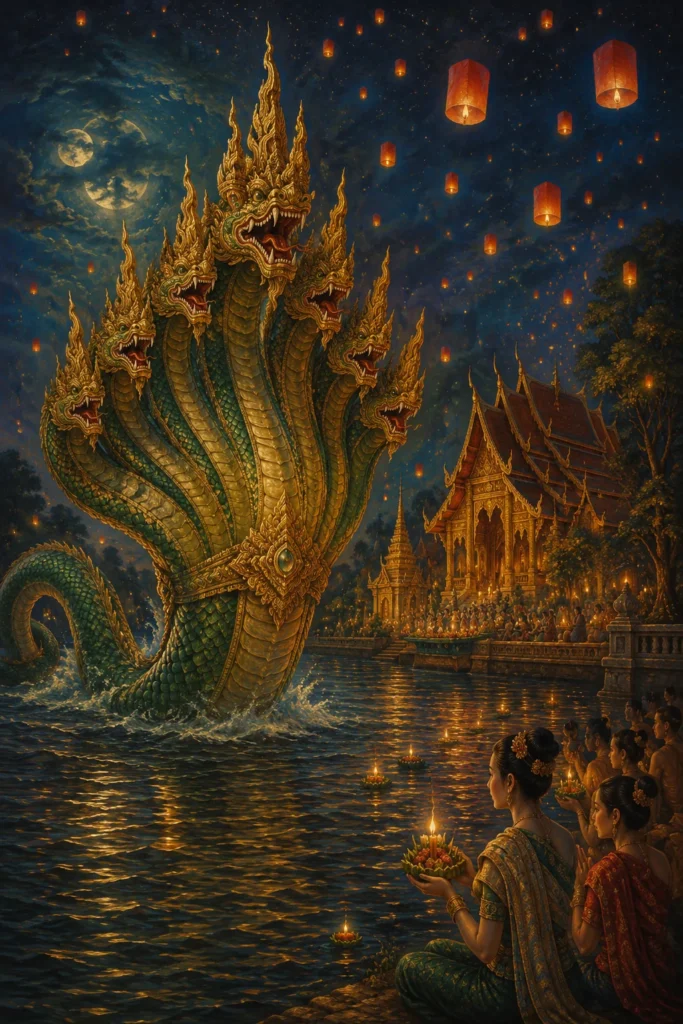
Multi-headed water serpent, partly with a human upper body, depicted as a temple figure on roof eaves.
Effect
Rules over the waters of the Mekong, brings rain; if angered, danger or flooding may threaten, but not abduction of people.
Profile: Phaya Naga
The key aspects of the serpent king at a glance.
Buddhist-inflected naga cult of Thailand and Laos.
The faithful of the Mekong bank region around Nong Khai.
Multi-headed water serpent, at temples partly with a human upper body.
Protection and rain; the annual naga fireballs as a visible sign.
Respect rather than warding off; honoured at the festival marking the end of Buddhist Lent.
The Philippine Naga (Bicol); to be distinguished from the Dragon King and from Lạc Long Quân.
From the naga king Mucalinda to lord of the river
Via Buddhism the naga concept entered the Pali Canon, including the Jataka. Mucalinda sheltered the Buddha from a storm with his cobra hood. The naga fireballs rise at the end of Buddhist Lent, popularly interpreted as tribute, scientifically explained as spontaneous ignition of marsh gas.
Tourism, temples and festival on the Mekong
The Naga Fireball Festival in Nong Khai is a major tourism factor. From a religious-studies perspective, the Phaya Naga combines serpent cult and water cult within the Theravada framework.
Honour rather than warding off on the riverbank
Respect rather than warding off: naga images protect the temple, and the naga is honoured at the festival marking the end of Buddhist Lent. An amulet is considered a protective sign, incense burning serves as an act of honour, and bells mark the sacred area.
Naga and dragon compared
Like the Philippine Naga (Bicol), the Phaya Naga belongs to the Indian naga family; unlike Lạc Long Quân, he remains firmly Buddhist and is not tied to the dragon archetype.
Frequently asked questions about the Phaya Naga
Are the naga fireballs real?
Yes, they have been observed; their cause is disputed.
Is the Phaya Naga evil?
No, he protects; danger only threatens in the case of disrespect.
Further links
Internal links:
Literature (selection)
Further standard works in the bibliography.
Those searching for Naga Mekong will find the Phaya Naga, lord of the river; the annual naga fireballs are his visible sign on the bank at Nong Khai.