iWell Guard

Nang Kwak, the beckoning mistress of the shop counter

Nang Kwak is a popular goddess of Thai tradition.

The Beckoning One, who draws customers, money and fortune into the shop.

GoddessThailand

Table of Contents

Nang Kwak, the fortune-bringer of Thailand
Nang Kwak

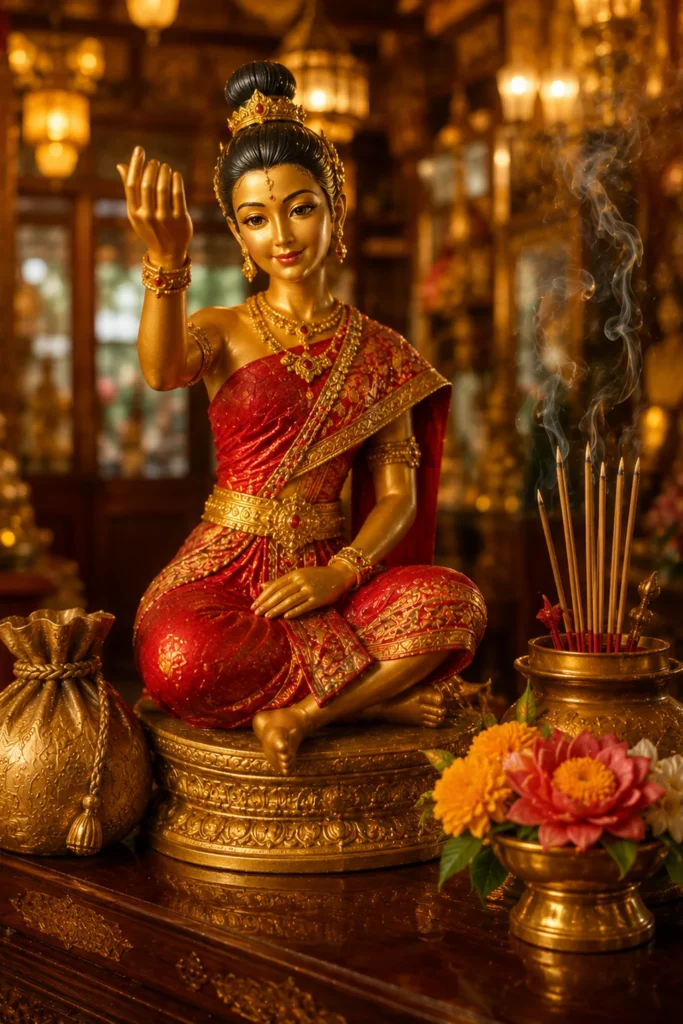
Nang Kwak is the beckoning bringer of fortune of Thai commerce: a seated woman in red dress whose raised hand beckons in customers, money and luck. She stands on shop counters, as a picture and as an amulet.

Her cult belongs to Thai Theravada folk Buddhism with animist and Brahmanical roots. Figurative depictions are roughly assigned to the Ayutthaya period, while her cultic prominence dates more to the early Bangkok period in the 19th century.

At a glance: Nang Kwak

Type: Bringer of fortune for commerce, popular goddess of prosperity
Origin: Thai folk Buddhism with animist and Brahmanical roots
Texts: McDaniel, Anuman Rajadhon, research on amulet culture
Period: Ayutthaya period to the present, cultic prominence from the Bangkok period
Appearance: seated woman in red dress with a beckoning hand

Historical Classification

Period of the Texts

Precise dating is uncertain: figurative depictions are roughly assigned to the Ayutthaya period, while cultic prominence dates more to the early Bangkok period in the 19th century.

Area of Diffusion

Thailand: Nang Kwak stands on shop counters, at market stalls and in households throughout the country.

Sources

Moderate source material: the studies by Justin Thomas McDaniel and Phya Anuman Rajadhon, along with research on Thai amulet and magic culture.

Name and variants

Thai: The name combines nang, lady or mistress, with kwak, to beckon; with the honorific prefix mae, mother, this forms Mae Nang Kwak, the lady who beckons.

Description

Appearance

Nang Kwak is a seated woman in traditional, usually red Thai dress; her right arm is raised, and her hand beckons in the Thai manner, palm facing downward. She often holds a money bag in her other hand, or one stands beside her.

Effect

Nang Kwak draws customers, money and good fortune into shops, market stalls and households. She is a pure prosperity and trade charm, not a canonical deity with a theological domain.

Profile: Nang Kwak

The key aspects of the fortune-bringer at a glance.

Cultural Context

A folk figure of good fortune in Thai Theravada folk Buddhism, a syncretism of animism, Brahmanism and Theravada.

Responsible for

Shops, market stalls and households: Nang Kwak attracts customers, money and good fortune, and is therefore preferably placed at the point of sale.

Depiction

A seated woman in red dress, her right arm raised, palm beckoning downward; often holding a money bag or with one beside her.

Function

A pure prosperity and trade charm: she brings turnover and good fortune, without the theological domain of a canonical deity.

Cult

Placed at points of sale and in homes; offerings include flowers, incense and sweets, along with consecrated statuettes and talismans.

Comparables

The Japanese beckoning cat Maneki-neko as a functional parallel without any documented connection; within Thailand, the spirit house San Phra Phum.

From Mae Nang Kwak to the merchant's daughter Supawadee

The name combines nang, lady or mistress, with kwak, to beckon, and with the honorific prefix mae, mother, forms Mae Nang Kwak, the lady who beckons. She belongs to Thai Theravada folk Buddhism, with animistic and Brahmanic roots. Precise dating is uncertain; figurative depictions are roughly attributed to the Ayutthaya period, while cultic prominence is more likely tied to the early Bangkok period in the 19th century.

Buddhist hagiography later gave the figure a life story: it turns Nang Kwak into the merchant’s daughter Nang Supawadee, who is blessed by an arahant. In this way, the folk figure of good fortune became a figure embedded within Buddhism.

Omnipresence on the shop counter

Nang Kwak remains omnipresent on Thai shop counters to this day, as an amulet and in popular culture, and is also a popular motif in tourism and souvenirs.

From a religious studies perspective, Nang Kwak is a folk figure of good fortune, later given a Buddhist hagiography, not a canonical goddess. Three clarifications: she is a syncretism of animism, Brahmanism and Theravada. The connection to Maneki-neko is only a functional parallel, not a relationship. And an Indian Lakshmi derivation is a later overlay.

Offerings, amulets and consecrated statuettes

Nang Kwak is placed at points of sale and in homes; offerings include flowers, incense and sweets. She is closely woven into Thai amulet and magic culture, with consecrated statuettes and talismans made by monks and ritual specialists. Whoever places the figure on a shop counter does not thereby bring protection against misfortune into the house, but rather an attractor of customers and good fortune.

Beckoning fortune-bringers in comparison

Nang Kwak is often compared to the Japanese beckoning cat Maneki-neko, with which she shares the beckoning gesture; however, there is no documented historical connection, it is a functional parallel. Within Thailand, she stands alongside the spirits of the spirit house San Phra Phum; related figures of the domestic prosperity cult include the Vietnamese earth god Ong Dia and the kitchen god Zao Jun.

Frequently asked questions about Nang Kwak

What is Nang Kwak?

The beckoning fortune-bringer of Thai commerce, who attracts customers and money. She stands on shop counters, as an image and as an amulet.

Is she related to the Japanese beckoning cat?

No, that is only a functional parallel, not a documented historical connection. The only thing they share is the beckoning gesture.

Is Nang Kwak a canonical goddess?

No, she is a folk figure of good fortune who was only later embedded within Buddhism, for instance in the hagiography of the merchant’s daughter Nang Supawadee.

Further links

Recommended internal links:

Literature (selection)

A selection of key sources and studies:
  • McDaniel, Justin Thomas: The Lovelorn Ghost and the Magical Monk. New York 2011.
  • Anuman Rajadhon, Phya: Essays on Thai Folklore. Bangkok 1968.
  • Pattana Kitiarsa: Mediums, Monks, and Amulets. Chiang Mai 2012.

Further standard works in the bibliography.

As Thailand’s goddess of fortune in commerce, Nang Kwak is the beckoning woman of shop counters: not a canonical deity, but one of the most present figures of everyday life in Thailand.

Classification & Protection

ILEVEL
The Protection Compass assigns this being to influence level I, Minor influence.

Against its influence, cross-cultural tradition names these protective means:

Compare in the Protection Compass →

Recommended protective means

iWell Guard

The simplest protective means in this collection: 41 layers of fine gold 999, platinum, silver and silicon, manufactured in Ruhla, Thuringia. It requires no activation, is bound to no person, and is effective within a radius of around 50 meters, even without being worn.

All protective means at a glance →