iWell Guard

San Phra Phum, the house of the lord of the land

San Phra Phum is the spirit house of a deity of the Thai tradition.

The spirit house that appeases the disturbed earth spirit.

GodThailand

Table of Contents

San Phra Phum, Thailand's spirit house
San Phra Phum

San Phra Phum is the Thai spirit house and the guardian spirit of the property. Because a building disturbs the resident earth spirit, it is offered a raised dwelling of its own, together with offerings, so that it protects the human house rather than punishing it.

The figure responsible for residential houses is called Phra Phum Chai Mongkhon. The cult is a syncretism of pre-Buddhist animism and Brahmanic-Hindu elements; belief in land-bound deities is documented at least as far back as the Ayutthaya period.

At a glance: San Phra Phum

Type: Spirit house and guardian spirit of the property
Origin: Thai folk religion, roots predating the Ayutthaya period
Texts: Anuman Rajadhon, McDaniel, Sparkes
Period: at least since the Ayutthaya period to the present
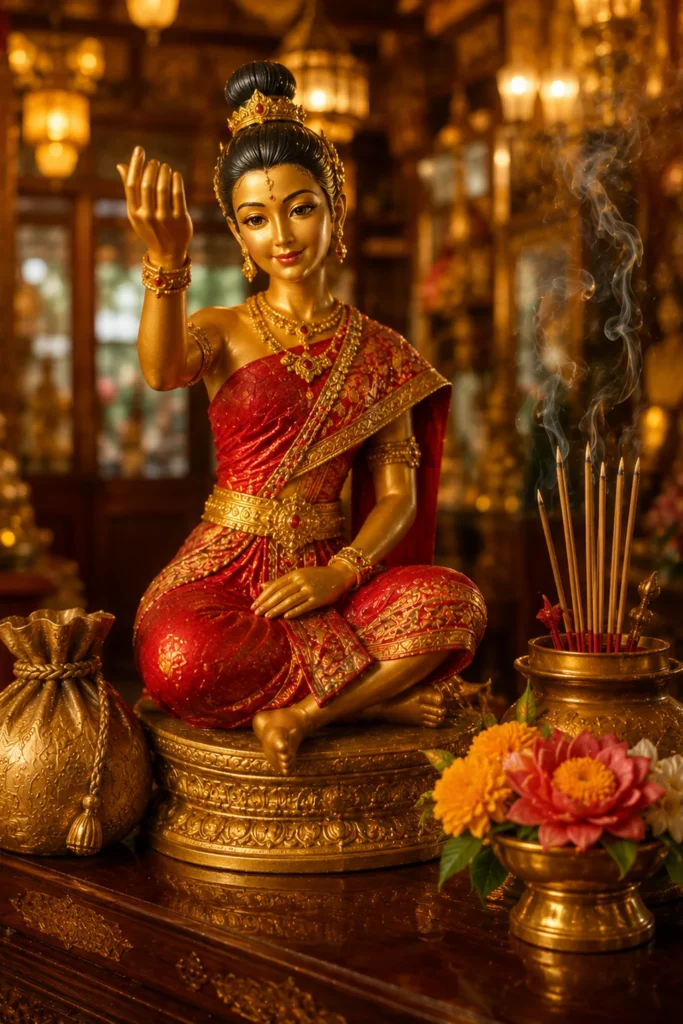
Appearance: an ornate house on a pillar, a figure with sword and money pouch

Source context

Period of the Texts

The animistic root is ancient; belief in land-bound deities is documented at least as far back as the Ayutthaya period and remains alive today.

Area of Diffusion

Thailand and its neighbouring countries: spirit houses stand in front of homes, shops, hotels and office towers.

Sources

Well documented: the folklore studies of Phya Anuman Rajadhon, the works of Justin Thomas McDaniel, and ethnographic studies such as those by Stephen Sparkes.

Name and variants

Thai: The name combines san, shrine or dwelling of the spirit, with phra, venerable, and phum, ground or place, from the Sanskrit bhumi: Phra Phum is the venerable lord of the ground. The figure responsible for dwelling houses is called Phra Phum Chai Mongkhon.

Form and effect

Appearance

The spirit house is a small, richly decorated, temple-like house on a single pillar, often with a Khmer-style tower symbolising the world mountain Meru. Inside stands an angelic, usually gilded figure of Chai Mongkhon, holding a sword in one hand and a money bag in the other.

Effect

San Phra Phum is the protective spirit of the plot of land. The relationship is reciprocal: the disturbed earth spirit is offered a raised dwelling with daily offerings so that it stays appeased and protects the human house instead of punishing it.

Profile: San Phra Phum

The key aspects of the spirit house at a glance.

Tradition

A textbook example of Southeast Asian syncretism: pre-Buddhist animism overlaid with Brahmanic-Hindu elements.

Relates To

Plot of land and residents: every construction disturbs the resident earth spirit, who is offered a raised dwelling of its own as compensation.

Depiction

A richly decorated, temple-like house on a pillar, often with a Khmer-style tower as the world mountain Meru; inside, the gilded figure with sword and money bag.

Function

Protection of the plot in an exchange relationship: dwelling and daily offerings for the goodwill of the lord of the ground.

Cult

Daily offerings ranging from flower garlands to drinks; location and timing are traditionally determined by a Brahmin priest with astrological calculation.

Distinctions

The four-pillared San Chao Thi of ancestors and former inhabitants; related are Burmese Nat shrines and the Philippine Anito.

A replacement house for the disturbed earth spirit

The cult of San Phra Phum is a syncretism of pre-Buddhist animism and Brahmanic-Hindu elements. The animistic root is old; belief in ground-bound deities is attested at the latest for the Ayutthaya period. The basic idea is an exchange: whoever builds disturbs the resident earth spirit, and whoever offers it its own raised dwelling with offerings gains it as protector of the plot.

The figure responsible for dwelling houses is called Phra Phum Chai Mongkhon: the venerable lord of the ground, depicted as an angelic figure with sword and money bag inside the house.

From the home garden to the office tower

Spirit houses are nearly omnipresent in Thailand, in front of houses, shops, hotels and office towers; decommissioned shrines end up in spirit house cemeteries. Thailand is also an unusually large market for Fanta, which is linked to the popular drink offering.

From a religious studies perspective, San Phra Phum is a textbook example of Southeast Asian syncretism with an animistic core and Brahmanic overlay. Three clarifications: it is not a Buddhist rite, consecration is performed by Brahmins, not monks. The interpretation of red Fanta as a blood substitute is the most popular but unproven, since red as a lucky colour and a preference for sweets are equally plausible. And the figure holds a sword and a money bag, not a book.

Offerings, location and Brahmanic consecration

Daily offerings include flower garlands, incense sticks, candles, rice, food, sweets and drinks, most famously red Fanta. The shrine stands at an auspicious spot, often in a corner of the plot, and must not stand in the shadow of the house. Location and timing are traditionally determined by a Brahmin priest, not a Buddhist monk, with astrological calculation and the invocation of the spirit into the figure.

Earth spirits and house shrines compared

Related are the Roman genius loci and the Lares with their household shrine, the Burmese Nat shrines and the Cambodian and Laotian house spirit shrines; also comparable are the Philippine Anito. In Vietnam, the counterpart to the lord of the ground is the earth god Ong Dia. Distinct from San Phra Phum is the four-pillared San Chao Thi of ancestors and former inhabitants.

Frequently asked questions about San Phra Phum

What is San Phra Phum?

The Thai spirit house and the protective spirit of the plot of land. The earth spirit disturbed by construction is offered its own raised dwelling with offerings.

Is this a Buddhist rite?

No, consecration is performed by Brahmins, not monks; Buddhist prayers at the shrine are lived syncretism.

Why is red Fanta often placed there?

The interpretation as a blood substitute is popular but uncertain; what matters is red and sweet, not the brand. Red as a lucky colour and a preference for sweets are equally plausible.

Further links

Recommended internal links:

Literature (selection)

A selection of key sources and studies:
  • Anuman Rajadhon, Phya: Essays on Thai Folklore. Bangkok 1968.
  • McDaniel, Justin Thomas: The Lovelorn Ghost and the Magical Monk. New York 2011.
  • Sparkes, Stephen: Spirits and Souls. Gender and Cosmology in an Isan Village. Bangkok 2005.

Further standard works in the bibliography.

As the Thai spirit house, San Phra Phum is the most visible form of dealing with a spirit of the land: whoever builds disturbs the lord of the ground, and whoever offers it its own house with daily offerings gains it as protector.

Classification & Protection

IILEVEL
The Protection Compass assigns this being to influence level II, Noticeable influence.

Against its influence, cross-cultural tradition names these protective means:

Compare in the Protection Compass →

Recommended protective means

iWell Guard

The simplest protective means in this collection: 41 layers of fine gold 999, platinum, silver and silicon, manufactured in Ruhla, Thuringia. It requires no activation, is bound to no person, and is effective within a radius of around 50 meters, even without being worn.

All protective means at a glance →