Apu Coropuna, destination of the souls of the dead
By Ralf Ittermann · last reviewed on
Apu Coropuna is a mountain god of the Quechua tradition.
The highest volcano in Peru and land of the dead in Andean tradition.
At about 6377 metres, Apu Coropuna is the highest volcano in Peru and was regarded as the most important Apu of the Kontisuyu, the southwestern part of the Inca Empire. At the same time, he is a land-of-the-dead and afterlife mountain: the destination to which the souls of the deceased travel.
Chroniclers of the 16th and 17th centuries named him a high-ranking oracle and sanctuary; at the southwestern foot lies the significant Inca site of Maucallacta, with an oracle and residence.
Type: most important Apu of the Kontisuyu, land-of-the-dead and afterlife mountain
Origin: Arequipa region, Kontisuyu, southern Peru
Texts: colonial chronicles, modern archaeology
Period: Inca era to present
Appearance: extensive, multi-peaked ice massif, about 6377 metres
Source context
Period of the Texts
Rooted in Inca times, described by chroniclers of the 16th and 17th centuries, and archaeologically studied since 1996.
Area of Diffusion
The Arequipa region and the Kontisuyu, the southwest of the Inca Empire, whose mountain world Coropuna towers over.
Sources
Good: Pedro Cieza de León and other chroniclers, an image by Guaman Poma from around 1615, and the excavations by the University of Warsaw and the Universidad Católica Santa María.
Name and variants
Quechua: The origin of the name is disputed. Widespread but uncertain interpretations link quri, gold, with puna, highland: the golden puna.
Form and effect
Appearance
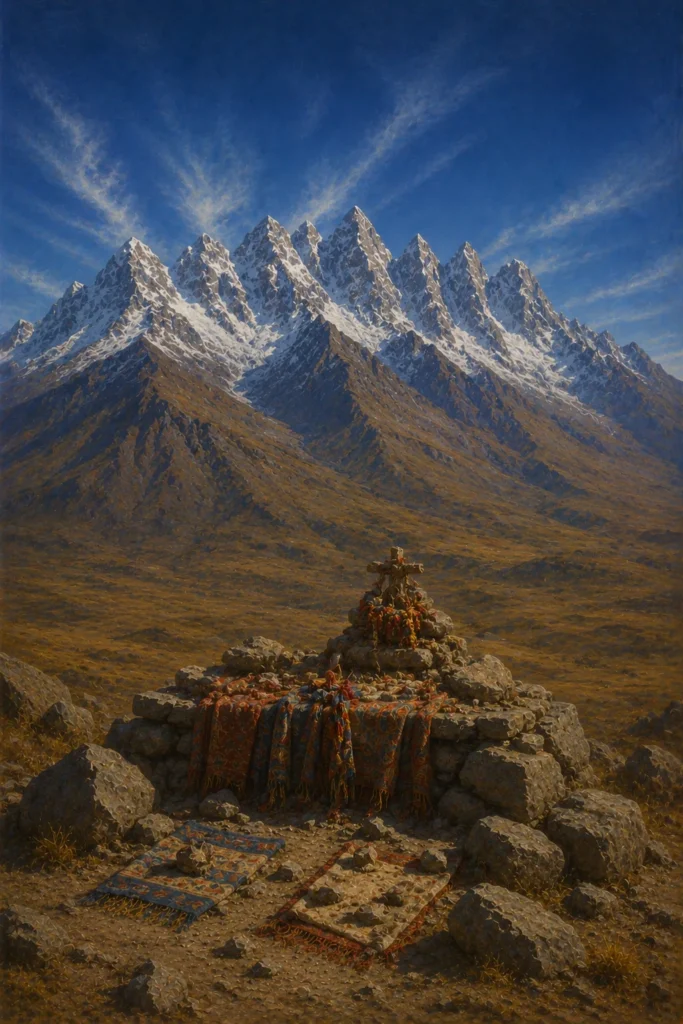
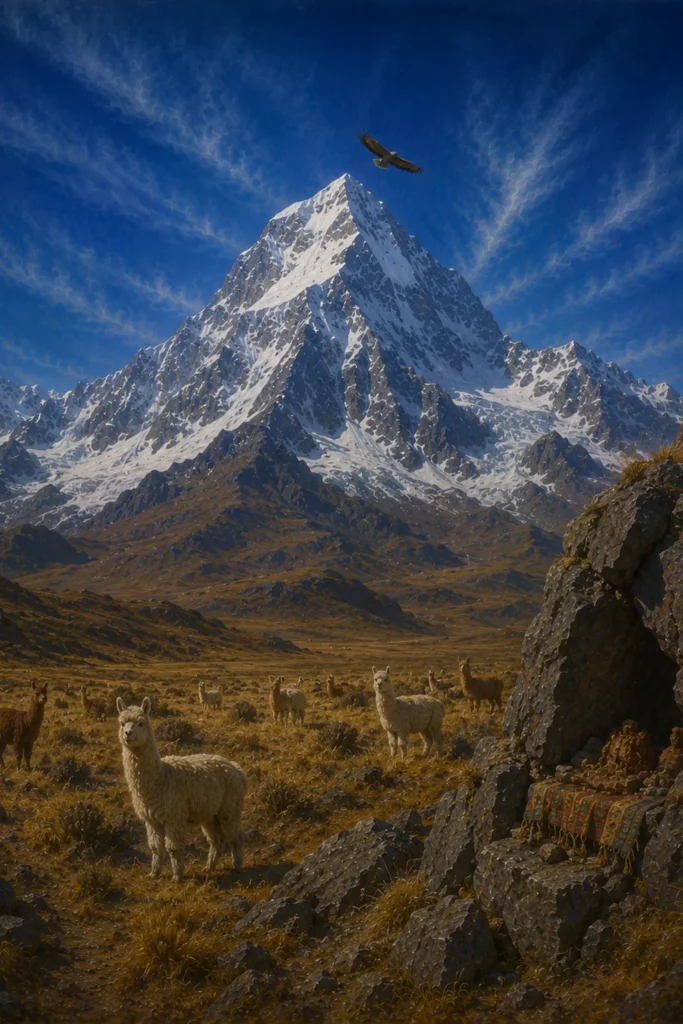
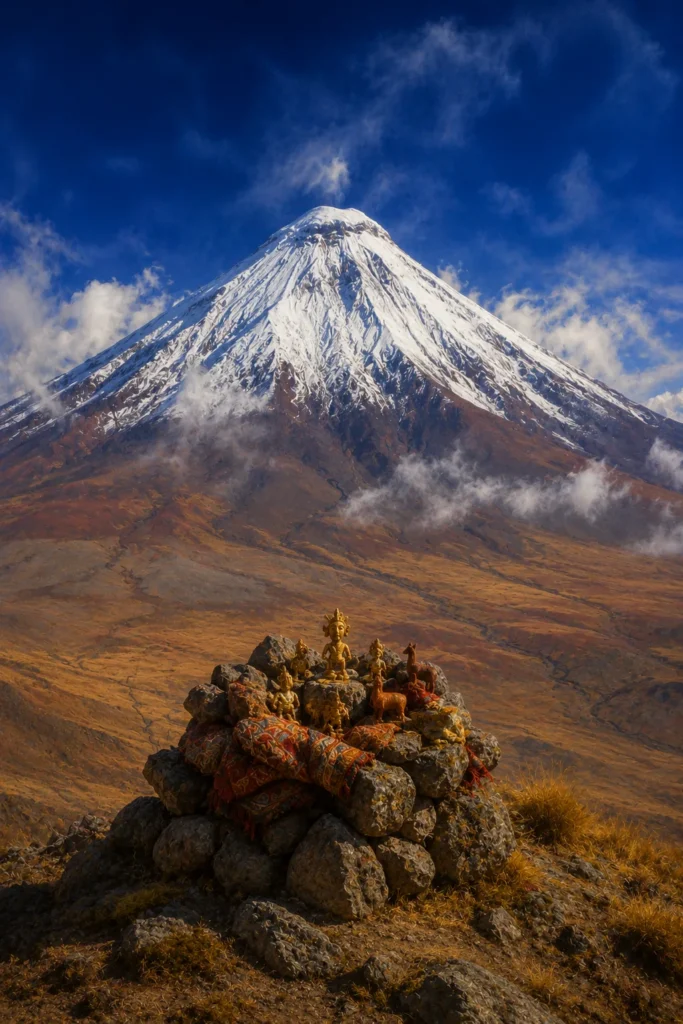
Coropuna is not a single cone but an extensive, multi-peaked ice massif, regarded as the most important Apu of the Kontisuyu.
Effect
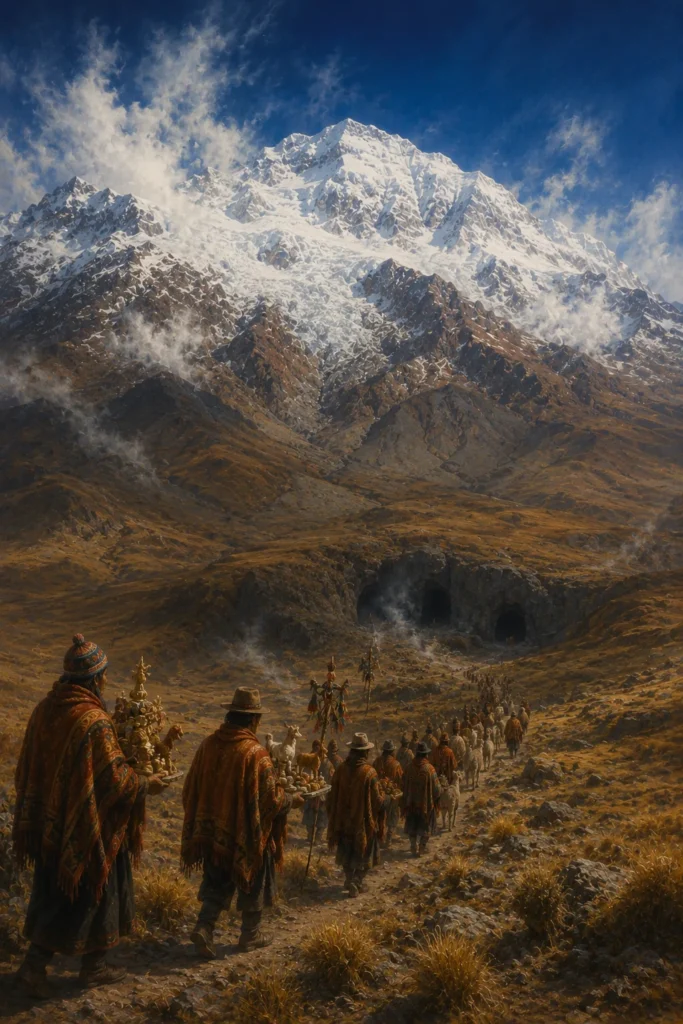
According to Andean tradition, Coropuna is the destination of the souls of the dead, a great village of the deceased, partly accessible through caves; on the way, souls would be judged for their treatment of livestock and tools. This role is documented ethnohistorically and in folklore, not as an archaeological finding.
Profile: Apu Coropuna
The mountain of the dead and oracle of the Kontisuyu, in brief.
The most important Apu of the Kontisuyu; Cieza de León counted him among the most significant sanctuaries of the Inca Empire.
The Kontisuyu and the souls of the dead: according to Andean tradition, the deceased travel to Coropuna.
An extensive, multi-peaked ice massif; an image by Guaman Poma from around 1615 shows offerings to Coropuna, a child and guinea pigs.
Oracle, sanctuary and afterlife mountain: the great village of the deceased, where the souls arrive.
An oracle cult at Maucallacta, pilgrimages and recorded capacocha offerings; pago rituals still take place today.
The silent land of the dead, Upamarca, and the Island of the Sun in Lake Titicaca as a pilgrimage huaca; as an Apu, comparable to the Achachila of the Aymara.
The oracle of Maucallacta and the village of the dead
Pedro Cieza de León counted Coropuna among the most significant sanctuaries of the Inca Empire. At the southwestern foot lies Maucallacta, an important Inca site with an oracle and residence; an image by Guaman Poma from around 1615 shows offerings to the mountain, a child and guinea pigs. The name itself is disputed, and the widespread interpretation golden puna remains uncertain.
Alongside this stands the mountain’s second, darker role: according to Andean tradition, the souls of the deceased travel to Coropuna, into a great village of the dead, said to be partly accessible through caves; on the way, they would be judged by how they treated livestock and tools. This idea is attested ethnohistorically and in folklore, not confirmed by excavations.
Research and interpretation
In Andean studies, Coropuna is prominent as a mountain of the dead and afterlife mountain of the southwest; archaeological research has been ongoing since 1996, conducted by the University of Warsaw and the Universidad Católica Santa María. For mountaineers, it is simply the highest volcano in Peru.
From a religious-studies perspective, Apu Coropuna is a classic example of the mountain as an afterlife and land-of-the-dead realm. Three clarifications: the etymology golden puna is not confirmed. The rank as the most important huaca varies depending on the chronicler. And the land-of-the-dead role is transmitted ethnohistorically, not proven through graves.
Forms of cult at Coropuna
Documented are the oracle cult at Maucallacta, pilgrimages to the mountain, and recorded capacocha offerings. The cult is thus not a purely reconstructed picture: the chroniclers describe it, and excavations since 1996 supplement the findings. Nor has it died out; pago rituals are still held at Coropuna today, with coca leaves as an offering to the Apu.
Mountains of the dead and pilgrimage huacas
Coropuna’s role as a land of the dead is comparable to the silent land of the dead, Upamarca, and its significance as a pilgrimage destination to the Island of the Sun in Lake Titicaca as a pilgrimage huaca. In the same region stand the capacocha mountains Apu Ampato and Apu Misti. His counterpart among the Aymara is the Achachila; with the earth mother Pachamama, he shares responsibility for land and life.
Frequently asked questions about Apu Coropuna
Why is Coropuna a mountain of the dead?
According to Andean tradition, he is the destination of the souls of the dead, a great village of the deceased, partly accessible through caves.
How high is Coropuna?
About 6377 metres; this makes him the highest volcano in Peru.
Is the land-of-the-dead role archaeologically confirmed?
No. It is transmitted ethnohistorically, not proven through graves.
Further links
Further reading:
- Apu Ampato and Apu Misti – capacocha mountains of the same region
- Achachila – the ancestral mountain of the Aymara
- Pachamama – the earth mother of the Andes
- Smudging, Amulet – traditional protective means
- Protection Compass – overview of protective means
Literature (selection)
Further standard works in the bibliography.
As the highest volcano in Peru, Apu Coropuna carries a double dignity: above, the ice that draws mountaineers; below, the afterlife mountain of souls, to which the deceased of the Andes are, according to ancient tradition, journeying.