iWell Guard

Apu Misti, protection and threat over Arequipa

Apu Misti is a mountain god of the Quechua tradition.

The active volcano above Arequipa with capacocha offerings in the crater.

GodQuechua

Table of Contents

Apu Misti, the mountain god above Arequipa
Apu Misti

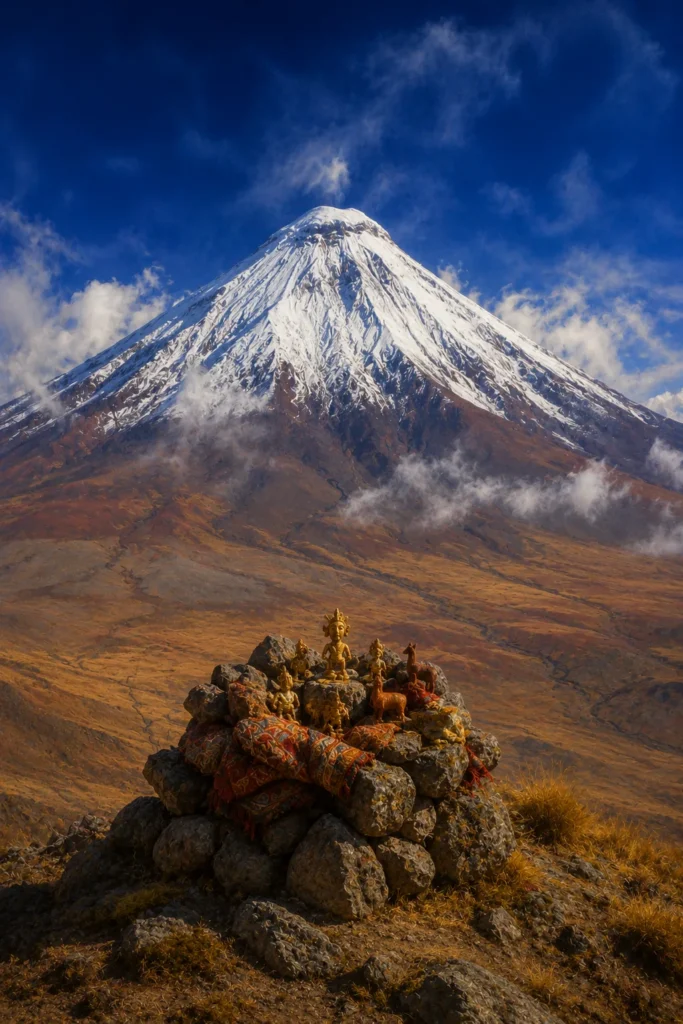
Apu Misti is an active volcano about 5822 metres high, directly above the city of Arequipa and its landmark. As an Apu, he is ambivalent: both a giver of fertility and a potential destroyer, which explains the propitiatory offerings made to him.

In 1998, Johan Reinhard, José Antonio Chávez and Constanza Ceruti excavated a capacocha sanctuary in the crater area, with several offerings and around forty to forty-seven figurines. The crater finds are considered one of the most significant capacocha assemblages.

At a glance: Apu Misti

Type: Apu, mountain of protection and threat, giver of fertility
Origin: Arequipa region, southern Peru
Texts: Inca-era capacocha, modern archaeology, crater finds from 1998
Period: Inca era to present
Appearance: near-perfect volcanic cone, about 5822 metres

Historical Classification

Period of the Texts

Used as a capacocha sanctuary in Inca times; modern knowledge is based chiefly on the crater finds of 1998.

Area of Diffusion

The city of Arequipa and its surroundings in southern Peru; the cone of Misti dominates the city’s skyline.

Sources

Very good: the crater finds of 1998, along with studies by Socha and Ceruti; however, preservation of the finds is poor due to sulphur and heat.

Name and variants

Quechua and local language: Misti means lord or mestizo in local usage; the older Quechua name Putina means the one that boils or seethes. The exact derivation remains partly uncertain.

Beings and effect

Appearance

Misti is an almost perfect volcanic cone and the landmark of Arequipa, at once a protective mountain and a threat because of the danger of eruption.

Effect

As an active volcano, the Apu has two faces: he bestows fertility and can also destroy. This dual nature explains the appeasement offerings that the Inca laid down in his crater.

Profile: Apu Misti

The volcano-Apu of Arequipa in its key features.

Cultural Context

Apu and landmark of Arequipa; in the Inca state religion the site of the Capacocha, the highest form of offering.

Object of Influence

The city of Arequipa and its surroundings, to which the mountain grants fertility while at the same time threatening eruption.

Depiction

Almost perfect volcanic cone above Arequipa; conceived of as an Apu personified, not worshipped as an image.

Function

A protective mountain and a threat: the offerings in the crater were meant to appease the giver, who can also be a destroyer.

Practices

In Inca times, human and figurine offerings in the crater; today the usual Despacho and Pago offerings of the Andes, from coca leaves to llama fat and chicha.

Comparables

Ampato and Coropuna in the same region, as well as the Argentine Llullaillaco; as an Apu, he corresponds to the Aymara Achachila.

The sanctuary in the crater: the 1998 excavation

In local usage, the name Misti means lord or mestizo; older is the Quechua name Putina, the one that boils or seethes, a name that precisely captures the mountain’s nature. As an active volcano, Misti was for the Inca both a giver of fertility and a potential danger, and it was to this that the state’s highest offering responded.

In 1998, Johan Reinhard, José Antonio Chávez and Constanza Ceruti uncovered a Capacocha sanctuary in the crater area: several human sacrifices and around forty to forty-seven small figures made of precious metal and Spondylus. Sulphur and heat from the active crater have badly damaged the finds, which is why their preservation is poor and their recovery was difficult.

Symbol of identity and classification

Misti is a central symbol of identity for Arequipa, and the 1998 crater finds are considered one of the most significant Capacocha ensembles known.

From the perspective of religious studies, Apu Misti illustrates the appeasement of an active volcano through the highest form of state offering. Two clarifications: the exact number of victims varies in the literature between six and eight or nine, as the crater conditions made recovery difficult. And Misti lies above Arequipa, not near Cusco; the opposite attribution is a popular misconception.

Appeasement of an active volcano

Well documented by sources is the Capacocha with human and figurine offerings in the crater, directly attested by the 1998 excavation; due to sulphur and heat, preservation of the finds is poor. Present-day veneration does not involve offering journeys into the crater: it follows the general Despacho and Pago forms, in which coca leaves, llama fat and chicha are presented to the Apu.

Volcano gods of the Arequipa region

Apu Misti stands alongside Apu Ampato and Apu Coropuna in the mountain world around Arequipa, as well as the Argentine Llullaillaco, which shows the same pattern of summit offerings. The counterpart to the Apu in Aymara tradition is the Achachila; the connection to the earth mother Pachamama lies at the core of Andean mountain veneration.

Frequently asked questions about Apu Misti

Where is Apu Misti located?

Directly above the city of Arequipa in southern Peru, not near Cusco; the Cusco attribution is a widespread misconception.

What was found in the crater?

A Capacocha sanctuary with several human sacrifices and around forty to forty-seven small figures of precious metal and Spondylus.

Is Misti dangerous?

Not mythologically; in reality it is an active volcano with a risk of eruption.

Further links

Recommended internal links:

Literature (selection)

A selection of key sources and studies:
  • Socha, Dagmar M. et al.: Inca Human Sacrifices on Misti Volcano (Peru). In: Latin American Antiquity 32. 2021.
  • Ceruti, María Constanza: Frozen Mummies from Andean Mountaintop Shrines. In: BioMed Research International. 2015.
  • Reinhard, Johan: The Ice Maiden. Washington 2005.

Further standard works in the bibliography.

As Arequipa’s volcano, Misti still shapes the image of its city today; as a mountain god who received offerings on its summit, it shows how seriously the Inca took his dual nature of blessing and threat.

Classification & Protection

IILEVEL
The Protection Compass assigns this being to influence level II, Noticeable influence.

Against its influence, cross-cultural tradition names these protective means:

Compare in the Protection Compass →

Recommended protective means

iWell Guard

The simplest protective means in this collection: 41 layers of fine gold 999, platinum, silver and silicon, manufactured in Ruhla, Thuringia. It requires no activation, is bound to no person, and is effective within a radius of around 50 meters, even without being worn.

All protective means at a glance →